



 Chat with AI
Exam 1: Environmental Problems, Their Causes, and Sustainability

Exam 1: Environmental Problems, Their Causes, and Sustainability101 Questions
Exam 2: Science, Matter, Energy, and Systems162 Questions
Exam 3: Biodiversity and Evolution104 Questions
Exam 4: Community Ecology, Population Ecology, and the Human Population117 Questions
Exam 5: Sustaining Biodiversity: The Species Approach114 Questions
Exam 6: Sustaining Biodiversity: The Ecosystem Approach142 Questions
Exam 7: Food,Soil,and Pest Management151 Questions
Exam 8: Water Resources and Water Pollution147 Questions
Exam 9: Nonrenewable Energy Resources100 Questions
Exam 10: Energy Efficiency and Renewable Energy114 Questions
Exam 11: Environmental Hazards and Human Health116 Questions
Exam 12: Air Pollution, Climate Change, and Ozone Depletion148 Questions
Exam 13: Urbanization and Solid and Hazardous Waste189 Questions
Exam 14: Economics, Politics, Worldviews, and Sustainability141 Questions
Select questions type


The "tragedy of the commons" refers to lack of agricultural sustenance available for the common (poor)people in a country.
(True/False)
4.8/5  (92)
(92) Which of the following major cultural changes to Homo sapiens has not intensified environmental degradation?
(Multiple Choice)
4.9/5 (81)
(81) Which of the following is not a result of being an affluent country?
(Multiple Choice)
4.9/5 (60)
(60) Which of the following statements about developing countries is true?
(Multiple Choice)
4.8/5 (90)
(90) The world's more developed countries contain relatively small populations,use large proportions of resources and produce the largest proportions of waste.
(True/False)
4.9/5 (85)
(85) Of the following behaviors,the one that runs counter to the three principles of sustainability is
(Multiple Choice)
4.9/5 (81)
(81) Life on earth has sustained itself over billions of years even during long periods of cooling and warming of the earth's surface.
(True/False)
4.8/5 (72)
(72) Which of the following is not associated with the pollution cleanup approach?
(Multiple Choice)
4.9/5 (84)
(84) Decreasing population growth in developed countries will decrease resource consumption.
(True/False)
4.8/5 (83)
(83) Developed countries have a significant negative effect on the environment because of the consumption per person and technological impact per unit of consumption.
(True/False)
4.8/5 (85)
(85) Is China's total ecological footprint greater than that of India's?
(Short Answer)
4.8/5 (80)
(80) Make an argument supporting the statement that individuals matter in making the shift toward environmental sustainability?
(Essay)
4.8/5 (84)
(84) List the three scientific principles of sustainability and give an example of each.
(Essay)
4.9/5 (73)
(73) All of the following are potentially renewable resources except
(Multiple Choice)
4.7/5 (82)
(82) 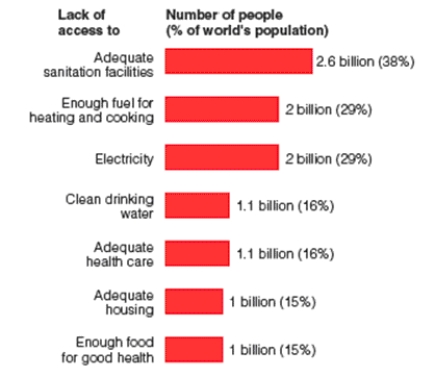 -Do you think that the numbers overlap in the graph of the percentage of the world's population who lack access to basic amenities? Why?
 (Essay)
4.8/5 (82)
(82) Which of the following characterizes sustainability revolutions?
(Multiple Choice)
4.9/5 (96)
(96) Although the poor have limited access to resources,they still have an overall high environmental impact. Explain why this statement is true.
(Essay)
4.8/5 (88)
(88) 
Filters
- Essay(0)
- Multiple Choice(0)
- Short Answer(0)
- True False(0)
- Matching(0)