



 Chat with AI
Exam 4: Energy and Life

Exam 1: An Introduction to the Science of Life51 Questions
Exam 2: The Chemistry of Life56 Questions
Exam 3: The Cell: The Fundamental Unit of Life56 Questions
Exam 4: Energy and Life64 Questions
Exam 5: Chromosomes and Inheritance66 Questions
Exam 6: Dna: the Molecule of Life64 Questions
Exam 7: Darwinian Evolution56 Questions
Exam 8: Biodiversity 1: Microscopic Organisms58 Questions
Exam 9: Biodiversity 2: Fungi and Plants58 Questions
Exam 10: Biodiversity 3: Animals56 Questions
Exam 11: Human Body Systems67 Questions
Exam 12: Ecology66 Questions
Select questions type


Which arrow would be most closely related to kinetic energy? 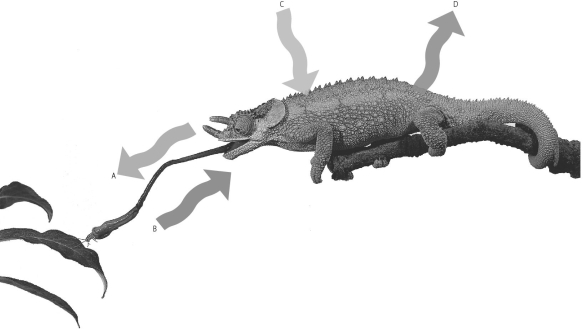
(Multiple Choice)
4.8/5  (80)
(80) For what purpose does a plant use the sugars produced during photosynthesis?
(Multiple Choice)
4.8/5 (71)
(71) During which stage of cellular respiration is the majority of the ATP produced?
(Multiple Choice)
4.8/5 (88)
(88) What happens to the ATP molecule after it has been used to do work?
(Multiple Choice)
4.7/5 (79)
(79) Which of the following is a waste product of photosynthesis?
(Multiple Choice)
4.8/5 (82)
(82) Predict what would happen as the entropy of a system approaches 100%.
(Multiple Choice)
4.9/5 (92)
(92) Which of the following best describes the chemical equation for photosynthesis?
(Multiple Choice)
4.9/5 (91)
(91) The following question(s) relate to the data table below, showing typical fluctuating pH and dissolved oxygen levels in a fish pond with a heavy concentration of algae over a 24-hour period.
 -Upon closer examination,the fish appeared to have died from a lack of oxygen.What time of day did the fish most likely die?
 (Multiple Choice)
4.9/5 (95)
(95) Which of the following is a common energy currency in living cells that powers most living organisms?
(Multiple Choice)
4.7/5 (74)
(74) What does it mean to "fix" carbon,and during which stage of photosynthesis is carbon fixed?
(Essay)
4.9/5 (82)
(82) We use energy in many ways.What is one thing we cannot do to energy?
(Multiple Choice)
4.9/5 (66)
(66) Yeast is used to produce beer and wine but can also make bread rise.All of these processes involve the production of alcohol.Explain why you can eat bread and not get drunk.
(Multiple Choice)
4.9/5 (86)
(86) 
Filters
- Essay(0)
- Multiple Choice(0)
- Short Answer(0)
- True False(0)
- Matching(0)