



 Chat with AI
Exam 20: Monetary Policy

Exam 1: Introducing the Economic Way of Thinking177 Questions
Exam 1: A: Appendix: Applying Graphs to Economics69 Questions
Exam 2: Production Possibilities,Opportunity Cost,and Economic Growth200 Questions
Exam 3: Part 1: Market Demand and Supply250 Questions
Exam 3: Part 2: Market Demand and Supply106 Questions
Exam 4: Markets in Action250 Questions
Exam 5: Price Elasticity of Demand177 Questions
Exam 6: Production Costs249 Questions
Exam 7: Perfect Competition222 Questions
Exam 8: Monopoly170 Questions
Exam 9: Monopolistic Competition and Oligopoly161 Questions
Exam 10: Labor Markets and Income Distribution180 Questions
Exam 11: Gross Domestic Product202 Questions
Exam 12: Business Cycles and Unemployment194 Questions
Exam 13: Inflation127 Questions
Exam 14: Aggregate Demand and Supply188 Questions
Exam 14: A: Appendix: The Self-Correcting Aggregate Demand and Supply Model83 Questions
Exam 15: Fiscal Policy201 Questions
Exam 16: The Public Sector127 Questions
Exam 17: Federal Deficits,Surpluses,and the National Debt97 Questions
Exam 18: Money and the Federal Reserve System154 Questions
Exam 19: Money Creation246 Questions
Exam 20: Monetary Policy214 Questions
Exam 20: A: Appendix: Policy Disputes Using the Self-Correcting Aggregate Demand and Supply Model31 Questions
Exam 21: International Trade and Finance246 Questions
Exam 22: Economies in Transition104 Questions
Exam 23: Growth and the Less-Developed Countries116 Questions
Select questions type


Given the strict quantity theory of money,if the quantity of money were decreased by 50 percent,prices would:
(Multiple Choice)
4.7/5  (67)
(67) The monetarists totally reject the importance of changes in the money stock as determinants of changes in real GDP,the price level,and employment.
(True/False)
4.9/5 (73)
(73) Exhibit 20-2 Money market demand and supply curves
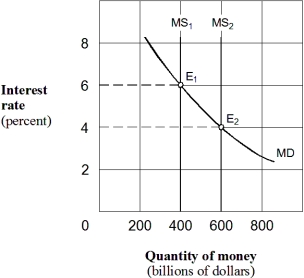 -Starting from an equilibrium at E₁ in Exhibit 20-2,a rightward shift of the money supply curve from MS₁ to MS₂ would cause an excess:
 (Multiple Choice)
4.7/5 (81)
(81) According to the quantity theory of money,a 10 percent increase in the money supply leads to a 10 percent increase in:
(Multiple Choice)
4.9/5 (71)
(71) If the money supply increases this will cause the interest rate to rise,investment to fall and GDP to fall.
(True/False)
4.9/5 (80)
(80) If the Fed reduces the discount rate,which of the following are most likely to result?
(Multiple Choice)
5.0/5 (80)
(80) If the Federal Reserve increases the money supply,ceteris paribus,the:
(Multiple Choice)
4.7/5 (92)
(92) Other things being equal,an increase in the rate of interest causes a(n):
(Multiple Choice)
4.9/5 (88)
(88) According to Keynesians,for monetary policy to have a stimulative effect on GDP,a(n):
(Multiple Choice)
4.8/5 (70)
(70) The speculative demand for money is the stock of money that people hold to:
(Multiple Choice)
4.7/5 (90)
(90) If the nominal GDP is $500 billion and the money supply is $100 billion,the velocity of money is:
(Multiple Choice)
4.7/5 (75)
(75) The quantity of money held in response to interest rates is the:
(Multiple Choice)
4.7/5 (82)
(82) When there is an excess demand for money,individuals and businesses will attempt to purchase bonds.
(True/False)
4.9/5 (79)
(79) Contrast the Keynesian and Monetarist views on the effectiveness of fiscal policy?
(Essay)
4.9/5 (81)
(81) 
Filters
- Essay(0)
- Multiple Choice(0)
- Short Answer(0)
- True False(0)
- Matching(0)