



 Chat with AI
Exam 16: The Public Sector

Exam 1: Introducing the Economic Way of Thinking177 Questions
Exam 1: A: Appendix: Applying Graphs to Economics69 Questions
Exam 2: Production Possibilities,Opportunity Cost,and Economic Growth200 Questions
Exam 3: Part 1: Market Demand and Supply250 Questions
Exam 3: Part 2: Market Demand and Supply106 Questions
Exam 4: Markets in Action250 Questions
Exam 5: Price Elasticity of Demand177 Questions
Exam 6: Production Costs249 Questions
Exam 7: Perfect Competition222 Questions
Exam 8: Monopoly170 Questions
Exam 9: Monopolistic Competition and Oligopoly161 Questions
Exam 10: Labor Markets and Income Distribution180 Questions
Exam 11: Gross Domestic Product202 Questions
Exam 12: Business Cycles and Unemployment194 Questions
Exam 13: Inflation127 Questions
Exam 14: Aggregate Demand and Supply188 Questions
Exam 14: A: Appendix: The Self-Correcting Aggregate Demand and Supply Model83 Questions
Exam 15: Fiscal Policy201 Questions
Exam 16: The Public Sector127 Questions
Exam 17: Federal Deficits,Surpluses,and the National Debt97 Questions
Exam 18: Money and the Federal Reserve System154 Questions
Exam 19: Money Creation246 Questions
Exam 20: Monetary Policy214 Questions
Exam 20: A: Appendix: Policy Disputes Using the Self-Correcting Aggregate Demand and Supply Model31 Questions
Exam 21: International Trade and Finance246 Questions
Exam 22: Economies in Transition104 Questions
Exam 23: Growth and the Less-Developed Countries116 Questions
Select questions type


How does total taxes as a percentage of GDP in the United States compare to those of Western European countries,such as the United Kingdom,Germany,and Sweden?
(Multiple Choice)
4.8/5  (86)
(86) Sharon pays a tax of $4,000 on her income of $40,000,while Brad pays a tax of $1,000 on his income of $20,000.This tax is:
(Multiple Choice)
4.9/5 (76)
(76) Rational voter ignorance occurs because the marginal cost of obtaining information is higher than the marginal benefit from obtaining the information.
(True/False)
4.8/5 (70)
(70) Which of the following answers best reflects the ability-to-pay philosophy of taxation?
(Multiple Choice)
4.7/5 (94)
(94) The term "public sector" refers only to federal government purchases of goods and services.
(True/False)
4.9/5 (93)
(93) Many public choice economists believe that elected political officials would make better choices if they had to vote for higher taxes in order to adopt new spending programs.
(True/False)
4.8/5 (92)
(92) Suppose fairness is defined as those with the highest incomes can afford to pay a greater proportion of their income in taxes.Then which of the following taxation systems would be consistent with this notion of fairness?
(Multiple Choice)
4.9/5 (73)
(73) Since World War II,most of the growth in U.S.government outlays is attributable to rapidly growing federal government transfer programs.
(True/False)
4.8/5 (85)
(85) The federal income tax is progressive because the tax rates increase at higher income levels.
(True/False)
5.0/5 (79)
(79) Which of the following countries devote the smallest percentage of its GDP to taxes?
(Multiple Choice)
4.8/5 (80)
(80) Exhibit 16-4 Marginal tax rate lines
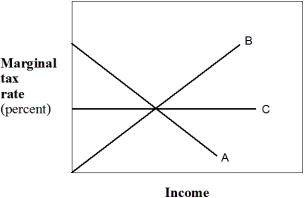 -In Exhibit 16-4,line A represents a(n):
 (Multiple Choice)
4.9/5 (84)
(84) According to the shortsightedness effect,politicians tend to favor projects with:
(Multiple Choice)
4.8/5 (75)
(75) When a tax is regressive,as a person's income rises,the tax rate:
(Multiple Choice)
4.7/5 (79)
(79) The amount of government expenditures on a project or program should continue to increase for as long as the marginal benefits exceed the marginal costs.
(True/False)
4.7/5 (89)
(89) Which of the following U.S.taxes is the most consistent with the ability-to-pay principle?
(Multiple Choice)
4.9/5 (79)
(79) The three major revenue sources for the federal government in order of decreasing percentages are individual income taxes,corporate taxes,and social security insurance.
(True/False)
4.8/5 (79)
(79) When the tax rate is constant when a person's income rises,the tax is a:
(Multiple Choice)
4.9/5 (70)
(70) When the government levies a tax where everyone is taxed the same fixed percentage of their incomes,this tax is known as a(n):
(Multiple Choice)
4.9/5 (82)
(82) 
Filters
- Essay(0)
- Multiple Choice(0)
- Short Answer(0)
- True False(0)
- Matching(0)