



 Chat with AI
Exam 15: Fiscal Policy

Exam 1: Introducing the Economic Way of Thinking177 Questions
Exam 1: A: Appendix: Applying Graphs to Economics69 Questions
Exam 2: Production Possibilities,Opportunity Cost,and Economic Growth200 Questions
Exam 3: Part 1: Market Demand and Supply250 Questions
Exam 3: Part 2: Market Demand and Supply106 Questions
Exam 4: Markets in Action250 Questions
Exam 5: Price Elasticity of Demand177 Questions
Exam 6: Production Costs249 Questions
Exam 7: Perfect Competition222 Questions
Exam 8: Monopoly170 Questions
Exam 9: Monopolistic Competition and Oligopoly161 Questions
Exam 10: Labor Markets and Income Distribution180 Questions
Exam 11: Gross Domestic Product202 Questions
Exam 12: Business Cycles and Unemployment194 Questions
Exam 13: Inflation127 Questions
Exam 14: Aggregate Demand and Supply188 Questions
Exam 14: A: Appendix: The Self-Correcting Aggregate Demand and Supply Model83 Questions
Exam 15: Fiscal Policy201 Questions
Exam 16: The Public Sector127 Questions
Exam 17: Federal Deficits,Surpluses,and the National Debt97 Questions
Exam 18: Money and the Federal Reserve System154 Questions
Exam 19: Money Creation246 Questions
Exam 20: Monetary Policy214 Questions
Exam 20: A: Appendix: Policy Disputes Using the Self-Correcting Aggregate Demand and Supply Model31 Questions
Exam 21: International Trade and Finance246 Questions
Exam 22: Economies in Transition104 Questions
Exam 23: Growth and the Less-Developed Countries116 Questions
Select questions type


The government can reduce unemployment or reduce inflation by:
(Multiple Choice)
4.9/5  (64)
(64) The fraction of each added dollar of income that is used for consumption is called the:
(Multiple Choice)
5.0/5 (82)
(82) Exhibit 15-3 Aggregate demand and supply model
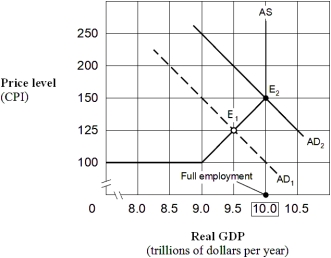 -Beginning at equilibrium E₁ in Exhibit 15-3,when the government increases spending or cuts taxes the economy will experience:
 (Multiple Choice)
4.9/5 (70)
(70) Assume the marginal propensity to consume (MPC)is 0.80 and the government cuts taxes by $100 billion.The aggregate demand curve will shift to the:
(Multiple Choice)
5.0/5 (75)
(75) When households' marginal propensity to consume (MPC)increases,the size of the spending multiplier:
(Multiple Choice)
4.9/5 (84)
(84) Following Keynesian economics,and assuming a marginal propensity to consume (MPC)of 0.75,an increase in taxes of $100 billion would be expected to shift the aggregate demand curve by $300 billion to the left.
(True/False)
4.9/5 (86)
(86) Exhibit 15-1 Disposable income and consumption data
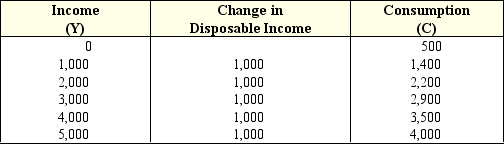 -In Exhibit 15-1,when disposable income (Y)is increased from $1,000 to $2,000,the marginal propensity to consume is:
 (Multiple Choice)
4.8/5 (80)
(80) Unemployment insurance payments act as automatic stabilizers by:
(Multiple Choice)
4.9/5 (76)
(76) Government programs that automatically shift the government budget toward a deficit during recessions and a surplus during recoveries are called:
(Multiple Choice)
4.9/5 (74)
(74) Assume that we want to drive our economy out of recession by generating a $400 billion change in real GDP.The MPC is 0.80.Which of the following policy prescriptions would generate the targeted $400 billion change in income?
(Multiple Choice)
5.0/5 (85)
(85) Because of the automatic stabilizers,a decline in the level of economic activity will cause:
(Multiple Choice)
4.9/5 (87)
(87) Suppose that the economy is operating in full-employment equilibrium along the vertical section of the aggregate supply curve.If the aggregate demand curve is reduced by $100 billion in order for the price level to decline by 5 percent,and if the marginal propensity to consume (MPC)is 0.75,then what change in taxes would generate the desired price reduction?
(Multiple Choice)
4.9/5 (81)
(81) If the marginal propensity to consume (MPC)is 0.80,the value of the spending multiplier is 2.
(True/False)
4.7/5 (75)
(75) The marginal propensity to consume (MPC)is computed as the change in:
(Multiple Choice)
4.8/5 (82)
(82) If MPC = 0.80,how much should government spending change to increase real GDP by $500?
(Multiple Choice)
4.9/5 (86)
(86) 
Filters
- Essay(0)
- Multiple Choice(0)
- Short Answer(0)
- True False(0)
- Matching(0)