



 Chat with AI
Exam 9: Monopolistic Competition and Oligopoly

Exam 1: Introducing the Economic Way of Thinking177 Questions
Exam 1: A: Appendix: Applying Graphs to Economics69 Questions
Exam 2: Production Possibilities,Opportunity Cost,and Economic Growth200 Questions
Exam 3: Part 1: Market Demand and Supply250 Questions
Exam 3: Part 2: Market Demand and Supply106 Questions
Exam 4: Markets in Action250 Questions
Exam 5: Price Elasticity of Demand177 Questions
Exam 6: Production Costs249 Questions
Exam 7: Perfect Competition222 Questions
Exam 8: Monopoly170 Questions
Exam 9: Monopolistic Competition and Oligopoly161 Questions
Exam 10: Labor Markets and Income Distribution180 Questions
Exam 11: Gross Domestic Product202 Questions
Exam 12: Business Cycles and Unemployment194 Questions
Exam 13: Inflation127 Questions
Exam 14: Aggregate Demand and Supply188 Questions
Exam 14: A: Appendix: The Self-Correcting Aggregate Demand and Supply Model83 Questions
Exam 15: Fiscal Policy201 Questions
Exam 16: The Public Sector127 Questions
Exam 17: Federal Deficits,Surpluses,and the National Debt97 Questions
Exam 18: Money and the Federal Reserve System154 Questions
Exam 19: Money Creation246 Questions
Exam 20: Monetary Policy214 Questions
Exam 20: A: Appendix: Policy Disputes Using the Self-Correcting Aggregate Demand and Supply Model31 Questions
Exam 21: International Trade and Finance246 Questions
Exam 22: Economies in Transition104 Questions
Exam 23: Growth and the Less-Developed Countries116 Questions
Select questions type


Exhibit 9-5 Two-Firm Payoff Matrix
 -Suppose costs are identical for the two firms in Exhibit 9-5.If both firms assume the other will compete and charge a lower price,equilibrium will be established by:
 (Multiple Choice)
4.8/5  (81)
(81) If a firm reacts to other firms' market decisions by anticipating how the other will then react,this is:
(Multiple Choice)
4.8/5 (73)
(73) Exhibit 9-2 A monopolistic competitive firm
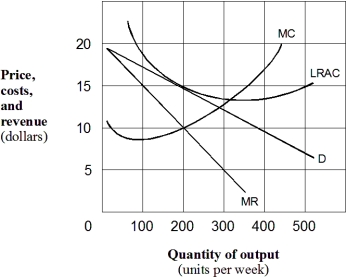 -To maximize long-run profits,the monopolistically competitive firm shown in Exhibit 9-2 will charge a price per unit of:
 (Multiple Choice)
4.9/5 (73)
(73) Which of the following is true for perfect competition,monopolistic competition,and monopoly?
(Multiple Choice)
4.7/5 (83)
(83) A cartel is a formal agreement among firms to control price and output of a product.
(True/False)
4.9/5 (76)
(76) Exhibit 9-4 Two-Firm Payoff Matrix
 -Assume costs are identical for the two firms in Exhibit 9-4.If both firms were allowed to form a cartel and agree on their prices,equilibrium would be established by:
 (Multiple Choice)
4.8/5 (77)
(77) Exhibit 9-1 A monopolistic competitive firm
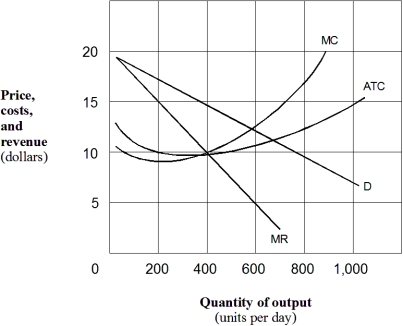 -As represented in Exhibit 9-1,the maximum long-run economic profit earned by this monopolistic competitive firm is:
 (Multiple Choice)
4.9/5 (83)
(83) Which of the following most closely approximates the conditions of a monopolistically competitive market?
(Multiple Choice)
4.9/5 (93)
(93) Which of the following is the best example of an oligopoly?
(Multiple Choice)
4.7/5 (73)
(73) Exhibit 9-2 A monopolistic competitive firm
-As presented in Exhibit 9-2,the long-run profit-maximizing output for the monopolistic competitive firm is:
-As presented in Exhibit 9-2,the long-run profit-maximizing output for the monopolistic competitive firm is: (Multiple Choice)
4.9/5 (79)
(79) The short-run equilibrium for a monopolistically competitive firm is at P = $28.47,ATC = $22.13,and MC = MR = $17.47.Which of the following is true?
(Multiple Choice)
4.8/5 (85)
(85) Which of the following is a characteristic of an oligopoly?
(Multiple Choice)
4.9/5 (72)
(72) The demand curve in monopolistic competition slopes downward because of:
(Multiple Choice)
4.8/5 (80)
(80) Which of the following is characteristic of a monopolistically competitive firm?
(Multiple Choice)
4.9/5 (72)
(72) We can represent the entry of new firms into a monopolistically competitive market by shifting the existing firms':
(Multiple Choice)
4.8/5 (80)
(80) Exhibit 9-3 A monopolistic competitive firm in the long run
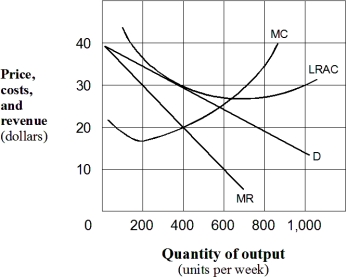 -As represented in Exhibit 9-3,the maximum long-run economic profit earned by this monopolistic competitive firm is:
 (Multiple Choice)
4.8/5 (75)
(75) Compared to the perfectly competitive outcome,monopolistically competitive markets will result in:
(Multiple Choice)
4.8/5 (76)
(76) Which of the following is a game theory strategy for oligopolists to avoid a low-price outcome?
(Multiple Choice)
4.8/5 (93)
(93) The marginal revenue curve of a monopolistically competitive firm will always lie:
(Multiple Choice)
4.7/5 (69)
(69) 
Filters
- Essay(0)
- Multiple Choice(0)
- Short Answer(0)
- True False(0)
- Matching(0)