



 Chat with AI
Exam 3: Part 2: Market Demand and Supply

Exam 1: Introducing the Economic Way of Thinking177 Questions
Exam 1: A: Appendix: Applying Graphs to Economics69 Questions
Exam 2: Production Possibilities,Opportunity Cost,and Economic Growth200 Questions
Exam 3: Part 1: Market Demand and Supply250 Questions
Exam 3: Part 2: Market Demand and Supply106 Questions
Exam 4: Markets in Action250 Questions
Exam 5: Price Elasticity of Demand177 Questions
Exam 6: Production Costs249 Questions
Exam 7: Perfect Competition222 Questions
Exam 8: Monopoly170 Questions
Exam 9: Monopolistic Competition and Oligopoly161 Questions
Exam 10: Labor Markets and Income Distribution180 Questions
Exam 11: Gross Domestic Product202 Questions
Exam 12: Business Cycles and Unemployment194 Questions
Exam 13: Inflation127 Questions
Exam 14: Aggregate Demand and Supply188 Questions
Exam 14: A: Appendix: The Self-Correcting Aggregate Demand and Supply Model83 Questions
Exam 15: Fiscal Policy201 Questions
Exam 16: The Public Sector127 Questions
Exam 17: Federal Deficits,Surpluses,and the National Debt97 Questions
Exam 18: Money and the Federal Reserve System154 Questions
Exam 19: Money Creation246 Questions
Exam 20: Monetary Policy214 Questions
Exam 20: A: Appendix: Policy Disputes Using the Self-Correcting Aggregate Demand and Supply Model31 Questions
Exam 21: International Trade and Finance246 Questions
Exam 22: Economies in Transition104 Questions
Exam 23: Growth and the Less-Developed Countries116 Questions
Select questions type


If the price of good X increases and this causes an increase in the demand for good Y,then goods X and Y are substitute goods.
(True/False)
4.9/5  (79)
(79) In economics,the term "surplus" means an excess quantity supplied.
(True/False)
4.7/5 (80)
(80) Exhibit 3-8 Demand and supply data for radios
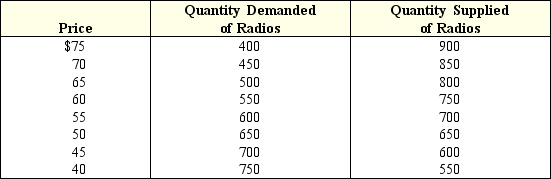 -In Exhibit 3-9,if the market price is $20,
 (Multiple Choice)
4.8/5 (84)
(84) A shortage means that the quantity demanded is greater than the quantity supplied at the prevailing price.
(True/False)
5.0/5 (90)
(90) If X and Y are substitutes,the demand curve for X will shift to the right when the price of Y decreases.
(True/False)
4.9/5 (77)
(77) The law of demand is the principle that there is an inverse between the price of a good and the quantity that buyers are willing to purchase in a defined time period,ceteris paribus.
(True/False)
4.8/5 (78)
(78) According to the law of demand,if the price of a good increases,other things being equal,the quantity demanded will decrease.
(True/False)
4.9/5 (77)
(77) Other things being equal,a fall in the price of orange juice will decrease the quantity supplied.
(True/False)
4.7/5 (79)
(79) Exhibit 3-6 Milk market
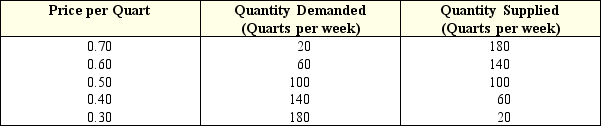 -In Exhibit 3-6,which of the following is true about the milk market?
 (Multiple Choice)
4.8/5 (81)
(81) Exhibit 3-8 Demand and supply data for radios
-In Exhibit 3-8,if the price of radios was currently $45,there would be an ____ of ____ radios in this market.
-In Exhibit 3-8,if the price of radios was currently $45,there would be an ____ of ____ radios in this market. (Multiple Choice)
5.0/5 (67)
(67) Suppose A and B are complementary goods.Other things being equal,the demand curve for A will shift to the right when the price of B goes down.
(True/False)
4.7/5 (84)
(84) Exhibit 3-11 Demand and supply curves
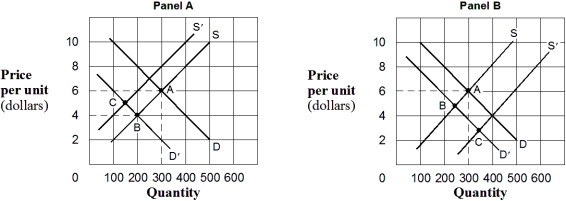 -In Exhibit 3-11,in Panel A the movement from A to B describes a(n):
 (Multiple Choice)
4.8/5 (80)
(80) In a market,competitive forces guarantee that any price other than the equilibrium price is:
(Multiple Choice)
4.7/5 (83)
(83) Exhibit 3-16 Supply and demand curves for chairs
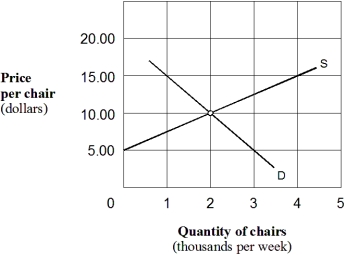 -In Exhibit 3-16,assume that the market price of chairs is $5 each.This price is:
 (Multiple Choice)
4.9/5 (68)
(68) An increase in the cost of chicken feed will reduce the supply of eggs.
(True/False)
5.0/5 (69)
(69) 
Filters
- Essay(0)
- Multiple Choice(0)
- Short Answer(0)
- True False(0)
- Matching(0)