



 Chat with AI
Exam 9: The Exchange Rate and the Balance of Payments

Exam 1: What Is Economics479 Questions
Exam 2: The Economic Problem439 Questions
Exam 3: Demand and Supply515 Questions
Exam 4: Measuring GDP and Economic Growth396 Questions
Exam 5: Monitoring Jobs and Inflation407 Questions
Exam 6: Economic Growth353 Questions
Exam 7: Finance, Saving, and Investment240 Questions
Exam 8: Money, The Price Level, and Inflation583 Questions
Exam 9: The Exchange Rate and the Balance of Payments481 Questions
Exam 10: Aggregate Supply and Aggregate Demand418 Questions
Exam 11: Expenditure Multipliers454 Questions
Exam 12: Inflation, Jobs, and the Business Cycle401 Questions
Exam 13: Fiscal Policy263 Questions
Exam 14: Monetary Policy225 Questions
Exam 15: International Trade Policy197 Questions
Exam 16: Introduction23 Questions
Exam 17: Monitoring Macroeconomic Performance11 Questions
Exam 18: Macroeconomic Trends19 Questions
Exam 19: Macroeconomic Fluctuations23 Questions
Exam 20: Macroeconomic Policy25 Questions
Select questions type


In the foreign exchange market,a decrease in the supply of dollars leads to an appreciation of the U.S.dollar.
(True/False)
5.0/5  (84)
(84) Suppose that U.S.inflation is 3 percent and Turkish inflation is 70 percent.The effect of this discrepancy on the foreign exchange market is that
(Multiple Choice)
4.9/5 (73)
(73) Component Amount (billions of dollars) Government expenditure, G 700 Net taxes, T 600 Investment, I 350 Savings, S 500
-In the table above,what is the government's sector balance?
(Multiple Choice)
4.9/5 (90)
(90) Investor Expected future value of a dollar (francs per dollar) Investor A 120 Investor B 100 Investor C 85
-Using the table above,if the current market value of the dollar is 70 francs,
(Multiple Choice)
4.8/5 (81)
(81) Which of the following countries are net lenders?
I. Japan
II. United States
(Multiple Choice)
4.8/5 (80)
(80) 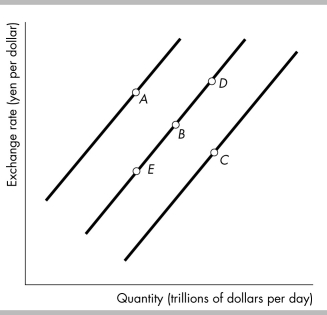 -In the figure above,suppose the economy is initially at point B.Then the interest rate in Japan rises relative to the interest rate in the United States.This change ________ the supply of dollars and the market moves to a point such as ________.
 (Multiple Choice)
4.9/5 (84)
(84) An increase in the U.S.interest rate differential increases the demand for dollars.
(True/False)
4.7/5 (81)
(81) Other things remaining the same,if the U.S.interest rate differential increases,the demand curve for U.S.dollars shifts ________ and the supply curve of U.S.dollars shifts ________.
(Multiple Choice)
4.9/5 (92)
(92) An exchange rate is the price of one country's currency in terms of another country's currency.
(True/False)
4.9/5 (95)
(95)  -The figure above shows the demand and supply of dollars in the foreign exchange market.The equilibrium in the market occurs at a price of ________ Brazilian reals per dollar and a quantity of ________ billion dollars.
 (Multiple Choice)
4.7/5 (79)
(79)  -In the figure above,the shift in the supply curve for U.S.dollars from S₀ to S₁ could occur when
 (Multiple Choice)
4.8/5 (68)
(68) When the U.S.exchange rate rises and the expected future exchange rate does not change,the expected profit from buying U.S.dollars today
(Multiple Choice)
4.9/5 (70)
(70) If net exports increases,but neither government expenditure nor net taxes change,saving must increase.
(True/False)
4.9/5 (74)
(74) Since the mid 1980s,the United States has been a net ________ and a ________ nation.
(Multiple Choice)
4.9/5 (82)
(82) If foreign investment in the United States exceeds U.S.investment abroad,there is a ________; and when U.S.investment abroad exceeds foreign investment in the United States,there is ________.
(Multiple Choice)
4.9/5 (81)
(81) In 2007,Japan reported that its overseas assets totalled more than $4.6 trillion. This implies that Japan
(Multiple Choice)
4.8/5 (83)
(83) In France,the price of a computer is 1,227.6 euros.In Japan,the price of the same computer is 137,920 yen.If a U.S.dollar can buy 1.023 euros or 119.93 yen,then purchasing power parity ________.
(Multiple Choice)
4.8/5 (75)
(75) 
Filters
- Essay(0)
- Multiple Choice(0)
- Short Answer(0)
- True False(0)
- Matching(0)