



 Chat with AI
Exam 2: The Economic Problem

Exam 1: What Is Economics479 Questions
Exam 2: The Economic Problem439 Questions
Exam 3: Demand and Supply515 Questions
Exam 4: Measuring GDP and Economic Growth396 Questions
Exam 5: Monitoring Jobs and Inflation407 Questions
Exam 6: Economic Growth353 Questions
Exam 7: Finance, Saving, and Investment240 Questions
Exam 8: Money, The Price Level, and Inflation583 Questions
Exam 9: The Exchange Rate and the Balance of Payments481 Questions
Exam 10: Aggregate Supply and Aggregate Demand418 Questions
Exam 11: Expenditure Multipliers454 Questions
Exam 12: Inflation, Jobs, and the Business Cycle401 Questions
Exam 13: Fiscal Policy263 Questions
Exam 14: Monetary Policy225 Questions
Exam 15: International Trade Policy197 Questions
Exam 16: Introduction23 Questions
Exam 17: Monitoring Macroeconomic Performance11 Questions
Exam 18: Macroeconomic Trends19 Questions
Exam 19: Macroeconomic Fluctuations23 Questions
Exam 20: Macroeconomic Policy25 Questions
Select questions type


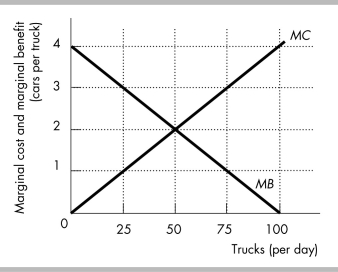 -Suppose a factory can be designed to produce either trucks or cars.The figure above shows the marginal cost and marginal benefit of producing trucks in terms of the forgone cars.
a) What is the marginal benefit of the 25th truck?
b) What is the marginal cost of the 25th truck?
c) Should the 25th truck be produced?
Why or why not.
d) What is the marginal benefit of the 75th truck?
e) What is the marginal cost of the 75th truck?
f) Should the 75th truck be produced?
Why or why not?
g) What is the allocatively efficient quantity of trucks?
-Suppose a factory can be designed to produce either trucks or cars.The figure above shows the marginal cost and marginal benefit of producing trucks in terms of the forgone cars.
a) What is the marginal benefit of the 25th truck?
b) What is the marginal cost of the 25th truck?
c) Should the 25th truck be produced?
Why or why not.
d) What is the marginal benefit of the 75th truck?
e) What is the marginal cost of the 75th truck?
f) Should the 75th truck be produced?
Why or why not?
g) What is the allocatively efficient quantity of trucks? (Essay)
4.8/5  (88)
(88) 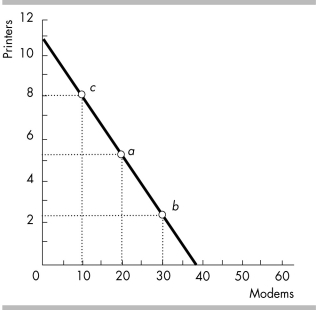 -Vicky currently produces at point a in the figure above.If Vicky moves from point a to point b to point c,her opportunity cost of a modem ________.
 (Multiple Choice)
5.0/5 (89)
(89) Why does it make sense for economies to specialize according to comparative advantage and trade?
(Essay)
4.7/5 (83)
(83) Explain how the production possibilities frontier illustrates scarcity.
(Essay)
4.9/5 (81)
(81)  -In the figure above,how can the economy represented by the production possibilities frontier move from point C to point F ?
 (Multiple Choice)
4.7/5 (72)
(72) 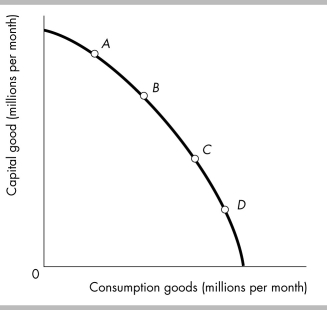 -In the figure above,an economy would grow fastest if it produces at point
 (Multiple Choice)
4.9/5 (83)
(83) Moving along a bowed-out PPF between milk and cotton,as more milk is produced the marginal cost of an additional gallon of milk
(Multiple Choice)
4.7/5 (81)
(81) Camel rides (per day) Marginal benefit (tubes of sunscreen) Marginal cost (tubes of sunscreen) 1 20 11 2 18 12 3 16 13 4 14 14 5 12 15 6 10 16
-Leisure Land produces only sun screen and camel rides.The table shows the marginal benefit and marginal cost schedules for sun screen and camel rides.The allocatively efficient number of camel rides is ________.
(Multiple Choice)
4.8/5 (79)
(79) 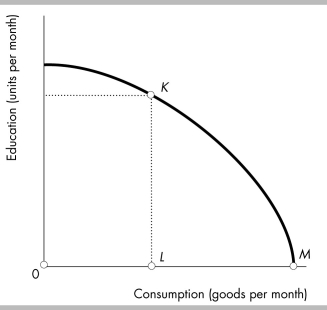 -Molly just graduated from high school.The figure shows her possibilities frontier.If Molly goes to college,she will move from point M to point K.In terms of consumption goods,Molly's opportunity cost of going to college is
 (Multiple Choice)
4.9/5 (85)
(85) Missouri can produce 10,000 tons of pecans per year or 5,000 tons of pears per year.Washington can produce 12,000 tons of pecans per year or 48,000 tons of pears per year.If these two states were to engage in trade,which of the following is true?
(Multiple Choice)
4.8/5 (72)
(72)  -Refer to the production possibilities frontier in the figure above.Which production point indicates that resources are NOT fully utilized or are misallocated?
 (Multiple Choice)
4.7/5 (81)
(81)  -Refer to the production possibilities frontier figure above.Which of the following movements requires the largest opportunity cost,in terms of good X forgone,per extra unit of good Y?
 (Multiple Choice)
4.9/5 (88)
(88) Point Production chocolate bars Production cans of cola A 0 100 B 10 90 C 20 70 D 30 40 E 40 0
-The above table shows production points on Sweet-Tooth Land's production possibilities frontier.What is the opportunity cost of one can of cola if Sweet-tooth Land moves from point C to point B?
(Multiple Choice)
4.9/5 (89)
(89)  -In the figure above,which of the following movements has the largest opportunity cost?
 (Multiple Choice)
4.8/5 (85)
(85) If a country must decrease current consumption to increase the amount of capital goods it produces today,then it must
(Multiple Choice)
4.8/5 (101)
(101) 
Filters
- Essay(0)
- Multiple Choice(0)
- Short Answer(0)
- True False(0)
- Matching(0)