



 Chat with AI
Exam 7: Dysrhythmia Interpretation and Management

Exam 1: Overview of Critical Care Nursing24 Questions
Exam 2: Patient and Family Response to the Critical Care Experience28 Questions
Exam 3: Ethical and Legal Issues in Critical Care Nursing23 Questions
Exam 4: End-Of-Life Care in the Critical Care Unit26 Questions
Exam 5: Comfort and Sedation33 Questions
Exam 6: Nutritional Support30 Questions
Exam 7: Dysrhythmia Interpretation and Management59 Questions
Exam 8: Hemodynamic Monitoring35 Questions
Exam 9: Ventilatory Assistance36 Questions
Exam 10: Rapid Response Teams and Code Management31 Questions
Exam 11: Shock, sepsis, and Multiple Organ Dysfunction Syndrome34 Questions
Exam 12: Cardiovascular Alterations37 Questions
Exam 13: Nervous System Alterations35 Questions
Exam 14: Acute Respiratory Failure36 Questions
Exam 15: Acute Kidney Injury50 Questions
Exam 16: Hematological and Immune Disorders55 Questions
Exam 17: Gastrointestinal Alterations52 Questions
Exam 18: Endocrine Alterations35 Questions
Exam 19: Trauma and Surgical Management31 Questions
Exam 20: Burns31 Questions
Exam 21: Solid Organ Transplantation35 Questions
Select questions type


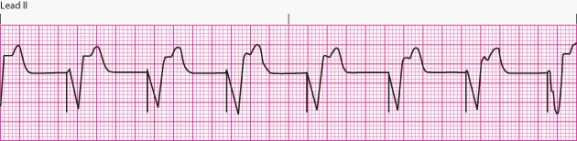

The QT interval is the total time taken for ventricular depolarization and repolarization.Prolongation of the QT interval:
(Multiple Choice)
5.0/5  (83)
(83) Which of the following are common causes of sinus tachycardia? (Select all that apply.)
(Multiple Choice)
4.8/5 (90)
(90) The nurse is examining the patient's cardiac rhythm strip in lead II and notices that all of the P waves are upright and look the same except one that has a different shape and is inverted.The nurse realizes that the P wave with the abnormal shape is probably:
(Multiple Choice)
5.0/5 (78)
(78) 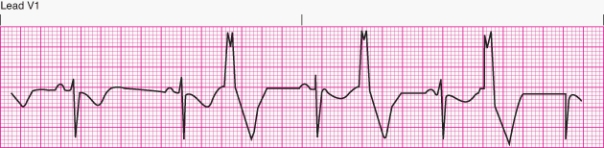
The patient is admitted with a fever and rapid heart rate.The patient's temperature is 103° F ( 39.4° C ).The nurse places the patient on a cardiac monitor and finds the patient's atrial and ventricular rates are above 105 beats per minute.P waves are clearly seen and appear normal in configuration.QRS complexes are normal in appearance and 0.08 seconds wide.The rhythm is regular,and blood pressure is normal.The nurse should focus on providing:
(Multiple Choice)
4.7/5 (89)
(89) The normal width of the QRS complex is which of the following? (Select all that apply.)
(Multiple Choice)
4.7/5 (85)
(85) The normal rate for the SA node when the patient is at rest is:
(Multiple Choice)
4.9/5 (77)
(77) The patient is scheduled to have a permanent pacemaker implanted.The patient asks the nurse,"How long will the battery in this thing last?" The nurse should answer,
(Multiple Choice)
4.7/5 (79)
(79) 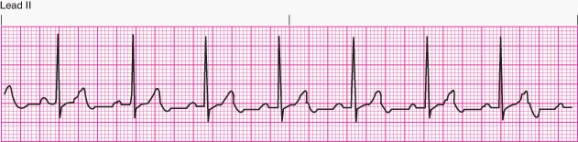
The nurse notices that the patient has a first-degree AV block.Everything else about the rhythm is normal.The nurse should:
(Multiple Choice)
4.7/5 (82)
(82) Because of the location of the AV node,the possible P waveforms that are associated with junctional rhythms include which of the following? (Select all that apply.)
(Multiple Choice)
4.8/5 (80)
(80) 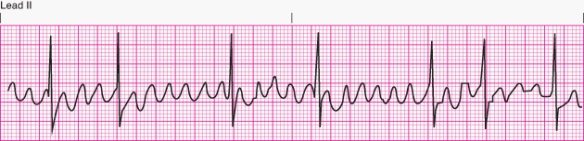
Which of the following is true about a patient diagnosed with sinus arrhythmia?
(Multiple Choice)
5.0/5 (83)
(83) The nurse is caring for a patient who has atrial fibrillation.Sequelae that place the patient at greater risk for mortality/morbidity include which of the following? (Select all that apply.)
(Multiple Choice)
4.9/5 (75)
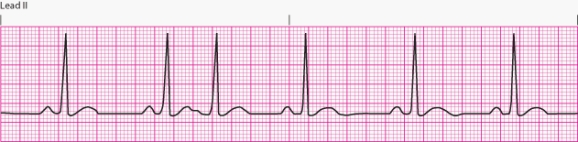
(75) 
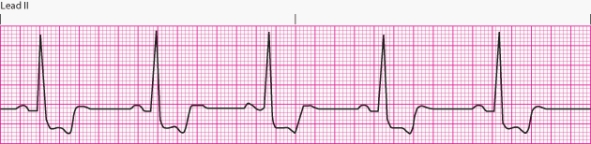
The nurse is caring for a patient who is on a cardiac monitor.The nurse realizes that the sinus node is the pacemaker of the heart because it is:
(Multiple Choice)
4.9/5 (79)
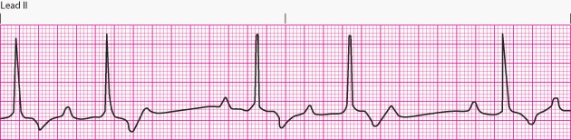
(79) 

Filters
- Essay(0)
- Multiple Choice(0)
- Short Answer(0)
- True False(0)
- Matching(0)