



 Chat with AI
Exam 2: Scarcity, trade-Offs, and Production Possibilities

Exam 1: The Role and Method of Economics288 Questions
Exam 2: Scarcity, trade-Offs, and Production Possibilities166 Questions
Exam 3: Supply and Demand122 Questions
Exam 4: Bringing Supply and Demand Together150 Questions
Exam 5: Introduction to the Macroeconomy170 Questions
Exam 6: Measuring Economic Performance126 Questions
Exam 7: Economic Growth in the Global Economy116 Questions
Exam 8: Aggregate Demand184 Questions
Exam 9: Aggregate Supply and Macroeconomic Equilibrium172 Questions
Exam 10: Fiscal Policy140 Questions
Exam 11: Money and the Banking System164 Questions
Exam 12: The Bank of Canada76 Questions
Exam 13: Monetary Policy81 Questions
Exam 14: International Trade139 Questions
Exam 15: International Finance114 Questions
Select questions type


FIGURE 2-8
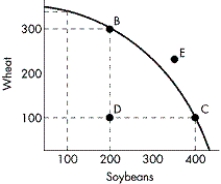 -Refer to Figure 2-8.In order to move from Point D to Point C,what will the economy have to give up?
 (Multiple Choice)
4.9/5  (88)
(88) FIGURE 2-14
 -Refer to the figure.Why is the opportunity cost of producing a mountain bike different when moving from Point A to Point B than when moving from Point C to Point D along the production possibilities curve?
 (Essay)
4.8/5 (82)
(82) Any output combination outside the production possibilities curve is attainable in the current period only if prices decrease.
(True/False)
4.8/5 (77)
(77) Which of the following describes when an economy may be operating at a point inside the production possibilities curve?
(Multiple Choice)
4.9/5 (73)
(73) Draw a picture of a production possibilities curve.Identify each axis as measuring either guns or butter.Select and label Point A,which is beyond the economy's ability to produce; Point B,which represents an inefficient level of production; Point C,an efficient combination of output in which more guns are produced than units of butter; and Point D,an efficient production point in which more units of butter are produced than guns.Be sure to label each clearly.
(Essay)
4.9/5 (73)
(73) Which of the following is NOT a payment made to households in exchange for the use of factors of production?
(Multiple Choice)
4.9/5 (78)
(78) FIGURE 2-2
 -Refer to Figure 2-2.Which of the following statements about a movement from Point B to Point C is the most accurate?
 (Multiple Choice)
4.8/5 (79)
(79) In a market economy,government officials make most production decisions in a centralized manner.
(True/False)
4.7/5 (85)
(85) FIGURE 2-2
-Refer to Figure 2-2.Which of the following statements about a movement from Point G to Point F is the most accurate?
-Refer to Figure 2-2.Which of the following statements about a movement from Point G to Point F is the most accurate? (Multiple Choice)
4.9/5 (71)
(71) Which of the following would most likely shift the production possibilities curve inward?
(Multiple Choice)
4.8/5 (76)
(76) FIGURE 2-4
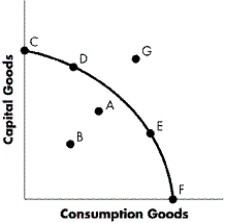 -Refer to Figure 2-4.Which of the following statements about the movement from Point D to Point E is the most accurate?
 (Multiple Choice)
4.9/5 (88)
(88) Any point NOT on the production possibilities curve cannot be optimal.What reasoning supports this?
(Multiple Choice)
4.7/5 (72)
(72) In the circular flow model,in what forms do households receive income?
(Multiple Choice)
4.9/5 (82)
(82) A virulent disease spreads throughout the population of an economy,causing death and disability.How can this be portrayed on the production possibilities curve?
(Multiple Choice)
4.8/5 (75)
(75) FIGURE 2-10
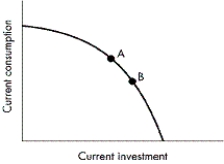 -Refer to Figure 2-10.Societies choose between the level of current consumption and current investment.What is occurring if a society moves from Point B to Point A?
 (Multiple Choice)
4.9/5 (81)
(81) Capital accumulation causes the production possibilities curve to shift inward over time.
(True/False)
5.0/5 (89)
(89) The production possibilities curve marks the boundary between attainable and unattainable combinations of output.
(True/False)
4.9/5 (85)
(85) Is increased capital spending the only way for an economy to expand its production possibilities curve?
(Multiple Choice)
4.9/5 (80)
(80) 
Filters
- Essay(0)
- Multiple Choice(0)
- Short Answer(0)
- True False(0)
- Matching(0)