



 Chat with AI
Exam 11: Industry

Exam 1: Thinking Geographically70 Questions
Exam 2: Weather, Climate, and Climate Change76 Questions
Exam 3: Landforms79 Questions
Exam 4: Biosphere78 Questions
Exam 5: Population67 Questions
Exam 6: Migration79 Questions
Exam 7: Languages and Religion91 Questions
Exam 8: Political Geography76 Questions
Exam 9: Development80 Questions
Exam 10: Food and Agriculture80 Questions
Exam 11: Industry81 Questions
Exam 12: Services and Settlements79 Questions
Exam 13: Urban Patterns76 Questions
Exam 14: Resources80 Questions
Select questions type


Industry arrived a bit later in North America than in the United Kingdom, but it grew much faster in the nineteenth century.
(True/False)
4.7/5  (90)
(90) In the U.S., between 1950 and 2009, the North and East lost 6 million manufacturing jobs and the South and West gained 2 million.
(True/False)
4.8/5 (76)
(76) An industry in which the inputs weigh more than the final products is a:
(Multiple Choice)
4.9/5 (95)
(95) Figure 11.7.2, Earned Annual Income (Males) 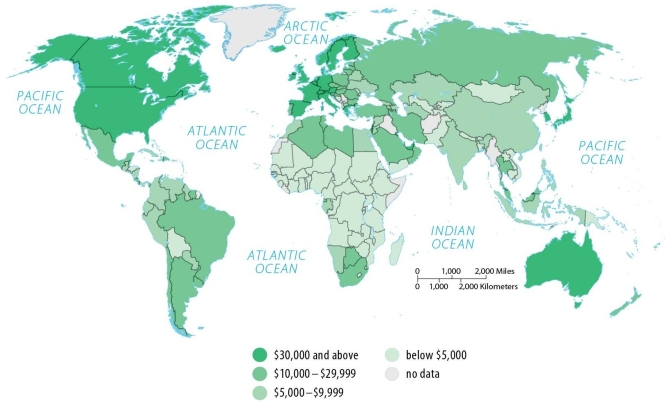 -Looking at Figure 11.7.2, the average annual wage paid to male workers exceeds ________ in most developed countries, compared to less than ________ in most African countries.
 (Multiple Choice)
4.9/5 (78)
(78) List the different modes of transporting goods in the United States and their comparative advantages.
(Essay)
4.8/5 (81)
(81) It is estimated that sixty percent of the world's final assembly plants are controlled by ________ carmakers.
(Multiple Choice)
4.8/5 (68)
(68) Half of the vehicles sold in North America are assembled in North America, and most of the remainder are assembled in China and Japan.
(True/False)
4.8/5 (81)
(81) Where in the United States are car assembly plants and parts makers distributed, and why?
(Essay)
4.7/5 (78)
(78) The distribution of steelmaking in the United States demonstrates that when the source of inputs or the relative importance of inputs changes, the optimal location for the industry remains the same.
(True/False)
4.8/5 (88)
(88) In the late nineteenth century, steel mills were built around all of the following except which one?
(Multiple Choice)
4.8/5 (68)
(68) For a bulk-gaining operation, such as a final vehicle assembly plant, the critical location factor is minimizing transportation to the market.
(True/False)
4.8/5 (88)
(88) Which of the following regions in the United States is the country's largest center for clothing and textile production?
(Multiple Choice)
4.9/5 (70)
(70) This is Russia's second largest city, specializing in shipbuilding and other industries serving Russia's navy and ports in the Baltic Sea.
(Multiple Choice)
4.9/5 (57)
(57) Russia and Brazil, currently classified by the United Nations as having relatively high levels of development, are especially rich in inputs critical for industry.
(True/False)
4.9/5 (77)
(77) Figure 11.4.4, World Steel Production, 1980 and 2010 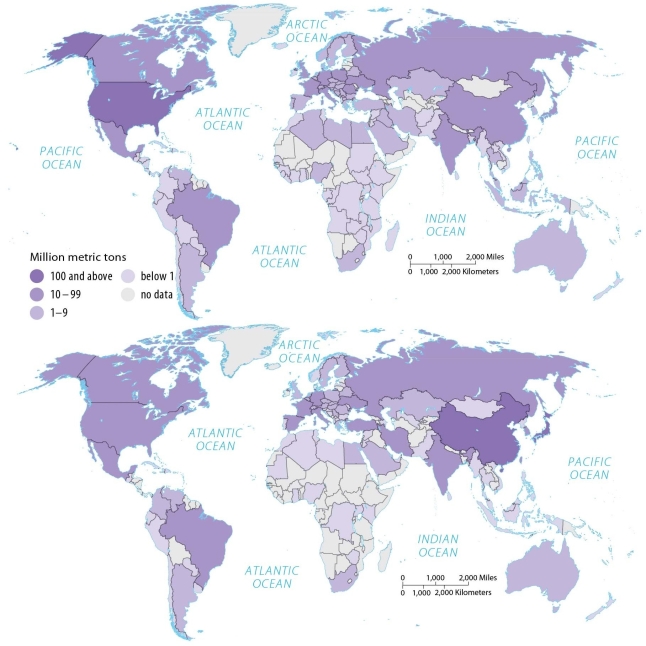 -Looking at Figure 11.4.4, which of the following countries had the highest steel production in 1980?
 (Multiple Choice)
4.9/5 (89)
(89) A ________ is a location where transfer among transportation modes is possible.
(Multiple Choice)
4.9/5 (85)
(85) Figure 11.4.4, World Steel Production, 1980 and 2010
-There are approximately fifty ________ in the United States.
-There are approximately fifty ________ in the United States. (Multiple Choice)
4.9/5 (76)
(76) Figure 11.7.2, Earned Annual Income (Males)
-Which of the following is a prominent example of an industry that generally requires less-skilled, low-cost workers?
-Which of the following is a prominent example of an industry that generally requires less-skilled, low-cost workers? (Multiple Choice)
5.0/5 (69)
(69) 
Filters
- Essay(0)
- Multiple Choice(0)
- Short Answer(0)
- True False(0)
- Matching(0)