



 Chat with AI
Exam 11: Oligopoly and Monopolistic Competition

Exam 1: Introduction41 Questions
Exam 2: Supply and Demand132 Questions
Exam 3: Empirical Methods for Demand Analysis84 Questions
Exam 4: Consumer Choice67 Questions
Exam 5: Production127 Questions
Exam 6: Costs117 Questions
Exam 7: Firm Organization and Market Structure70 Questions
Exam 8: Competitive Firms and Markets97 Questions
Exam 9: Monopoly81 Questions
Exam 10: Pricing With Market Power139 Questions
Exam 11: Oligopoly and Monopolistic Competition84 Questions
Exam 12: Game Theory and Business Strategy90 Questions
Exam 13: Strategies Over Time69 Questions
Exam 14: Managerial Decision-Making Under Uncertainty116 Questions
Exam 15: Asymmetric Information111 Questions
Exam 16: Government and Business103 Questions
Exam 17: Global Business72 Questions
Select questions type


Suppose the demand for pizza in a small isolated town is p = 10 - Q.There are only two firms,A and B,and each has a cost function TC = 2 + q.Determine the Cournot equilibrium.
(Essay)
4.9/5  (83)
(83) 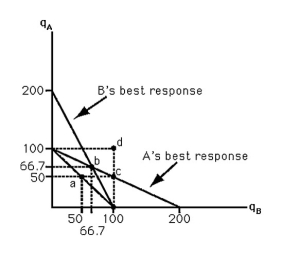 -The above figure shows the reaction functions for two pizza shops in a small isolated town.Collusion would result in
 (Multiple Choice)
4.8/5 (70)
(70) A merger between a firm and one of its suppliers would be called
(Multiple Choice)
4.8/5 (79)
(79) Suppose two Cournot duopolist firms operate at zero marginal cost.The market demand is p = a - bQ.Firm 1's best-response function is
(Multiple Choice)
4.9/5 (80)
(80) Assuming a homogeneous product,the Bertrand equilibrium price is
(Multiple Choice)
4.9/5 (72)
(72) In a Bertrand duopoly with product differentiation,explain how a change in one firm's marginal cost can have an effect on the price charged by the other firm.
(Essay)
4.8/5 (78)
(78) A monopolistically competitive firm has the free entry characteristics of ________ and the price setting characteristics of ________.
(Multiple Choice)
4.8/5 (75)
(75) In the simplest version of the Cournot model,we assume the firms
(Multiple Choice)
4.7/5 (79)
(79)
-The above figure shows the reaction functions for two pizza shops in a small isolated town.The perfect competitive outcome is that
-The above figure shows the reaction functions for two pizza shops in a small isolated town.The perfect competitive outcome is that (Multiple Choice)
4.7/5 (80)
(80) 
Filters
- Essay(0)
- Multiple Choice(0)
- Short Answer(0)
- True False(0)
- Matching(0)