



 Chat with AI
Exam 4: Consumer Choice

Exam 1: Introduction41 Questions
Exam 2: Supply and Demand132 Questions
Exam 3: Empirical Methods for Demand Analysis84 Questions
Exam 4: Consumer Choice67 Questions
Exam 5: Production127 Questions
Exam 6: Costs117 Questions
Exam 7: Firm Organization and Market Structure70 Questions
Exam 8: Competitive Firms and Markets97 Questions
Exam 9: Monopoly81 Questions
Exam 10: Pricing With Market Power139 Questions
Exam 11: Oligopoly and Monopolistic Competition84 Questions
Exam 12: Game Theory and Business Strategy90 Questions
Exam 13: Strategies Over Time69 Questions
Exam 14: Managerial Decision-Making Under Uncertainty116 Questions
Exam 15: Asymmetric Information111 Questions
Exam 16: Government and Business103 Questions
Exam 17: Global Business72 Questions
Select questions type


4.5 Deriving Demand Curves
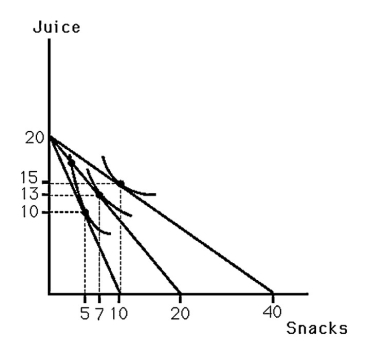 -The above figure shows Bobby's indifference map for juice and snacks.Also shown are three budget lines resulting from different prices for snacks.As the price of snacks rises,Bobby's utility
 (Multiple Choice)
4.7/5  (78)
(78) Joe's budget constraint equals 500 = 2F + 100S,where $500 is Joe's income,$2 is the price of food (F,y-axis)and $100 is the price of shelter (S,x-axis).How much food can Joe buy if he buys one unit of shelter?
(Multiple Choice)
4.9/5 (75)
(75) Indifference curves are downward sloping because of the assumption of
(Multiple Choice)
4.8/5 (86)
(86) If Fred's marginal utility of pizza equals 10 and his marginal utility of salad equals 2,then
(Multiple Choice)
4.8/5 (83)
(83) Economists assume consumers select a bundle of goods that maximizes their well-being subject to
(Multiple Choice)
4.7/5 (78)
(78) 4.5 Deriving Demand Curves
-The above figure shows Bobby's indifference map for juice and snacks.Also shown are three budget lines resulting from different prices for snacks.Bobby's demand for snacks is
-The above figure shows Bobby's indifference map for juice and snacks.Also shown are three budget lines resulting from different prices for snacks.Bobby's demand for snacks is (Multiple Choice)
4.7/5 (77)
(77) Joe's income is $500,the price of food (F,y-axis)is $2 per unit,and the price of shelter (S,x-axis)is $100.Which of the following represents his marginal rate of transformation of food for shelter?
(Multiple Choice)
4.9/5 (67)
(67) If the price of one good increases while the price of the other good and the consumer's income remain unchanged,what will happen to the budget line?
(Multiple Choice)
4.9/5 (76)
(76) The rate at which a consumer must give up y to get one more x is equal to
(Multiple Choice)
5.0/5 (83)
(83) If two indifference curves were to intersect at a point,this would violate the assumption of
(Multiple Choice)
4.9/5 (86)
(86) In Spain,people are considered organ donors unless the explicitly indicate they do not want to be.In the United States,people are only considered organ donors if they explicitly indicate they wish to be.Behavioral economics would suggest that
(Multiple Choice)
4.8/5 (73)
(73) If the utility function (U)between food (F)and clothing (C)can be represented as U =  ,the marginal utility of food
 (Multiple Choice)
4.8/5 (75)
(75) If two goods are perfect substitutes,then the indifference curves for those two goods would be
(Multiple Choice)
4.7/5 (83)
(83) 4.5 Deriving Demand Curves
-The above figure shows Bobby's indifference map for juice and snacks.Also shown are three budget lines resulting from different prices for snacks.As the price of snacks rises,the price for juice
-The above figure shows Bobby's indifference map for juice and snacks.Also shown are three budget lines resulting from different prices for snacks.As the price of snacks rises,the price for juice (Multiple Choice)
4.8/5 (76)
(76) With respect to consuming food and shelter,two consumers face the same prices and both claim to be in equilibrium.We therefore know that
(Multiple Choice)
4.8/5 (94)
(94) 
Filters
- Essay(0)
- Multiple Choice(0)
- Short Answer(0)
- True False(0)
- Matching(0)