



 Chat with AI
Exam 25: Metabolism and Energetics

Exam 1: An Introduction to Anatomy and Physiology82 Questions
Exam 2: The Chemical Level of Organization165 Questions
Exam 3: The Cellular Level of Organization183 Questions
Exam 4: The Tissue Level of Organization121 Questions
Exam 5: The Integumentary System112 Questions
Exam 6: Osseous Tissue and Bone Structure139 Questions
Exam 7: The Axial Skeleton142 Questions
Exam 8: The Appendicular Skeleton115 Questions
Exam 9: Joints127 Questions
Exam 10: Muscle Tissue136 Questions
Exam 11: The Muscular System163 Questions
Exam 12: Neural Tissue168 Questions
Exam 13: The Spinal Cord, spinal Nerves, and Spinal Reflexes111 Questions
Exam 14: The Brain and Cranial Nerves179 Questions
Exam 15: Sensory Pathways and the Somatic Nervous System120 Questions
Exam 16: The Autonomic Nervous System and Higher-Order Functions124 Questions
Exam 17: The Special Senses166 Questions
Exam 18: The Endocrine System183 Questions
Exam 19: Blood158 Questions
Exam 20: The Heart172 Questions
Exam 21: Blood Vessels and Circulation219 Questions
Exam 22: The Lymphatic System and Immunity161 Questions
Exam 23: The Respiratory System193 Questions
Exam 24: The Digestive System208 Questions
Exam 25: Metabolism and Energetics135 Questions
Exam 26: The Urinary System129 Questions
Exam 27: Fluid, electrolyte, and Acid-Base Balance61 Questions
Exam 28: The Reproductive System197 Questions
Exam 29: Development and Inheritance140 Questions
Select questions type


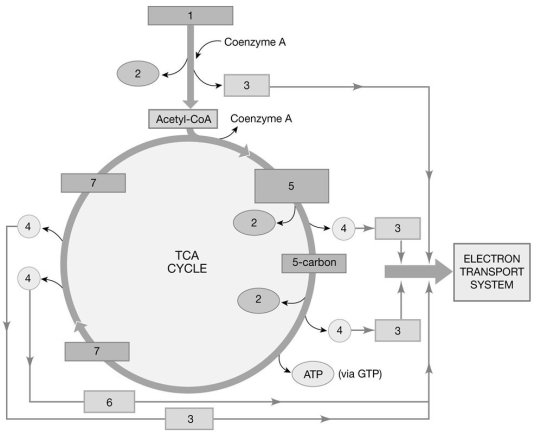 Figure 25-1 The Citric Acid Cycle
Use Figure 25-1 to answer the following questions:
-What is the molecule labeled "5"?
Figure 25-1 The Citric Acid Cycle
Use Figure 25-1 to answer the following questions:
-What is the molecule labeled "5"? (Multiple Choice)
4.9/5  (77)
(77) The sum of all of the biochemical processes going on within the human body at any given time is called
(Multiple Choice)
4.8/5 (71)
(71) Although other nutrients can feed into the citric acid cycle,________ yields energy the quickest.
(Multiple Choice)
4.8/5 (84)
(84) ________ carry excess cholesterol from peripheral tissues to the liver.
(Multiple Choice)
4.9/5 (78)
(78) The vitamin that is required for proper bone growth and for calcium absorption and retention is vitamin
(Multiple Choice)
4.7/5 (86)
(86) In an environment that is cooler than your body,you lose heat in a process called
(Multiple Choice)
4.8/5 (71)
(71) The ________ of the mitochondrion contains large-diameter pores that are permeable to ions and small organic molecules such as pyruvic acid.
(Multiple Choice)
4.8/5 (86)
(86) What percent of energy released from catabolism is lost as heat?
(Multiple Choice)
4.8/5 (82)
(82) When the body is relying on internal energy reserves to continue meeting its energy demands,it is in the ________ state.
(Multiple Choice)
4.9/5 (89)
(89) When the temperature of the preoptic area of the hypothalamus exceeds its thermostat setting,
(Multiple Choice)
4.8/5 (73)
(73) The Dietary Guidelines for Americans recommends many servings a day of dark-green and orange vegetables.Which vitamin is particularly abundant in this food group?
(Multiple Choice)
4.9/5 (81)
(81) The inherited metabolic disorder that results from the accumulation of phenylketones from phenylalanine is
(Multiple Choice)
4.9/5 (70)
(70) An element that is a component of hemoglobin,myoglobin,and cytochromes is
(Multiple Choice)
4.8/5 (70)
(70) In order for glycolysis to proceed,which of the following need not be present?
(Multiple Choice)
4.8/5 (75)
(75) Which of the following individuals would lose heat the fastest in a cold room?
(Multiple Choice)
5.0/5 (88)
(88) Inorganic ions released through the dissociation of electrolytes are called
(Multiple Choice)
4.8/5 (62)
(62) 
Filters
- Essay(0)
- Multiple Choice(0)
- Short Answer(0)
- True False(0)
- Matching(0)