



 Chat with AI
Exam 24: The Digestive System

Exam 1: An Introduction to Anatomy and Physiology82 Questions
Exam 2: The Chemical Level of Organization165 Questions
Exam 3: The Cellular Level of Organization183 Questions
Exam 4: The Tissue Level of Organization121 Questions
Exam 5: The Integumentary System112 Questions
Exam 6: Osseous Tissue and Bone Structure139 Questions
Exam 7: The Axial Skeleton142 Questions
Exam 8: The Appendicular Skeleton115 Questions
Exam 9: Joints127 Questions
Exam 10: Muscle Tissue136 Questions
Exam 11: The Muscular System163 Questions
Exam 12: Neural Tissue168 Questions
Exam 13: The Spinal Cord, spinal Nerves, and Spinal Reflexes111 Questions
Exam 14: The Brain and Cranial Nerves179 Questions
Exam 15: Sensory Pathways and the Somatic Nervous System120 Questions
Exam 16: The Autonomic Nervous System and Higher-Order Functions124 Questions
Exam 17: The Special Senses166 Questions
Exam 18: The Endocrine System183 Questions
Exam 19: Blood158 Questions
Exam 20: The Heart172 Questions
Exam 21: Blood Vessels and Circulation219 Questions
Exam 22: The Lymphatic System and Immunity161 Questions
Exam 23: The Respiratory System193 Questions
Exam 24: The Digestive System208 Questions
Exam 25: Metabolism and Energetics135 Questions
Exam 26: The Urinary System129 Questions
Exam 27: Fluid, electrolyte, and Acid-Base Balance61 Questions
Exam 28: The Reproductive System197 Questions
Exam 29: Development and Inheritance140 Questions
Select questions type


Movements unique to the large intestine are ________ movements.
(Multiple Choice)
4.9/5  (65)
(65) People who lack the enzyme ________ often experience GI upset after consuming milk and other dairy products.
(Multiple Choice)
4.9/5 (70)
(70) Powerful peristaltic contractions that occur a few times each day in the colon are called
(Multiple Choice)
4.9/5 (82)
(82) 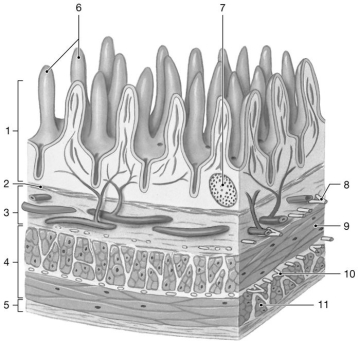 Figure 24-2 The Wall of the Small Intestine
Use Figure 24-2 to answer the following questions:
-What is the function of the structure labeled "7"?
Figure 24-2 The Wall of the Small Intestine
Use Figure 24-2 to answer the following questions:
-What is the function of the structure labeled "7"? (Multiple Choice)
4.9/5 (68)
(68) The clinical term for the gas produced by bacteria in the colon as they metabolize indigestible carbohydrates is called
(Multiple Choice)
4.9/5 (90)
(90)  Figure 24-1 The Stomach (dissected)
Use Figure 24-1 to answer the following questions:
-Which structure(s)help(s)the stomach to stretch as it fills with food?
Figure 24-1 The Stomach (dissected)
Use Figure 24-1 to answer the following questions:
-Which structure(s)help(s)the stomach to stretch as it fills with food? (Multiple Choice)
4.7/5 (85)
(85) An intestinal hormone that stimulates the release of insulin from the pancreatic islet cells is
(Multiple Choice)
4.8/5 (87)
(87) All of the following are true of the intestinal phase of gastric digestion except that it
(Multiple Choice)
4.7/5 (67)
(67) The portion of the stomach that is superior to the junction between the stomach and the esophagus is the
(Multiple Choice)
4.7/5 (84)
(84) Which of the following is not a function of the digestive system?
(Multiple Choice)
4.7/5 (85)
(85) Functions of the stomach include all of the following except
(Multiple Choice)
4.9/5 (85)
(85) All of the following contain mucous cells in the epithelium except the
(Multiple Choice)
4.9/5 (65)
(65) The enzyme that digests starch into disaccharides and trisaccharides is
(Multiple Choice)
4.8/5 (82)
(82) The portion of the small intestine that attaches to the cecum is the
(Multiple Choice)
4.8/5 (60)
(60) 
Filters
- Essay(0)
- Multiple Choice(0)
- Short Answer(0)
- True False(0)
- Matching(0)