



 Chat with AI
Exam 23: The Respiratory System

Exam 1: An Introduction to Anatomy and Physiology81 Questions
Exam 2: The Chemical Level of Organization167 Questions
Exam 3: The Cellular Level of Organization186 Questions
Exam 4: The Tissue Level of Organization122 Questions
Exam 5: The Integumentary System111 Questions
Exam 6: Osseous Tissue and Bone Structure143 Questions
Exam 7: The Axial Skeleton148 Questions
Exam 8: The Appendicular Skeleton113 Questions
Exam 9: Articulations126 Questions
Exam 10: Muscle Tissue135 Questions
Exam 11: The Muscular System164 Questions
Exam 12: Neural Tissue168 Questions
Exam 13: The Spinal Cord, spinal Nerves, and Spinal Reflexes111 Questions
Exam 14: The Brain and Cranial Nerves179 Questions
Exam 15: Neural Integration I: Sensory Pathways and the Somatic Nervous System120 Questions
Exam 16: Neural Integration Ii: the Autonomic Nervous System and127 Questions
Exam 17: The Special Senses166 Questions
Exam 18: The Endocrine System179 Questions
Exam 19: Blood146 Questions
Exam 20: The Heart172 Questions
Exam 21: Blood Vessels and Circulation223 Questions
Exam 22: The Lymphatic System and Immunity161 Questions
Exam 23: The Respiratory System193 Questions
Exam 24: The Digestive System208 Questions
Exam 25: Metabolism and Energetics135 Questions
Exam 26: The Urinary System123 Questions
Exam 27: Fluid, electrolyte, and Acid-Base Balance59 Questions
Exam 28: The Reproductive System196 Questions
Exam 29: Development and Inheritance140 Questions
Select questions type


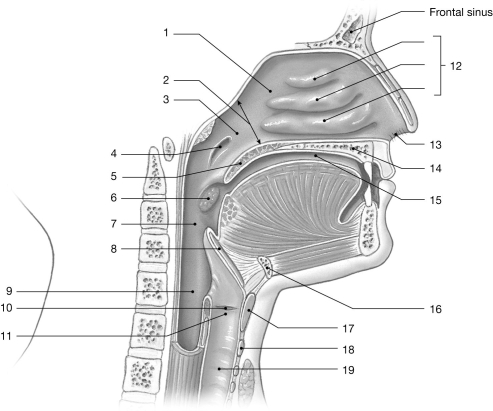 Figure 23-1 The Upper Airways
Use Figure 23-1 to answer the following question:
-Identify the structure labeled "2."
Figure 23-1 The Upper Airways
Use Figure 23-1 to answer the following question:
-Identify the structure labeled "2." (Multiple Choice)
4.8/5  (70)
(70) The volume of air moved in a single respiratory cycle is termed ________.
(Short Answer)
4.9/5 (88)
(88) Tina is singing a song.At a certain point in the song she forces a large volume of air out of the glottis and at the same time increases the tension on her vocal cords.The sound that she produces is
(Multiple Choice)
4.8/5 (99)
(99) ________ is the amount of air that you can inhale above the resting tidal volume.
(Multiple Choice)
4.9/5 (80)
(80) Sympathetic input to the smooth muscle tissue in bronchioles causes all of these except
(Multiple Choice)
4.9/5 (78)
(78) The respiratory membrane of the gas exchange surfaces consists of
(Multiple Choice)
5.0/5 (75)
(75) The flap-like structure that prevents food from entering the larynx is called the ________.
(Short Answer)
4.9/5 (80)
(80) The resulting pain and inflammation when pleural fluid is unable to prevent friction between the opposing pleural surfaces is known as
(Multiple Choice)
4.9/5 (77)
(77) If a patient inhales as deeply as possible and then exhales as much as possible,the volume of air expelled would be the patient's
(Multiple Choice)
4.8/5 (77)
(77) Decompression sickness is a painful condition that develops when a person is exposed to a sudden drop in atmospheric pressure.Bubbles of ________ gas are responsible for the problem.
(Multiple Choice)
4.8/5 (78)
(78) The C shape of the tracheal cartilages is important because
(Multiple Choice)
4.9/5 (83)
(83) The partial pressure of oxygen in atmospheric air at sea level is
(Multiple Choice)
4.8/5 (79)
(79) The beating of the cilia of the respiratory passages in the direction of the pharynx forms a(n)________.
(Short Answer)
4.8/5 (72)
(72) 
Filters
- Essay(0)
- Multiple Choice(0)
- Short Answer(0)
- True False(0)
- Matching(0)