



 Chat with AI
Exam 21: Blood Vessels and Circulation

Exam 1: An Introduction to Anatomy and Physiology81 Questions
Exam 2: The Chemical Level of Organization167 Questions
Exam 3: The Cellular Level of Organization186 Questions
Exam 4: The Tissue Level of Organization122 Questions
Exam 5: The Integumentary System111 Questions
Exam 6: Osseous Tissue and Bone Structure143 Questions
Exam 7: The Axial Skeleton148 Questions
Exam 8: The Appendicular Skeleton113 Questions
Exam 9: Articulations126 Questions
Exam 10: Muscle Tissue135 Questions
Exam 11: The Muscular System164 Questions
Exam 12: Neural Tissue168 Questions
Exam 13: The Spinal Cord, spinal Nerves, and Spinal Reflexes111 Questions
Exam 14: The Brain and Cranial Nerves179 Questions
Exam 15: Neural Integration I: Sensory Pathways and the Somatic Nervous System120 Questions
Exam 16: Neural Integration Ii: the Autonomic Nervous System and127 Questions
Exam 17: The Special Senses166 Questions
Exam 18: The Endocrine System179 Questions
Exam 19: Blood146 Questions
Exam 20: The Heart172 Questions
Exam 21: Blood Vessels and Circulation223 Questions
Exam 22: The Lymphatic System and Immunity161 Questions
Exam 23: The Respiratory System193 Questions
Exam 24: The Digestive System208 Questions
Exam 25: Metabolism and Energetics135 Questions
Exam 26: The Urinary System123 Questions
Exam 27: Fluid, electrolyte, and Acid-Base Balance59 Questions
Exam 28: The Reproductive System196 Questions
Exam 29: Development and Inheritance140 Questions
Select questions type


Each of the following changes will result in increased blood flow to a tissue,except
(Multiple Choice)
4.8/5  (79)
(79) Arrange the structures in the following list in the order that blood will encounter as it flows from the output side to the input side of the cardiovascular flow circuit. 1.venules
2)arterioles
3)capillaries
4)elastic arteries
5)medium veins
6)large veins
7)muscular arteries
(Multiple Choice)
4.9/5 (80)
(80) The hepatic portal vein forms from the fusion of the superior and inferior ________ and the splenic veins.
(Short Answer)
5.0/5 (81)
(81) Elevated levels of the hormones ANP and BNP will produce increased
(Multiple Choice)
4.9/5 (76)
(76) The condition known as ________ is characterized by the formation of fatty plaques within the wall of arteries.
(Short Answer)
4.8/5 (78)
(78) Blood from capillaries on the superior surface of the foot drains into a(n)
(Multiple Choice)
5.0/5 (77)
(77) The layer of the arteriole wall that can produce vasoconstriction is the
(Multiple Choice)
4.8/5 (81)
(81) Relative to the lumen,which of these vessels has the thickest tunica media?
(Multiple Choice)
4.9/5 (82)
(82) 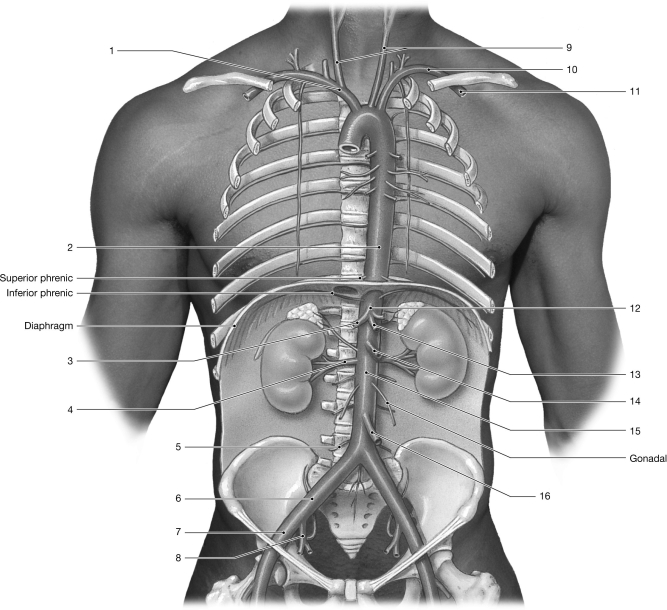 Figure 21-1 Arteries
Use Figure 21-1 to answer the following question:
-Identify the artery labeled "6."
Figure 21-1 Arteries
Use Figure 21-1 to answer the following question:
-Identify the artery labeled "6." (Multiple Choice)
4.9/5 (77)
(77) The vein that is formed from the fusion of the subclavian with the internal and external jugulars is the ________ vein.
(Multiple Choice)
4.7/5 (93)
(93) Each of the following factors would increase cardiac output,except
(Multiple Choice)
4.8/5 (80)
(80) Vickie has a tumor that secretes excess amounts of the hormone aldosterone.Because of the elevated level of hormone,she exhibits
(Multiple Choice)
4.9/5 (86)
(86) The brachial artery branches to form the radial and ________ arteries.
(Multiple Choice)
5.0/5 (86)
(86) The vessels that receive blood from the ovaries or testes are the ________.
(Short Answer)
4.9/5 (76)
(76) Near the level of vertebra L₄,the aorta branches to form the ________ arteries.
(Multiple Choice)
4.9/5 (80)
(80) Major branches of the subclavian artery include the ________ artery(ies).
(Multiple Choice)
4.8/5 (79)
(79) 
Filters
- Essay(0)
- Multiple Choice(0)
- Short Answer(0)
- True False(0)
- Matching(0)