



 Chat with AI
Exam 12: Neural Tissue

Exam 1: An Introduction to Anatomy and Physiology81 Questions
Exam 2: The Chemical Level of Organization167 Questions
Exam 3: The Cellular Level of Organization186 Questions
Exam 4: The Tissue Level of Organization122 Questions
Exam 5: The Integumentary System111 Questions
Exam 6: Osseous Tissue and Bone Structure143 Questions
Exam 7: The Axial Skeleton148 Questions
Exam 8: The Appendicular Skeleton113 Questions
Exam 9: Articulations126 Questions
Exam 10: Muscle Tissue135 Questions
Exam 11: The Muscular System164 Questions
Exam 12: Neural Tissue168 Questions
Exam 13: The Spinal Cord, spinal Nerves, and Spinal Reflexes111 Questions
Exam 14: The Brain and Cranial Nerves179 Questions
Exam 15: Neural Integration I: Sensory Pathways and the Somatic Nervous System120 Questions
Exam 16: Neural Integration Ii: the Autonomic Nervous System and127 Questions
Exam 17: The Special Senses166 Questions
Exam 18: The Endocrine System179 Questions
Exam 19: Blood146 Questions
Exam 20: The Heart172 Questions
Exam 21: Blood Vessels and Circulation223 Questions
Exam 22: The Lymphatic System and Immunity161 Questions
Exam 23: The Respiratory System193 Questions
Exam 24: The Digestive System208 Questions
Exam 25: Metabolism and Energetics135 Questions
Exam 26: The Urinary System123 Questions
Exam 27: Fluid, electrolyte, and Acid-Base Balance59 Questions
Exam 28: The Reproductive System196 Questions
Exam 29: Development and Inheritance140 Questions
Select questions type


The following are the main steps in the generation of an action potential. 1.Sodium channels are inactivated.
2)Voltage-gated potassium channels open and potassium moves out of the cell,initiating repolarization.
3)Sodium channels regain their normal properties.
4)A graded depolarization brings an area of an excitable membrane to threshold.
5)A temporary hyperpolarization occurs.
6)Sodium channel activation occurs.
7)Sodium ions enter the cell and depolarization occurs.
The proper sequence of these events is
(Multiple Choice)
4.8/5  (70)
(70) Ion channels that are always open are called ________ channels.
(Multiple Choice)
4.9/5 (83)
(83) The basic functional unit of the nervous system are cells called ________.
(Short Answer)
4.8/5 (74)
(74) 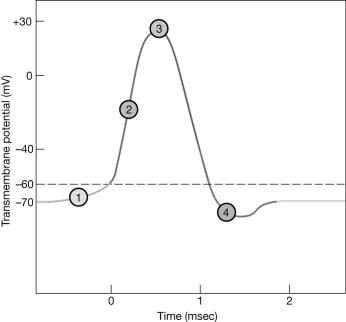 Figure 12-2 The Nerve Action Potential
Use Figure 12-2 to answer the following questions:
-Which area of the graph shows when membrane potential approaches the potassium equilibrium potential?
Figure 12-2 The Nerve Action Potential
Use Figure 12-2 to answer the following questions:
-Which area of the graph shows when membrane potential approaches the potassium equilibrium potential? (Multiple Choice)
4.8/5 (80)
(80) If the potassium permeability of a resting neuron increases above the resting permeability,what effect will this have on the transmembrane potential?
(Multiple Choice)
5.0/5 (76)
(76) A postsynaptic neuron will have an Excitatory Postsynaptic Potential (EPSP)when
(Multiple Choice)
4.7/5 (82)
(82) At the normal resting potential of a typical neuron,its sodium-potassium exchange pump transports
(Multiple Choice)
4.9/5 (78)
(78) Neuron cell bodies in the PNS are clustered together in masses called ________.
(Short Answer)
4.9/5 (72)
(72) 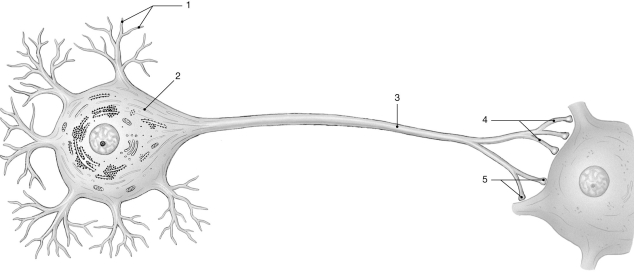 Figure 12-1 The Neuron
Use Figure 12-1 to answer the following questions:
-On which structure do most neuron to neuron communications occur?
Figure 12-1 The Neuron
Use Figure 12-1 to answer the following questions:
-On which structure do most neuron to neuron communications occur? (Multiple Choice)
4.8/5 (78)
(78) A change in the conditions in the synaptic terminal can influence the soma as a result of ________ axoplasmic transport.
(Short Answer)
5.0/5 (81)
(81) Which of the following interactions between electrical and chemical gradients does not lead to the establishment of a neuron's resting potential?
(Multiple Choice)
4.9/5 (80)
(80) In the peripheral nervous system,Schwann cells participate in the repair of damaged nerves by
(Multiple Choice)
4.8/5 (83)
(83) The following are the steps involved in transmission at a cholinergic synapse. 1.Chemically-gated sodium channels on the postsynaptic membrane are activated.
2)Calcium ions enter the synaptic terminal.
3)Acetylcholinesterase hydrolyzes acetylcholine.
4)An action potential depolarizes the synaptic terminal at the presynaptic membrane.
5)The synaptic terminal reabsorbs choline.
6)Acetylcholine is released from storage vesicles by exocytosis.
7)Acetylcholine binds to receptors on the postsynaptic membrane.
8)Calcium ions are removed from the cytoplasm of the synaptic terminal.
The correct sequence for these events is
(Multiple Choice)
4.8/5 (81)
(81) Neurons that have several dendrites and a single axon are called
(Multiple Choice)
4.9/5 (79)
(79) How would the absolute refractory period be affected if voltage-regulated sodium channels failed to inactivate?
(Multiple Choice)
5.0/5 (92)
(92) The neurilemma of axons in the peripheral nervous system is formed by
(Multiple Choice)
4.8/5 (69)
(69) 
Filters
- Essay(0)
- Multiple Choice(0)
- Short Answer(0)
- True False(0)
- Matching(0)