



 Chat with AI
Exam 11: The Muscular System

Exam 1: An Introduction to Anatomy and Physiology81 Questions
Exam 2: The Chemical Level of Organization167 Questions
Exam 3: The Cellular Level of Organization186 Questions
Exam 4: The Tissue Level of Organization122 Questions
Exam 5: The Integumentary System111 Questions
Exam 6: Osseous Tissue and Bone Structure143 Questions
Exam 7: The Axial Skeleton148 Questions
Exam 8: The Appendicular Skeleton113 Questions
Exam 9: Articulations126 Questions
Exam 10: Muscle Tissue135 Questions
Exam 11: The Muscular System164 Questions
Exam 12: Neural Tissue168 Questions
Exam 13: The Spinal Cord, spinal Nerves, and Spinal Reflexes111 Questions
Exam 14: The Brain and Cranial Nerves179 Questions
Exam 15: Neural Integration I: Sensory Pathways and the Somatic Nervous System120 Questions
Exam 16: Neural Integration Ii: the Autonomic Nervous System and127 Questions
Exam 17: The Special Senses166 Questions
Exam 18: The Endocrine System179 Questions
Exam 19: Blood146 Questions
Exam 20: The Heart172 Questions
Exam 21: Blood Vessels and Circulation223 Questions
Exam 22: The Lymphatic System and Immunity161 Questions
Exam 23: The Respiratory System193 Questions
Exam 24: The Digestive System208 Questions
Exam 25: Metabolism and Energetics135 Questions
Exam 26: The Urinary System123 Questions
Exam 27: Fluid, electrolyte, and Acid-Base Balance59 Questions
Exam 28: The Reproductive System196 Questions
Exam 29: Development and Inheritance140 Questions
Select questions type


Which of the following describes the action of the digastric muscle?
(Multiple Choice)
4.8/5  (77)
(77) Muscles including the term capitis would be found within or attached to the
(Multiple Choice)
4.8/5 (78)
(78) Muscles that guard entrances and exits of internal passageways are ________ muscles.
(Multiple Choice)
4.8/5 (76)
(76) Which of the following muscles does not have an action that is antagonistic to the action of the brachialis muscle?
(Multiple Choice)
4.9/5 (83)
(83) All of the following are innervated by the facial nerve (N VII),except for the ________ muscle.
(Multiple Choice)
4.9/5 (78)
(78) The vastus lateralis,vastus medialis,and vastus intermedius muscles originate on the ________ of the femur.
(Multiple Choice)
4.9/5 (90)
(90) In a convergent muscle,fascicles converge on a common attachment site that may be a slender band of collagen fibers known as a ________.
(Short Answer)
5.0/5 (70)
(70) 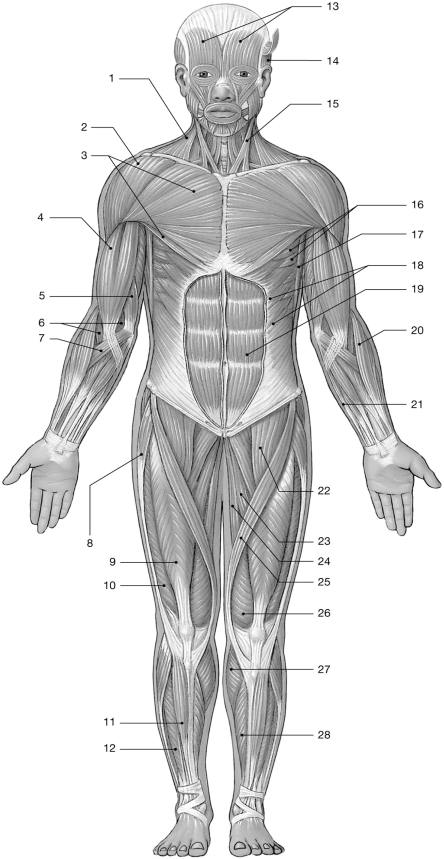 Figure 11-1 Major Anterior Skeletal Muscles
Use Figure 11-1 to answer the following questions:
-Identify the muscle labeled "27."
Figure 11-1 Major Anterior Skeletal Muscles
Use Figure 11-1 to answer the following questions:
-Identify the muscle labeled "27." (Multiple Choice)
4.8/5 (80)
(80) Which of the following is not one of the forms of fascicle organization?
(Multiple Choice)
4.9/5 (81)
(81) The action of the masseter muscle is to ________ the mandible.
(Short Answer)
4.8/5 (70)
(70) The inferior ramus of the pubis is the origin and the medial tibia is the insertion of the ________ muscle.
(Multiple Choice)
4.9/5 (76)
(76) Medial rotation of the eyeball is performed by the ________ muscle.
(Multiple Choice)
4.9/5 (70)
(70)
Figure 11-1 Major Anterior Skeletal Muscles
Use Figure 11-1 to answer the following questions:
-Identify the muscle labeled "6."
Figure 11-1 Major Anterior Skeletal Muscles
Use Figure 11-1 to answer the following questions:
-Identify the muscle labeled "6." (Multiple Choice)
4.8/5 (79)
(79) Contracting the gastrocnemius muscles to elevate the body on the toes involves a ________ lever.
(Multiple Choice)
4.7/5 (84)
(84) Muscles that insert on the olecranon process of the ulna can act to
(Multiple Choice)
4.8/5 (75)
(75) 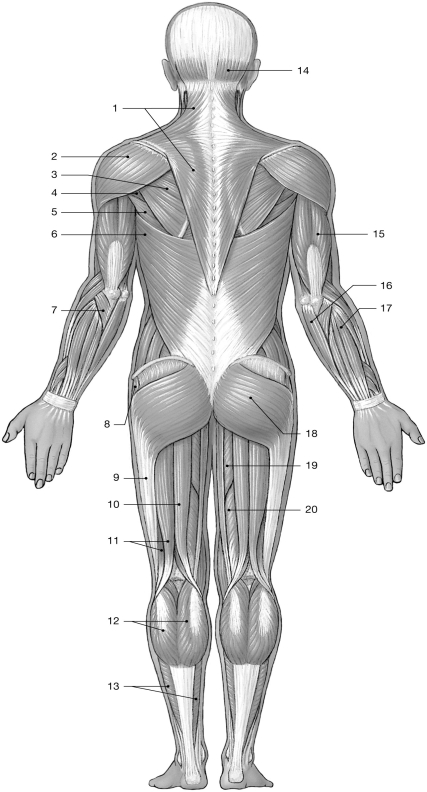 Figure 11-2 Major Posterior Skeletal Muscles
Use Figure 11-2 to answer the following questions:
-Identify the muscle labeled "2."
Figure 11-2 Major Posterior Skeletal Muscles
Use Figure 11-2 to answer the following questions:
-Identify the muscle labeled "2." (Multiple Choice)
4.8/5 (70)
(70) 
Filters
- Essay(0)
- Multiple Choice(0)
- Short Answer(0)
- True False(0)
- Matching(0)