



 Chat with AI
Exam 10: Muscle Tissue

Exam 1: An Introduction to Anatomy and Physiology81 Questions
Exam 2: The Chemical Level of Organization167 Questions
Exam 3: The Cellular Level of Organization186 Questions
Exam 4: The Tissue Level of Organization122 Questions
Exam 5: The Integumentary System111 Questions
Exam 6: Osseous Tissue and Bone Structure143 Questions
Exam 7: The Axial Skeleton148 Questions
Exam 8: The Appendicular Skeleton113 Questions
Exam 9: Articulations126 Questions
Exam 10: Muscle Tissue135 Questions
Exam 11: The Muscular System164 Questions
Exam 12: Neural Tissue168 Questions
Exam 13: The Spinal Cord, spinal Nerves, and Spinal Reflexes111 Questions
Exam 14: The Brain and Cranial Nerves179 Questions
Exam 15: Neural Integration I: Sensory Pathways and the Somatic Nervous System120 Questions
Exam 16: Neural Integration Ii: the Autonomic Nervous System and127 Questions
Exam 17: The Special Senses166 Questions
Exam 18: The Endocrine System179 Questions
Exam 19: Blood146 Questions
Exam 20: The Heart172 Questions
Exam 21: Blood Vessels and Circulation223 Questions
Exam 22: The Lymphatic System and Immunity161 Questions
Exam 23: The Respiratory System193 Questions
Exam 24: The Digestive System208 Questions
Exam 25: Metabolism and Energetics135 Questions
Exam 26: The Urinary System123 Questions
Exam 27: Fluid, electrolyte, and Acid-Base Balance59 Questions
Exam 28: The Reproductive System196 Questions
Exam 29: Development and Inheritance140 Questions
Select questions type


Skeletal muscle fibers are formed from embryonic cells called
(Multiple Choice)
4.8/5  (78)
(78) At peak levels of muscle exertion the mitochondria can supply
(Multiple Choice)
4.8/5 (91)
(91) Since each myofibril is attached at either end of the muscle fiber,when sarcomeres shorten,the muscle fiber
(Multiple Choice)
4.9/5 (78)
(78) The type of contraction in which the muscle fibers do not shorten is called
(Multiple Choice)
4.9/5 (73)
(73) Which of the following is not a function of smooth muscle tissue?
(Multiple Choice)
4.8/5 (90)
(90) Put the following structures in order from superficial to deep: 1. muscle fiber
2) perimysium
3) myofibril
4) fascicle
5) endomysium
6) epimysium
(Multiple Choice)
4.8/5 (78)
(78) Describe the basic sequence of events that occurs as an action potential arrives at the neuromuscular junction and is transmitted to the muscle cell.
(Essay)
4.9/5 (79)
(79) The protein that is found in the Z line of a sarcomere is called ________.
(Short Answer)
4.7/5 (70)
(70) In which of the following would the motor units have the fewest muscle fibers?
(Multiple Choice)
4.7/5 (82)
(82) 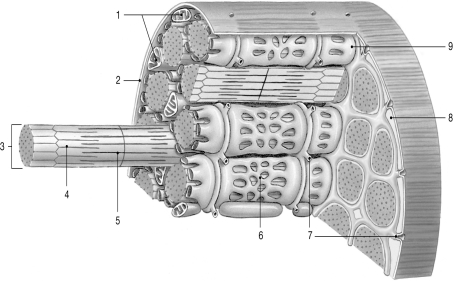 Figure 10-1 Skeletal Muscle Fiber
Use Figure 10-1 to answer the following question:
-Where would calcium ions be predominately found?
Figure 10-1 Skeletal Muscle Fiber
Use Figure 10-1 to answer the following question:
-Where would calcium ions be predominately found? (Multiple Choice)
4.8/5 (89)
(89) A single motor neuron together with all the muscle fibers it innervates is called
(Multiple Choice)
5.0/5 (71)
(71)
Figure 10-1 Skeletal Muscle Fiber
Use Figure 10-1 to answer the following question:
-Identify the structure labeled "1."
Figure 10-1 Skeletal Muscle Fiber
Use Figure 10-1 to answer the following question:
-Identify the structure labeled "1." (Multiple Choice)
4.9/5 (68)
(68) When a muscle is stimulated repeatedly at a high rate,the amount of tension gradually increases to a steady maximum tension.This is called
(Multiple Choice)
4.8/5 (83)
(83) During the recovery period following exercise,all of the following are true,except
(Multiple Choice)
5.0/5 (92)
(92) The thin filaments of striated muscle are made primarily of which protein(s)?
(Multiple Choice)
4.8/5 (73)
(73)
Figure 10-1 Skeletal Muscle Fiber
Use Figure 10-1 to answer the following question:
-What physiological process occurs in the structure labeled "7"?
Figure 10-1 Skeletal Muscle Fiber
Use Figure 10-1 to answer the following question:
-What physiological process occurs in the structure labeled "7"? (Multiple Choice)
4.8/5 (83)
(83) The delicate connective tissue that surrounds the skeletal muscle fibers and ties adjacent muscle fibers together is the
(Multiple Choice)
5.0/5 (80)
(80) Which of the following hormones directly stimulates growth of muscle tissue,leading to increased muscle mass?
(Multiple Choice)
4.9/5 (75)
(75) 
Filters
- Essay(0)
- Multiple Choice(0)
- Short Answer(0)
- True False(0)
- Matching(0)