



 Chat with AI
Exam 12: Oligopoly and Strategic Behavior

Exam 1: Introduction: What Is Economics163 Questions
Exam 2: The Key Principles of Economics199 Questions
Exam 3: Exchange and Markets133 Questions
Exam 4: Demand,supply,and Market Equilibrium279 Questions
Exam 5: Elasticity: a Measure of Responsiveness170 Questions
Exam 6: Market Efficiency and Government Intervention120 Questions
Exam 7: Consumer Choice: Utility Theory and Insights From Neuroscience114 Questions
Exam 8: Production Technology and Cost163 Questions
Exam 9: Perfect Competition167 Questions
Exam 10: Monopoly and Price Discrimination127 Questions
Exam 11: Market Entry and Monopolistic Competition112 Questions
Exam 12: Oligopoly and Strategic Behavior116 Questions
Exam 13: Controlling Market Power: Antitrust and Regulation81 Questions
Exam 14: Imperfect Information: Adverse Selection and Moral Hazard98 Questions
Exam 15: Public Goods and Public Choice95 Questions
Exam 16: External Costs and Environmental Policy100 Questions
Exam 17: The Labor Market and the Distribution of Income177 Questions
Exam 18: International Trade and Public Policy224 Questions
Select questions type


Entry into a market can be deterred by practicing limit pricing.
(True/False)
4.9/5  (82)
(82) Recall the Application about low-price guarantees and the prices of tires to answer the following question(s).
-Recall the Application.A study of the retail tire market suggests that prices are generally ________ in markets where firms offer low-price guarantees.
(Multiple Choice)
4.8/5 (82)
(82) Do firms in a perfectly contestable market earn positive economic profit in the long run? Explain.
(Essay)
4.9/5 (86)
(86) Suppose four firms in the airline industry have gotten together and formed a cartel.Which of the following is true?
(Multiple Choice)
4.8/5 (82)
(82) A game tree is a graphical representation of the consequences of different actions in a strategic setting.
(True/False)
4.7/5 (87)
(87) Recall the Application about advertising in the milk industry to answer the following question(s).
-Recall the Application.In the "Got Milk?" advertising campaign,individual milk producers solved the advertisers' dilemma by sharing the costs and benefits of the campaign.
(True/False)
4.8/5 (73)
(73) The advertisers' dilemma suggests that firms would be worse off if they did not advertise,even though advertising only raises total output in an industry by only a small amount.
(True/False)
4.9/5 (76)
(76) If a firm in a monopolistically competitive market uses advertising to lower the price elasticity of demand for its product,
(Multiple Choice)
4.9/5 (65)
(65) In a two-person repeated game,a tit-for-tat strategy starts with
(Multiple Choice)
4.8/5 (80)
(80) A profit-maximizing firm will choose the level of advertisements such that
(Multiple Choice)
4.9/5 (83)
(83) 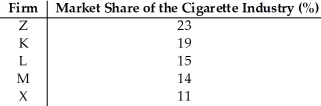 Table 12.1
-Refer to Table 12.1.The four-firm concentration ratio of the cigarette industry is equal to
Table 12.1
-Refer to Table 12.1.The four-firm concentration ratio of the cigarette industry is equal to (Multiple Choice)
5.0/5 (78)
(78) 12.3 Simultaneous Decision Making and the Payoff Matrix
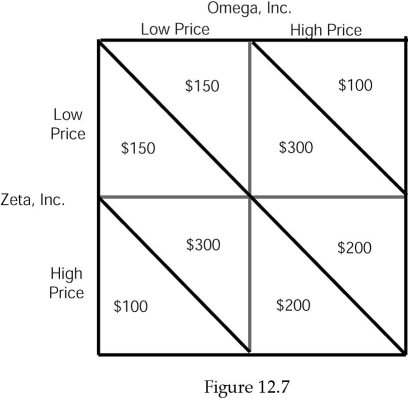 -Refer to Figure 12.7.The numerical data show daily profits for each of the two firms when they choose a specific pricing strategy.If both firms choose a high-price strategy,
 (Multiple Choice)
4.8/5 (62)
(62) If firms A and B do not have dominant strategies,the payoff matrix can be used to predict the Nash equilibrium between firms A and B.
(True/False)
4.9/5 (68)
(68) A single firm selling its output in a contestable market will
(Multiple Choice)
4.9/5 (83)
(83) The prisoners' dilemma shows that the players' dominant strategies often lead them to less than optimal outcomes.Explain the Nash equilibrium and why both prisoners confessing is the Nash equilibrium.
(Essay)
4.8/5 (92)
(92) Not practicing limit pricing and allowing entry can hurt an incumbent firm's profits.
(True/False)
4.9/5 (88)
(88) Firms participating in implicit price leadership openly discuss their pricing strategies with one another.
(True/False)
4.8/5 (66)
(66) 
Filters
- Essay(0)
- Multiple Choice(0)
- Short Answer(0)
- True False(0)
- Matching(0)