



 Chat with AI
Exam 11: Market Entry and Monopolistic Competition

Exam 1: Introduction: What Is Economics163 Questions
Exam 2: The Key Principles of Economics199 Questions
Exam 3: Exchange and Markets133 Questions
Exam 4: Demand,supply,and Market Equilibrium279 Questions
Exam 5: Elasticity: a Measure of Responsiveness170 Questions
Exam 6: Market Efficiency and Government Intervention120 Questions
Exam 7: Consumer Choice: Utility Theory and Insights From Neuroscience114 Questions
Exam 8: Production Technology and Cost163 Questions
Exam 9: Perfect Competition167 Questions
Exam 10: Monopoly and Price Discrimination127 Questions
Exam 11: Market Entry and Monopolistic Competition112 Questions
Exam 12: Oligopoly and Strategic Behavior116 Questions
Exam 13: Controlling Market Power: Antitrust and Regulation81 Questions
Exam 14: Imperfect Information: Adverse Selection and Moral Hazard98 Questions
Exam 15: Public Goods and Public Choice95 Questions
Exam 16: External Costs and Environmental Policy100 Questions
Exam 17: The Labor Market and the Distribution of Income177 Questions
Exam 18: International Trade and Public Policy224 Questions
Select questions type


Positive economic profit encourages new firms to enter an industry.
(True/False)
4.8/5  (78)
(78) In a perfectly competitive market,an individual firm's demand curve is horizontal at the market price.
(True/False)
4.8/5 (86)
(86) Explain the conditions that must be satisfied for a monopolistically competitive industry to be in long-run equilibrium.
(Essay)
4.8/5 (81)
(81) The cost of paying celebrities to advertise a product is always less than the increase in profits.
(True/False)
4.7/5 (70)
(70) Which of the following goods are NOT sold in a monopolistically competitive market?
(Multiple Choice)
5.0/5 (62)
(62) If producers differentiate themselves by location,consumers can reduce their travel costs.
(True/False)
4.9/5 (87)
(87) The condition for long-run equilibrium in a monopolistically competitive industry is
(Multiple Choice)
4.9/5 (78)
(78) 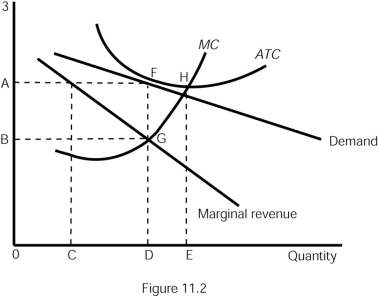 -Refer to Figure 11.2.In the long run,the monopolistic competitor would charge a price of ________ per unit.
 (Multiple Choice)
4.8/5 (90)
(90)
-Refer to Figure 11.2.In the long run,the monopolistic competitor would earn an economic profit equal to the area
-Refer to Figure 11.2.In the long run,the monopolistic competitor would earn an economic profit equal to the area (Multiple Choice)
4.8/5 (86)
(86) Firms in monopolistically competitive markets sell identical products.
(True/False)
4.8/5 (66)
(66) The demand curve facing a monopolistically competitive firm is
(Multiple Choice)
4.9/5 (76)
(76) No barriers to entry in a market implies that,in the long run,economic profit will be
(Multiple Choice)
4.7/5 (71)
(71) Monopolistically competitive firms tend to operate on the positively-sloped portion of their average cost curves.
(True/False)
4.8/5 (69)
(69)
-Refer to Figure 11.2.In the long run,the monopolistic competitor would generate total cost equal to the area
-Refer to Figure 11.2.In the long run,the monopolistic competitor would generate total cost equal to the area (Multiple Choice)
4.9/5 (83)
(83) The demand for a product of a monopolistically competitive firm is very price inelastic.
(True/False)
4.8/5 (70)
(70) The main purpose of advertising is to inform the consumers about a product's features.
(True/False)
4.9/5 (82)
(82) Which type of profit-maximizing firm will choose to produce where price equals marginal cost?
(Multiple Choice)
4.8/5 (71)
(71) Like firms in perfect competition,firms in monopolistic competition will earn zero economic profit in the long run.
(True/False)
4.9/5 (79)
(79) 
Filters
- Essay(0)
- Multiple Choice(0)
- Short Answer(0)
- True False(0)
- Matching(0)