



 Chat with AI
Exam 10: Monopoly and Price Discrimination

Exam 1: Introduction: What Is Economics163 Questions
Exam 2: The Key Principles of Economics199 Questions
Exam 3: Exchange and Markets133 Questions
Exam 4: Demand,supply,and Market Equilibrium279 Questions
Exam 5: Elasticity: a Measure of Responsiveness170 Questions
Exam 6: Market Efficiency and Government Intervention120 Questions
Exam 7: Consumer Choice: Utility Theory and Insights From Neuroscience114 Questions
Exam 8: Production Technology and Cost163 Questions
Exam 9: Perfect Competition167 Questions
Exam 10: Monopoly and Price Discrimination127 Questions
Exam 11: Market Entry and Monopolistic Competition112 Questions
Exam 12: Oligopoly and Strategic Behavior116 Questions
Exam 13: Controlling Market Power: Antitrust and Regulation81 Questions
Exam 14: Imperfect Information: Adverse Selection and Moral Hazard98 Questions
Exam 15: Public Goods and Public Choice95 Questions
Exam 16: External Costs and Environmental Policy100 Questions
Exam 17: The Labor Market and the Distribution of Income177 Questions
Exam 18: International Trade and Public Policy224 Questions
Select questions type


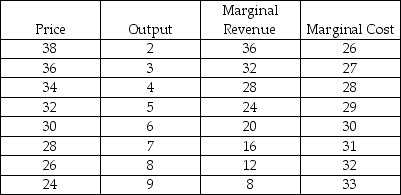 Table 10.3
-Refer to Table 10.3.The profit-maximizing monopolist will choose to produce ________ units of output.
Table 10.3
-Refer to Table 10.3.The profit-maximizing monopolist will choose to produce ________ units of output. (Multiple Choice)
4.7/5  (77)
(77) Price discrimination can be an effective way to increase a firm's profit if the price elasticity of demand is the same across all buyers the firm serves.
(True/False)
4.8/5 (58)
(58) The government is not able to regulate the price that a monopolist charges because the price is set by the market.
(True/False)
4.7/5 (80)
(80) From an economic standpoint,patents reduce efficiency because they serve as a barrier to entry and thus limit market competition.Are there any positive economic benefits of patents? Explain.
(Essay)
5.0/5 (72)
(72) Strawberry,Inc.has a monopoly on the sale of a specialized smartphone.If it sells 9 of these smartphones its total revenue is $1,800,and if it sells 10 smartphones its total revenue is $1,950.The marginal revenue of the tenth smartphone sold is
(Multiple Choice)
4.8/5 (79)
(79) To maximize profit,the monopolist produces on the ________ portion of the demand curve where ________.
(Multiple Choice)
4.8/5 (88)
(88) When the firm is producing at the monopoly equilibrium,its producer surplus will be ________ and the consumer surplus will be ________ than if the industry was competitive.
(Multiple Choice)
4.7/5 (77)
(77) For a competitive firm,the level of output that maximizes profits is where marginal revenue ________ marginal cost,and for a monopolist it is where marginal revenue ________ marginal cost.
(Multiple Choice)
4.9/5 (87)
(87) From society's point of view,a monopolist produces too little because price
(Multiple Choice)
4.9/5 (73)
(73) Assume a non-price discriminating monopolist can sell 20 units of a good for 4.00 each and can sell 21 units of that good for $ 3.85 each.The marginal revenue of the 21st unit is
(Multiple Choice)
4.8/5 (83)
(83) 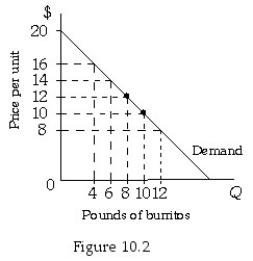 -Refer to Figure 10.2.The marginal revenue of the eighth pound of burritos is
 (Multiple Choice)
4.9/5 (87)
(87) 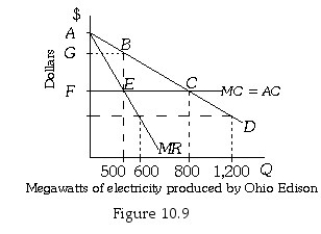 -Refer to Figure 10.9.The profit-maximizing level of output for the monopolist is
 (Multiple Choice)
4.9/5 (67)
(67) Recall the Application about the reason for the high price of movie popcorn to answer the following question(s).
-Recall the Application.What happens with the high demanders and low demanders if the movie theater were to lower the price of the popcorn from $4 to $0.10 and increase the admission from $10 to $12?
(Multiple Choice)
4.9/5 (76)
(76) Which of the following is a result of the monopolization of a perfectly competitive industry,ceteris paribus?
(Multiple Choice)
4.9/5 (79)
(79) 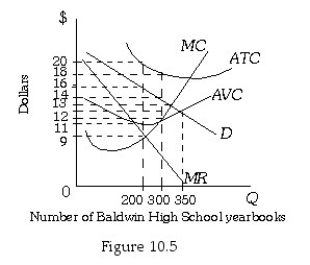 -Refer to Figure 10.5.The profit-maximizing price for the Memory Company's high school yearbook is
 (Multiple Choice)
4.9/5 (97)
(97) A monopoly firm cannot affect the price,and is therefore a price taker.
(True/False)
4.9/5 (97)
(97) 
Filters
- Essay(0)
- Multiple Choice(0)
- Short Answer(0)
- True False(0)
- Matching(0)