



 Chat with AI
Exam 21: Climate Change and Ozone Loss

Exam 1: Environmental Problems: an Introduction and Overview85 Questions
Exam 2: Environmental History: Learning From the Past83 Questions
Exam 3: Science, systems, matter, and Energy126 Questions
Exam 4: Ecosystems: What Are They, and How Do They Work201 Questions
Exam 5: Evolution and Biodiversity80 Questions
Exam 6: Climate and Terrestrial Biodiversity156 Questions
Exam 7: Aquatic Biodiversity99 Questions
Exam 8: Community Ecology104 Questions
Exam 9: Population Ecology90 Questions
Exam 10: Applying Population Ecology: the Human Population119 Questions
Exam 11: Sustaining Terrestrial Biodiversity: Managing and Protecting Ecosystems93 Questions
Exam 12: Sustaining Biodiversity: the Species Approach106 Questions
Exam 13: Sustaining Aquatic Biodiversity77 Questions
Exam 14: Food and Soil Resources113 Questions
Exam 15: Water Resources86 Questions
Exam 16: Geology and Nonrenewable Mineral Resources91 Questions
Exam 17: Nonrenewable Energy Resources105 Questions
Exam 18: Energy Efficiency and Renewable Energy106 Questions
Exam 19: Risk,toxicology,and Human Health116 Questions
Exam 20: Air Pollution120 Questions
Exam 21: Climate Change and Ozone Loss99 Questions
Exam 22: Water Pollution110 Questions
Exam 23: Pest Management91 Questions
Exam 24: Solid and Hazardous Waste91 Questions
Exam 25: Sustainable Cities85 Questions
Exam 26: Economics, environment, and Sustainability71 Questions
Exam 27: Politics, environment, and Sustainability65 Questions
Exam 28: Environmental World-views, ethics, and Sustainability78 Questions
Select questions type


What might occur if climate belts move faster than trees migrate?
(Multiple Choice)
4.7/5  (81)
(81) The human health problems closely associated with ozone depletion include an increased incidence of heart disease.
(True/False)
4.9/5 (90)
(90) The fact that increased rates of skin cancer may not become apparent until 15 to 40 years after ozone depletion has occurred illustrates the concept of lag time.
(True/False)
4.9/5 (68)
(68) Increases in ultraviolet radiation will cause an increase in the incidence of skin cancers and eye cataracts,and will suppress the human immune system.
(True/False)
4.9/5 (76)
(76) Coal burning,diesel engines,and open fires produce ___________________________________,which may be the second largest contributor to global warming.
(Short Answer)
4.9/5 (72)
(72) Which measure is urged by scientists,who claim the global climate system is so complex that society will never have the level of certainty wanted by decision makers?
(Multiple Choice)
4.9/5 (85)
(85) Which strategy was proposed in the 1997 Kyoto Protocol to reduce global warming?
(Multiple Choice)
4.8/5 (74)
(74) Mankind's use of renewable energy will lessen the effects of human activities on climate change.
(True/False)
4.9/5 (91)
(91) Which outcome of global warming is unlikely to affect food production?
(Multiple Choice)
4.8/5 (85)
(85) Which pair are the two predominant greenhouse gases in the troposphere?
(Multiple Choice)
4.8/5 (80)
(80) The ______________________________ assumes that efforts to prevent or reverse global warming will not succeed.
(Short Answer)
4.9/5 (82)
(82) TEMPERATURE
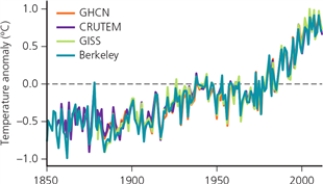 -According to the graphs,before 150 000 years ago,when did the Earth have a high average surface temperature?
 (Short Answer)
4.7/5 (76)
(76) About 90% of sunlight's melanoma-causing effects may come from exposure to ____________________ rays.
(Short Answer)
4.7/5 (74)
(74) The ____________________ Protocol is a treaty designed to help slow global warming.
(Short Answer)
4.8/5 (77)
(77) 
Filters
- Essay(0)
- Multiple Choice(0)
- Short Answer(0)
- True False(0)
- Matching(0)