



 Chat with AI
Exam 20: Air Pollution

Exam 1: Environmental Problems: an Introduction and Overview85 Questions
Exam 2: Environmental History: Learning From the Past83 Questions
Exam 3: Science, systems, matter, and Energy126 Questions
Exam 4: Ecosystems: What Are They, and How Do They Work201 Questions
Exam 5: Evolution and Biodiversity80 Questions
Exam 6: Climate and Terrestrial Biodiversity156 Questions
Exam 7: Aquatic Biodiversity99 Questions
Exam 8: Community Ecology104 Questions
Exam 9: Population Ecology90 Questions
Exam 10: Applying Population Ecology: the Human Population119 Questions
Exam 11: Sustaining Terrestrial Biodiversity: Managing and Protecting Ecosystems93 Questions
Exam 12: Sustaining Biodiversity: the Species Approach106 Questions
Exam 13: Sustaining Aquatic Biodiversity77 Questions
Exam 14: Food and Soil Resources113 Questions
Exam 15: Water Resources86 Questions
Exam 16: Geology and Nonrenewable Mineral Resources91 Questions
Exam 17: Nonrenewable Energy Resources105 Questions
Exam 18: Energy Efficiency and Renewable Energy106 Questions
Exam 19: Risk,toxicology,and Human Health116 Questions
Exam 20: Air Pollution120 Questions
Exam 21: Climate Change and Ozone Loss99 Questions
Exam 22: Water Pollution110 Questions
Exam 23: Pest Management91 Questions
Exam 24: Solid and Hazardous Waste91 Questions
Exam 25: Sustainable Cities85 Questions
Exam 26: Economics, environment, and Sustainability71 Questions
Exam 27: Politics, environment, and Sustainability65 Questions
Exam 28: Environmental World-views, ethics, and Sustainability78 Questions
Select questions type


The ________________________________________ may not be an efficient method of reducing emissions because it creates incentive to cheat and would have to be carefully monitored.
(Short Answer)
4.9/5  (77)
(77) Which substance would NOT likely cause a person to have an irritated respiratory tract on a sunny day in a large city?
(Multiple Choice)
5.0/5 (79)
(79) REACTION
 -Which letter in the diagram corresponds to a substance that is formed from the photolysis of nitrogen dioxide but can also result from stratospheric penetrations?
 (Short Answer)
4.9/5 (75)
(75) For humans,cigarette smoking is a major source of ______________________________,which is a gas that is poisonous to all air-breathing animals.
(Short Answer)
4.8/5 (62)
(62) What is one effect on human health of increased ozone in the troposphere?
(Multiple Choice)
4.9/5 (78)
(78) Which substance is a source of radon-222 in or around the home?
(Multiple Choice)
4.9/5 (73)
(73) Which U.S.president did NOT consider acid rain to be a problem when our Canadian Prime Minister approached him with the topic?
(Multiple Choice)
4.9/5 (88)
(88) Which of the following is an unlikely source of carbon monoxide?
(Multiple Choice)
4.9/5 (81)
(81) REACTION
-Which letter in the diagram corresponds to the substances that can form by the reaction of nitrogen dioxide with organic compounds?
-Which letter in the diagram corresponds to the substances that can form by the reaction of nitrogen dioxide with organic compounds? (Short Answer)
4.9/5 (99)
(99) Air pollution is worsened by burning fossil fuels,as well as by increasing carbon dioxide emissions.
(True/False)
4.9/5 (79)
(79) A(n)____________________ can be defined as any substance that,when dissolved in water,dissociates to yield corrosive hydrogen ions.
(Short Answer)
4.8/5 (85)
(85) Which pair of words describes what human activity is doing to the ozone layer in the troposphere and stratosphere,respectively?
(Multiple Choice)
4.9/5 (78)
(78) Which chronic disease would NOT likely be worsened by ozone in photochemical smog?
(Multiple Choice)
4.8/5 (95)
(95) In which area have trees been seriously affected by U.S.air pollution?
(Multiple Choice)
5.0/5 (76)
(76) ATMOSHPERE
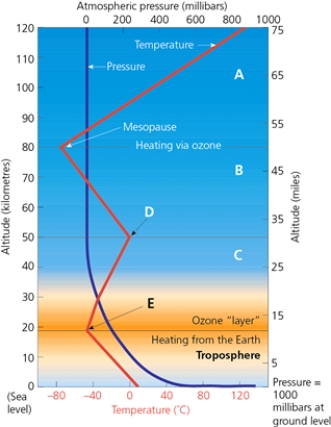 -Which letter in the diagram corresponds to the layer that contains ozone and which keeps approximately 95% of the sun's ultraviolet radiation from reaching the Earth's surface?
 (Short Answer)
4.7/5 (78)
(78) Tall smokestacks and smaller industrial plants in urban areas are beneficial because they reduce local and regional air pollution.
(True/False)
4.9/5 (81)
(81) Which of the following would represent the thickness of the lower layer of the atmosphere,if the Earth were the size of an apple?
(Multiple Choice)
4.8/5 (78)
(78) The next steps in controlling air pollution involve controlling emissions,imposing stricter standards,and taxing polluters.
(True/False)
4.8/5 (95)
(95) Tall buildings,mountains,and high temperatures all contribute to ________________________________________.
(Short Answer)
4.9/5 (74)
(74) 
Filters
- Essay(0)
- Multiple Choice(0)
- Short Answer(0)
- True False(0)
- Matching(0)