



 Chat with AI
Exam 15: Water Resources

Exam 1: Environmental Problems: an Introduction and Overview85 Questions
Exam 2: Environmental History: Learning From the Past83 Questions
Exam 3: Science, systems, matter, and Energy126 Questions
Exam 4: Ecosystems: What Are They, and How Do They Work201 Questions
Exam 5: Evolution and Biodiversity80 Questions
Exam 6: Climate and Terrestrial Biodiversity156 Questions
Exam 7: Aquatic Biodiversity99 Questions
Exam 8: Community Ecology104 Questions
Exam 9: Population Ecology90 Questions
Exam 10: Applying Population Ecology: the Human Population119 Questions
Exam 11: Sustaining Terrestrial Biodiversity: Managing and Protecting Ecosystems93 Questions
Exam 12: Sustaining Biodiversity: the Species Approach106 Questions
Exam 13: Sustaining Aquatic Biodiversity77 Questions
Exam 14: Food and Soil Resources113 Questions
Exam 15: Water Resources86 Questions
Exam 16: Geology and Nonrenewable Mineral Resources91 Questions
Exam 17: Nonrenewable Energy Resources105 Questions
Exam 18: Energy Efficiency and Renewable Energy106 Questions
Exam 19: Risk,toxicology,and Human Health116 Questions
Exam 20: Air Pollution120 Questions
Exam 21: Climate Change and Ozone Loss99 Questions
Exam 22: Water Pollution110 Questions
Exam 23: Pest Management91 Questions
Exam 24: Solid and Hazardous Waste91 Questions
Exam 25: Sustainable Cities85 Questions
Exam 26: Economics, environment, and Sustainability71 Questions
Exam 27: Politics, environment, and Sustainability65 Questions
Exam 28: Environmental World-views, ethics, and Sustainability78 Questions
Select questions type


Serious water shortages are emerging as the demand for water in many countries simply exceeds the supply,thus forcing people to live in ______________________________.
(Short Answer)
4.9/5  (77)
(77) The process of water evaporation uses large amounts of energy because of the strong forces of attraction between the water's molecules.
(True/False)
4.9/5 (83)
(83) The majority of the residential fresh water consumed in Canada is used to flush toilets and take showers.
(True/False)
4.8/5 (95)
(95) The building of the Aswan Dam in Egypt has contributed to the spread of a disease called ____________________.
(Short Answer)
4.8/5 (64)
(64) WATER
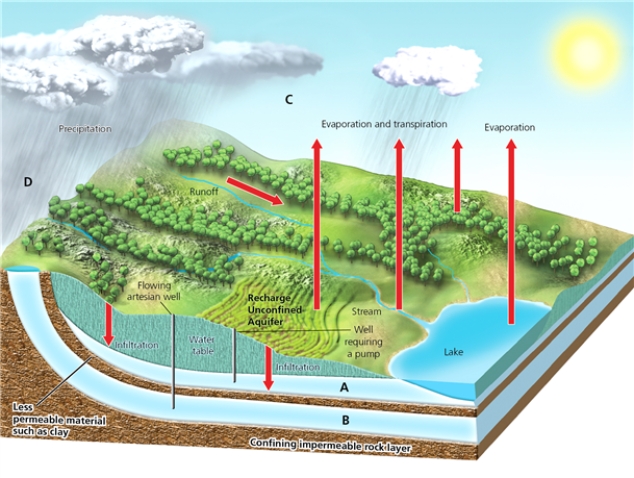 -Which letter in the diagram corresponds to the graph that represents the amount of global freshwater that is readily available to the public?
 (Short Answer)
4.8/5 (82)
(82) WATER
-Which letter in the diagram corresponds to the graph that represents the total amount of freshwater and saltwater in the world?
-Which letter in the diagram corresponds to the graph that represents the total amount of freshwater and saltwater in the world? (Short Answer)
4.8/5 (89)
(89) About 65% of water consumed by Canadian households is used for flushing toilets and taking showers.
(True/False)
4.8/5 (71)
(71) WATER
-Which letter in the diagram corresponds to an area that replenishes an aquifer by precipitation?
-Which letter in the diagram corresponds to an area that replenishes an aquifer by precipitation? (Short Answer)
4.9/5 (77)
(77) WATER
-Which letter in the diagram corresponds to an area with a water table that is replenished by infiltration?
-Which letter in the diagram corresponds to an area with a water table that is replenished by infiltration? (Short Answer)
4.9/5 (76)
(76) A(n)______________________________ system is very efficient,reduces water waste,and is adaptable.
(Short Answer)
4.9/5 (82)
(82) Building levees or floodwalls is a precautionary approach to solving flooding problems.
(True/False)
4.8/5 (75)
(75) A country is said to be water stressed when the volume of reliable runoff falls below the amount of water withdrawn.
(True/False)
4.9/5 (80)
(80) Which human activity decreases the likelihood that flooding will occur?
(Multiple Choice)
4.9/5 (81)
(81) 
Filters
- Essay(0)
- Multiple Choice(0)
- Short Answer(0)
- True False(0)
- Matching(0)