



 Chat with AI
Exam 7: Aquatic Biodiversity

Exam 1: Environmental Problems: an Introduction and Overview85 Questions
Exam 2: Environmental History: Learning From the Past83 Questions
Exam 3: Science, systems, matter, and Energy126 Questions
Exam 4: Ecosystems: What Are They, and How Do They Work201 Questions
Exam 5: Evolution and Biodiversity80 Questions
Exam 6: Climate and Terrestrial Biodiversity156 Questions
Exam 7: Aquatic Biodiversity99 Questions
Exam 8: Community Ecology104 Questions
Exam 9: Population Ecology90 Questions
Exam 10: Applying Population Ecology: the Human Population119 Questions
Exam 11: Sustaining Terrestrial Biodiversity: Managing and Protecting Ecosystems93 Questions
Exam 12: Sustaining Biodiversity: the Species Approach106 Questions
Exam 13: Sustaining Aquatic Biodiversity77 Questions
Exam 14: Food and Soil Resources113 Questions
Exam 15: Water Resources86 Questions
Exam 16: Geology and Nonrenewable Mineral Resources91 Questions
Exam 17: Nonrenewable Energy Resources105 Questions
Exam 18: Energy Efficiency and Renewable Energy106 Questions
Exam 19: Risk,toxicology,and Human Health116 Questions
Exam 20: Air Pollution120 Questions
Exam 21: Climate Change and Ozone Loss99 Questions
Exam 22: Water Pollution110 Questions
Exam 23: Pest Management91 Questions
Exam 24: Solid and Hazardous Waste91 Questions
Exam 25: Sustainable Cities85 Questions
Exam 26: Economics, environment, and Sustainability71 Questions
Exam 27: Politics, environment, and Sustainability65 Questions
Exam 28: Environmental World-views, ethics, and Sustainability78 Questions
Select questions type


In the summer in many temperate lakes,the ________________________ separates the epilimnion from the hypolimnion.
(Short Answer)
4.9/5  (65)
(65) ZONES
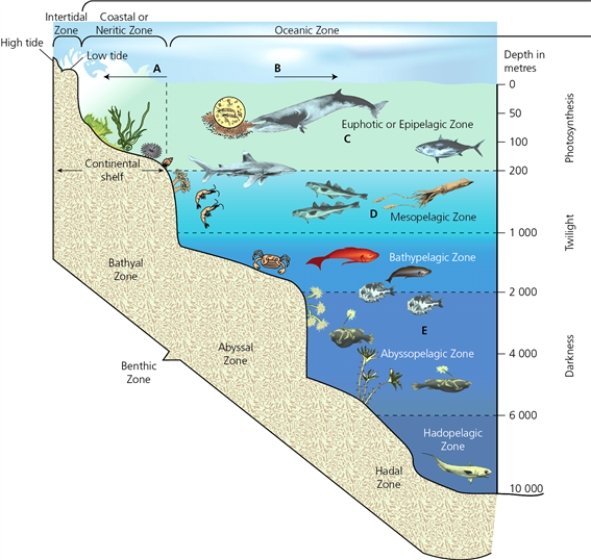 -Which letter in the diagram corresponds to the zone that contains the majority of all marine species?
 (Short Answer)
4.7/5 (69)
(69) LAND ZONES
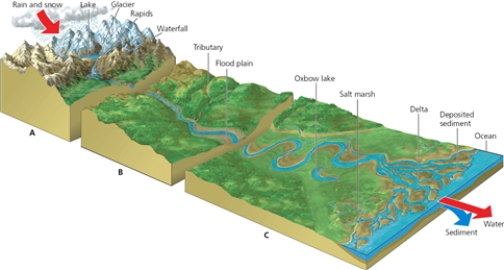 -Which letter in the diagram corresponds to the zone containing rivers that have the largest population of primary producers?
 (Short Answer)
4.9/5 (80)
(80) A major group of marine organisms that live on the bottom of the ocean are called nekton.
(True/False)
4.7/5 (76)
(76) In which areas of Canada are freshwater inland wetlands at greatest risk of being lost due to human-related activities?
(Multiple Choice)
4.8/5 (80)
(80) In which zone does most of the photosynthesis in the open sea occur?
(Multiple Choice)
4.8/5 (71)
(71) The area of shoreline between low and high tides is called the ____________________ zone.
(Short Answer)
4.9/5 (82)
(82) The aquatic equivalent of terrestrial biomes are called aquatic life zones.
(True/False)
4.9/5 (85)
(85) During which season would an ecologist expect to find a thermocline in a temperate lake?
(Multiple Choice)
4.7/5 (78)
(78) What is an advantage for populations of organisms living in water?
(Multiple Choice)
4.9/5 (77)
(77) What percentage of the world's freshwater supply is located in Canada?
(Multiple Choice)
4.9/5 (79)
(79) Currently,about _________________________ of the world's population live along coasts or within 100 kilometres of a coast.
(Short Answer)
4.8/5 (81)
(81) What would be a result of building a dam in the transition zone of a river?
(Multiple Choice)
4.9/5 (92)
(92) What is a characteristic of the floodplain zone of a river?
(Multiple Choice)
4.8/5 (83)
(83) What best describes most food chains and webs in aquatic life zones when compared to those in terrestrial biomes?
(Multiple Choice)
4.8/5 (70)
(70) Which characteristic would a marine organism that lives in the intertidal zone on a barrier beach possess?
(Multiple Choice)
4.9/5 (100)
(100) Which trees are characteristic of a tropical coastal wetland?
(Multiple Choice)
4.8/5 (81)
(81) 
Filters
- Essay(0)
- Multiple Choice(0)
- Short Answer(0)
- True False(0)
- Matching(0)