



 Chat with AI
Exam 38: Nursing Management Dysrhythmias

Exam 1: Introduction to Medical-Surgical Nursing Practice in Canada16 Questions
Exam 2: Cultural Competence and Health Equity in Nursing Care17 Questions
Exam 3: Health History and Physical Examination15 Questions
Exam 4: Patient and Caregiver Teaching19 Questions
Exam 5: Chronic Illness18 Questions
Exam 6: Community-Based Nursing and Home Care11 Questions
Exam 7: Older Adults19 Questions
Exam 8: Stress and Stress Management10 Questions
Exam 9: Sleep and Sleep Disorders11 Questions
Exam 10: Pain23 Questions
Exam 11: Substance Use22 Questions
Exam 12: Complementary and Alternative Therapies11 Questions
Exam 13: Palliative Care at the End of Life15 Questions
Exam 14: Inflammation and Wound Healing21 Questions
Exam 15: Genetics11 Questions
Exam 16: Altered Immune Response and Transplantation27 Questions
Exam 17: Infection and Human Immunodeficiency Virus Infection22 Questions
Exam 18: Cancer36 Questions
Exam 19: Fluid33 Questions
Exam 20: Nursing Management Preoperative Care22 Questions
Exam 21: Nursing Management Intraoperative Care19 Questions
Exam 22: Nursing Management Postoperative Care21 Questions
Exam 23: Nursing Assessment Visual and Auditory Systems23 Questions
Exam 24: Nursing Management Visual and Auditory Problems41 Questions
Exam 25: Nursing Assessment Integumentary System12 Questions
Exam 26: Nursing Management Integumentary Problems24 Questions
Exam 27: Nursing Management Burns29 Questions
Exam 28: Nursing Assessment Respiratory System22 Questions
Exam 29: Nursing Management Upper Respiratory Problems23 Questions
Exam 30: Nursing Management Lower Respiratory Problems43 Questions
Exam 31: Nursing Management Obstructive Pulmonary Diseases42 Questions
Exam 32: Nursing Assessment Hematological System16 Questions
Exam 33: Nursing Management Hematological Problems39 Questions
Exam 34: Nursing Assessment Cardiovascular System20 Questions
Exam 35: Nursing Management Hypertension23 Questions
Exam 36: Nursing Management Coronary Artery Disease and Acute Coronary Syndrome37 Questions
Exam 37: Nursing Management Heart Failure23 Questions
Exam 38: Nursing Management Dysrhythmias27 Questions
Exam 39: Nursing Management Inflammatory and Structural Heart Disorders28 Questions
Exam 40: Nursing Management Vascular Disorders31 Questions
Exam 41: Nursing Assessment Gastro-intestinal System16 Questions
Exam 42: Nursing Management Nutritional Problems23 Questions
Exam 43: Nursing Management Obesity19 Questions
Exam 44: Nursing Management Upper Gastro-intestinal Problems42 Questions
Exam 45: Nursing Management Lower Gastro-intestinal Problems46 Questions
Exam 46: Nursing Management Liver40 Questions
Exam 47: Nursing Assessment Urinary System22 Questions
Exam 48: Nursing Management Renal and Urologic Problems39 Questions
Exam 49: Nursing Management Acute Kidney Injury and Chronic Kidney Disease36 Questions
Exam 50: Nursing Assessment Endocrine System20 Questions
Exam 51: Nursing Management Endocrine Problems39 Questions
Exam 52: Nursing Management Diabetes Mellitus39 Questions
Exam 53: Nursing Assessment Reproductive System18 Questions
Exam 54: Nursing Management Breast Disorders25 Questions
Exam 55: Nursing Management Sexually Transmitted Infections16 Questions
Exam 56: Nursing Management Female Reproductive Problems42 Questions
Exam 57: Nursing Management Male Reproductive Problems27 Questions
Exam 58: Nursing Assessment Nervous System20 Questions
Exam 59: Nursing Management Acute Intracranial Problems36 Questions
Exam 60: Nursing Management Stroke29 Questions
Exam 61: Nursing Management Chronic Neurological Problems33 Questions
Exam 62: Nursing Management Delirium16 Questions
Exam 63: Nursing Management Peripheral Nerve and Spinal Cord Problems29 Questions
Exam 64: Nursing Assessment Musculo-skeletal System16 Questions
Exam 65: Nursing Management Musculo-skeletal Trauma and Orthopedic Surgery40 Questions
Exam 66: Nursing Management Musculo-skeletal Problems19 Questions
Exam 67: Nursing Management Arthritis and Connective Tissue Diseases42 Questions
Exam 68: Nursing Management Critical Care Environment37 Questions
Exam 69: Nursing Management Shock25 Questions
Exam 70: Nursing Management Respiratory Failure and Acute Respiratory Distress Syndrome23 Questions
Exam 71: Nursing Management Emergency Care Situations24 Questions
Exam 72: Emergency Management and Disaster Planning24 Questions
Select questions type


The nurse is caring for a client who was admitted with a myocardial infarction and experiences a 50-second episode of ventricular tachycardia, then converts to sinus rhythm with a heart rate of 98 beats/minute. Which of the following actions should the nurse take next?

Free
(Multiple Choice)
4.9/5  (88)
(88) Correct Answer: Verified
C
The nurse is caring for a young adult client who had a mandatory electrocardiogram (ECG) before participating on a college swim team and is found to have sinus bradycardia, rate 52. BP is 114/54 mm Hg, and the student denies any health problems. Which of thefollowing actions by the nurse is best?
Free
(Multiple Choice)
4.8/5 (83)
(83) Correct Answer:Verified
VerifiedA
Which of the following actions should the nurse take when preparing for cardioversion of a client with supraventricular tachycardia who is alert and has a blood pressure of 110/66 mm Hg?
Free
(Multiple Choice)
4.9/5 (82)
(82) Correct Answer:Verified
VerifiedD
The nurse is caring for a client who has a ST segment change that indicates an acute inferior wall myocardial infarction. Which of the following leads is best for monitoring the client?
(Multiple Choice)
5.0/5 (86)
(86) The nurse is caring for a client who has been experiencing dizziness and shortness of breath for several days. During cardiac monitoring in the emergency department (ED), the nurse obtains the following electrocardiographictracing. 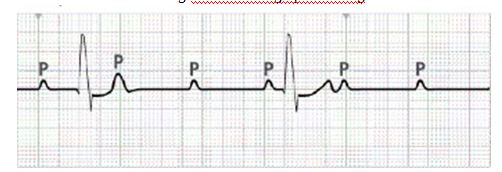 Which of the following cardiac rhythms should the nurse identify?
 (Multiple Choice)
4.9/5 (73)
(73) The nurse needs to estimate quickly the heart rate for a client with a regular heart rhythm. Which of the following methods is best to use?
(Multiple Choice)
4.7/5 (103)
(103) The nurse is analyzing an electrocardiographic rhythm strip of a client with a regular cardiac rhythm and finds there are 25 small blocks from one R wave to the next. The nurse calculates the client's heart rate as beats per minute.
(Short Answer)
4.8/5 (91)
(91) The nurse is caring for a client with dilated cardiomyopathy who has an atrial fibrillation that has been unresponsive to drug therapy for several days. Which of the following actions should the nurse anticipate?
(Multiple Choice)
4.8/5 (86)
(86) The nurse administers IV atropine to a client with symptomatic type 1, second-degree atrioventricular (AV) block. Which of the following findings indicate that the medication has been effective?
(Multiple Choice)
4.8/5 (83)
(83) The nurse is caring for a client who is on the telemetry unit and develops atrial flutter, rate 150, with associated dyspnea and diaphoresis. Which of the following actions that are included in the hospital dysrhythmia protocol should the nurse take first?
(Multiple Choice)
4.7/5 (79)
(79) When analyzing the waveforms of a client's electrocardiogram (ECG), the nurse will need to investigate further upon assessing which of the following findings?
(Multiple Choice)
4.9/5 (90)
(90) The nurse is caring for a client whose cardiac monitor shows sinus tachycardia, rate 102, and is apneic with no pulses are palpable by the nurse. Which of the following actions should the nurse do first?
(Multiple Choice)
4.7/5 (88)
(88) The nurse is caring for a client who requires defibrillation. In which order will the nurse accomplish the following steps?
(Multiple Choice)
4.9/5 (80)
(80) The nurse is providing instruction to a client on the management of a new implantable cardioverter-defibrillator (ICD). Which of the following client statements indicate that the teaching has been effective?
(Multiple Choice)
4.9/5 (70)
(70) The nurse has received change-of-shift report about the following clients on the telemetry unit. Which of the following clients should the nurse see first?
(Multiple Choice)
4.8/5 (65)
(65) The nurse is interpreting an ECG strip to determine whether there is a delay in impulse conduction through the atria. Which of the following components of an ECG strip should the nurse measure?
(Multiple Choice)
4.8/5 (78)
(78) Which of the following information will the nurse include when teaching a client who is scheduled to have a permanent pacemaker inserted for treatment of chronic atrial fibrillation with slow ventricular response?
(Multiple Choice)
4.8/5 (75)
(75) The nurse obtains a monitor strip on a client who has had a myocardial infarction and makes the following analysis: P wave not apparent, ventricular rate 162, R-R interval regular, P-R interval not measurable, and QRS complex wide and distorted, QRS duration 0.18 second. Which of the following cardiac rhythms should the nurse interpret from these findings?
(Multiple Choice)
4.9/5 (79)
(79) The nurse is caring for a client whose cardiac monitor shows sinus rhythm, rate 60-70. The P-R interval is 0.18 seconds at 1:00 A.M., 0.20 seconds at 2:30 P.M., and 0.23 seconds at 4:00 P.M. Which of the following actions should the nurse take at this time?
(Multiple Choice)
4.9/5 (85)
(85) Which of the following actions by a new nurse who is caring for a client who has just had an implantable cardioverter-defibrillator (ICD) inserted indicates a need for more education about care of clients with ICDs?
(Multiple Choice)
4.9/5 (77)
(77) 
Filters
- Essay(0)
- Multiple Choice(0)
- Short Answer(0)
- True False(0)
- Matching(0)