



 Chat with AI
Exam 9: Cardiac Physiology

Exam 1: Introduction to Physiology and Homeostasis115 Questions
Exam 2: Cell Physiology207 Questions
Exam 3: The Plasma Membrane and Membrane Potential250 Questions
Exam 4: Principles of Neural and Hormonal Communication231 Questions
Exam 5: The Central Nervous System323 Questions
Exam 6: The Peripheral Nervous System: Afferent Division Special Senses280 Questions
Exam 7: The Peripheral Nervous System: Efferent Division175 Questions
Exam 8: Muscle Physiology321 Questions
Exam 9: Cardiac Physiology300 Questions
Exam 10: The Blood Vessels and Blood Pressure249 Questions
Exam 11: The Blood242 Questions
Exam 12: Body Defenses250 Questions
Exam 13: The Respiratory System283 Questions
Exam 14: The Urinary System316 Questions
Exam 15: Fluid and Acid-Base Balance291 Questions
Exam 16: The Digestive System318 Questions
Exam 17: Energy Balance and Temperature Regulation175 Questions
Exam 18: Principles of Endocrinology: the Central Endocrine Glands289 Questions
Exam 19: The Peripheral Endocrine Glands344 Questions
Exam 20: The Reproductive System330 Questions
Select questions type


Match EKG feature with the correct characteristic.
a.P wave
b.QRS complex
c.T wave
d.PR interval
e.TP interval
f.ST segment
-Time when threshold voltage is reached in pacemaker cells
(Short Answer)
4.8/5  (75)
(75) An increase in parasympathetic activity ____________________ the atrial contractility.
(Short Answer)
5.0/5 (80)
(80) A pacemaker potential depends on the increased inward current of calcium ions.
(True/False)
4.9/5 (72)
(72) Indicate which valve abnormality is being described using the answer code below.
a.valvular stenosis
b.valvular insufficiency
-Valve does not close completely
(Short Answer)
4.7/5 (82)
(82) With 2:1 rhythm, the atrial rate is very rapid and the ventricular rate is normal or above normal, whereas with 2:1 block, the atrial rate is normal but the ventricular rate is below normal.
(True/False)
4.8/5 (62)
(62) The ____________________ are the kinds of blood vessels that experience congestion for congestive heart failure.
(Short Answer)
4.8/5 (94)
(94) 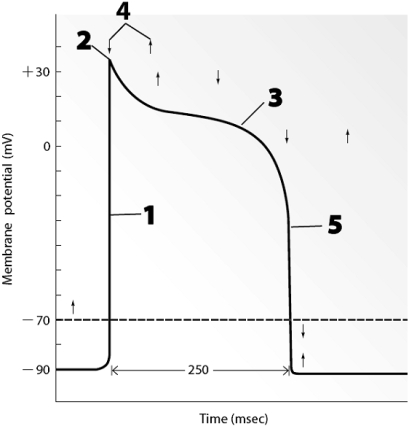 Use this figure to answer the corresponding questions.
-Identify the location(s) that indicates when fast calcium channels open within the cell.
a.1
b.2 and 3
c.2, 3, and 4
d.1 and 4
e.There are no fast calcium channels in these cells.
Use this figure to answer the corresponding questions.
-Identify the location(s) that indicates when fast calcium channels open within the cell.
a.1
b.2 and 3
c.2, 3, and 4
d.1 and 4
e.There are no fast calcium channels in these cells. (Short Answer)
4.8/5 (77)
(77) Use the following answer code to compare the magnitude of the items in question.
a.A is greater than b.b.B is greater than a.c.A and B are equal or nearly equal.
-a.Spontaneous rate of depolarization in the SA node
B.Spontaneous rate of depolarization in the ventricles
(Short Answer)
5.0/5 (75)
(75) Which is the normal sequence of the spread of cardiac excitation?
1)AV node
2)SA node
3)atria
4)Purkinje fibers
5)bundle of His
6)ventricular myocardium
(Multiple Choice)
4.9/5 (87)
(87) The stroke volume is the total volume of blood ejected by both ventricles each minute.
(True/False)
4.8/5 (102)
(102) The _____ phase of the action potential in _____ cells is due to a _____.
(Multiple Choice)
4.8/5 (82)
(82) Increased ____ permeability of nodal cells hyperpolarizes the SA node.
(Multiple Choice)
4.8/5 (79)
(79) Indicate which ion is involved in each event being described by using the following answer code.
a.K+
b.Na+
c.Ca₂₊
-The rapid falling phase of the cardiac action potential is brought about primarily by the outward diffusion of _____.
(Short Answer)
4.8/5 (95)
(95) The extent of ventricular filling is the preload of the heart, whereas the magnitude of the arterial blood pressure is the afterload of the heart.
(True/False)
4.8/5 (79)
(79) What percentage of ventricular filling is normally accomplished before atrial contraction begins?
(Multiple Choice)
4.7/5 (83)
(83) The ____________________ delay ensures that atrial systole is complete before ventricular systole begins.
(Short Answer)
4.7/5 (87)
(87) 
Filters
- Essay(0)
- Multiple Choice(0)
- Short Answer(0)
- True False(0)
- Matching(0)