



 Chat with AI
Exam 3: The Plasma Membrane and Membrane Potential

Exam 1: Introduction to Physiology and Homeostasis115 Questions
Exam 2: Cell Physiology207 Questions
Exam 3: The Plasma Membrane and Membrane Potential250 Questions
Exam 4: Principles of Neural and Hormonal Communication231 Questions
Exam 5: The Central Nervous System323 Questions
Exam 6: The Peripheral Nervous System: Afferent Division Special Senses280 Questions
Exam 7: The Peripheral Nervous System: Efferent Division175 Questions
Exam 8: Muscle Physiology321 Questions
Exam 9: Cardiac Physiology300 Questions
Exam 10: The Blood Vessels and Blood Pressure249 Questions
Exam 11: The Blood242 Questions
Exam 12: Body Defenses250 Questions
Exam 13: The Respiratory System283 Questions
Exam 14: The Urinary System316 Questions
Exam 15: Fluid and Acid-Base Balance291 Questions
Exam 16: The Digestive System318 Questions
Exam 17: Energy Balance and Temperature Regulation175 Questions
Exam 18: Principles of Endocrinology: the Central Endocrine Glands289 Questions
Exam 19: The Peripheral Endocrine Glands344 Questions
Exam 20: The Reproductive System330 Questions
Select questions type


The following questions refer to comparative concentrations, permeabilities, and potentials under various circumstances.Indicate the relationship between the two items listed in each situation using the following answer code.
a.A is greater than B
b.B is greater than A
c.A and B are equal
-a.amount of Na⁺ transported out of the cell
B.amount of K⁺ transported into the cell
(Short Answer)
4.8/5  (69)
(69) In facilitated diffusion, particles move from a(n) ____________________ concentration to a(n) ____________________ concentration.
(Short Answer)
4.9/5 (83)
(83) The resting membrane potential of a typical nerve cell is ____ mV.
(Multiple Choice)
4.7/5 (89)
(89) Indicate whether the force in question tends to move the involved ion into or out of the cell by filling in the blank using the following code.
a.tends to move the ion into the cell
b.tends to move out of the cell
-Electrical gradient for Na⁺ at resting potential
(Short Answer)
4.8/5 (80)
(80) The following questions refer to comparative concentrations, permeabilities, and potentials under various circumstances.Indicate the relationship between the two items listed in each situation using the following answer code.
a.A is greater than B
b.B is greater than A
c.A and B are equal
-a.concentration gradient for K⁺ at EK₊
B.electrical gradient for K⁺ at EK₊
(Short Answer)
4.7/5 (80)
(80) Indicate the various roles of the following ions using the answer in the column below.
a.Na+
b.K+
c.A-
d.Cl-
-Anion in greatest concentration in the ICF
(Short Answer)
4.8/5 (84)
(84) According to the Nernst equation, the equilibrium potential for a given ion decreases as the difference in concentration of the ion outside and inside the cell increases.
(True/False)
4.9/5 (75)
(75) Indicate the various roles of the following ions using the answer in the column below.
a.Na+
b.K+
c.A-
d.Cl-
-Ion whose equilibrium potential is opposite in charge of the resting membrane potential
(Short Answer)
4.8/5 (79)
(79) Match the term to the correct description.
a.collagen
b.elastin
c.fibronectin
d.keratin
-Serves as carriers to transport particles across the membrane
(Short Answer)
5.0/5 (78)
(78) 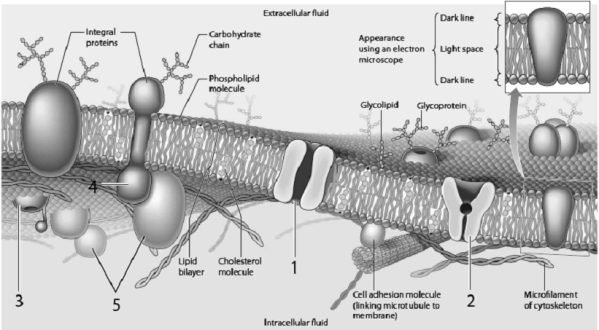 Use the figure above to answer the corresponding questions.
-Which protein might be an ATPase?
a.1
b.2
c.3
d.4
e.5
Use the figure above to answer the corresponding questions.
-Which protein might be an ATPase?
a.1
b.2
c.3
d.4
e.5 (Short Answer)
4.8/5 (75)
(75) 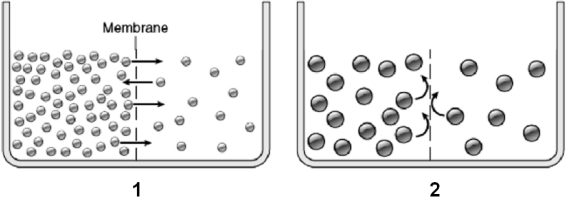 Use the figure above to answer the corresponding questions.Assume the membrane is always permeable to water.
-In beaker 2, the solution on the right side of the membrane
a.has a higher osmolarity than the solution on the left side of the membrane
b.will gain water from the solution on the left side of the membrane
c.has a lower osmotic pressure than the solution on the left side of the membrane
d.has a higher osmolarity than the solution on the left side of the membrane and will gain water from the solution on the left side of the membrane
e.none of these
Use the figure above to answer the corresponding questions.Assume the membrane is always permeable to water.
-In beaker 2, the solution on the right side of the membrane
a.has a higher osmolarity than the solution on the left side of the membrane
b.will gain water from the solution on the left side of the membrane
c.has a lower osmotic pressure than the solution on the left side of the membrane
d.has a higher osmolarity than the solution on the left side of the membrane and will gain water from the solution on the left side of the membrane
e.none of these (Short Answer)
4.9/5 (75)
(75) Cadherins are docking-marker acceptors to which secretory vesicles bind prior to exocytosis.
(True/False)
4.8/5 (79)
(79) Placing pure water around cells causes the cells to swell because the cytosol has a lower osmotic pressure than the pure water.
(True/False)
4.9/5 (73)
(73) Match the term to the correct description.
a.collagen
b.elastin
c.fibronectin
d.keratin
-Extracellular protein promoting cell adhesion
(Short Answer)
4.9/5 (70)
(70) The rate of diffusion for water-soluble substances through a membrane decreases as
(Multiple Choice)
5.0/5 (79)
(79) Which of the following is most closely related to transcellular transport?
(Multiple Choice)
4.8/5 (72)
(72) 
Filters
- Essay(0)
- Multiple Choice(0)
- Short Answer(0)
- True False(0)
- Matching(0)