



 Chat with AI
Exam 17: Monetary Policy

Exam 1: Getting Started350 Questions
Exam 2: The Usand Global Economies199 Questions
Exam 3: The Economic Problem271 Questions
Exam 4: Demand and Supply317 Questions
Exam 5: Gdp: a Measure of Total Production and Income254 Questions
Exam 6: Jobs and Unemployment343 Questions
Exam 7: The Cpi and the Cost of Living265 Questions
Exam 8: Potential Gdp and the Natural Unemployment Rate207 Questions
Exam 9: Economic Growth267 Questions
Exam 10: Finance, Saving, and Investment269 Questions
Exam 11: The Monetary System361 Questions
Exam 12: Money, Interest, and Inflation261 Questions
Exam 13: Aggregate Supply and Aggregate Demand272 Questions
Exam 14: Aggregate Expenditure Multiplier311 Questions
Exam 15: The Short-Run Policy Tradeoff208 Questions
Exam 16: Fiscal Policy203 Questions
Exam 17: Monetary Policy188 Questions
Exam 18: International Trade Policy218 Questions
Exam 19: International Finance255 Questions
Select questions type


Suppose the Federal Reserve lowers the federal funds rate.Put the following changes in order in which they occur, starting with the changes that take place almost immediately and ending with the changes that may occur up to a year afterwards: i. quantity of money increases
Ii) quantity of reserves increases
Iii) aggregate demand increases
Iv) the long-term real interest rate falls
(Multiple Choice)
4.9/5  (81)
(81) 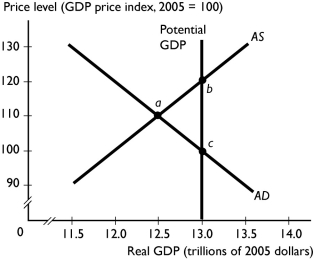 -The economy is at the equilibrium shown as point a in the above figure.To restore the economy to potential GDP, the Fed should
 (Multiple Choice)
4.8/5 (81)
(81) If the Fed lowers the federal funds rate, which of the following will NOT happen?
(Multiple Choice)
4.9/5 (89)
(89) When the Fed lowers the federal funds rate, the quantity of money ________ and the supply of loanable funds ________.
(Multiple Choice)
4.8/5 (68)
(68) When the Fed lowers the federal funds rate, which of the following economic variables responds most rapidly?
(Multiple Choice)
4.9/5 (78)
(78) Which monetary policy rule needs a stable demand for money to work well?
(Multiple Choice)
4.9/5 (86)
(86) In the short run, when the Fed raises the federal funds rate,
(Multiple Choice)
4.9/5 (85)
(85) Which of the following is a monetary policy goal?
i. keeping the inflation rate low
ii. attaining maximum employment
iii. keeping the long-term interest rate at a moderate level
(Multiple Choice)
5.0/5 (70)
(70) When would the Fed want to carry out a monetary policy that decreases aggregate demand?
(Essay)
4.7/5 (66)
(66) Explain how the Fed's response to inflation works its through the economy to ultimately affecting real GDP and the price level.
(Essay)
4.9/5 (86)
(86) Maximum employment and moderate long-term interest rates are best achieved with
(Multiple Choice)
4.9/5 (81)
(81) The monetary policy instrument the Federal Reserve choose to use is the
(Multiple Choice)
4.9/5 (75)
(75) Describe the main difference between the core inflation rate and the PCE inflation rate.
(Essay)
4.8/5 (74)
(74) In a recession, the Fed's monetary policy aims to ________ the real interest rate, ________ aggregate demand, and ________ aggregate supply.
(Multiple Choice)
4.9/5 (80)
(80) 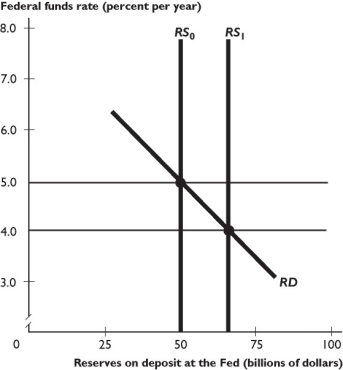 The figure above shows the market for reserves.
-To shift the RS curve rightward as illustrated, the Fed has ________ government securities in the open market.The Fed will undertake this type of policy if it is concerned about ________.
The figure above shows the market for reserves.
-To shift the RS curve rightward as illustrated, the Fed has ________ government securities in the open market.The Fed will undertake this type of policy if it is concerned about ________. (Multiple Choice)
4.8/5 (80)
(80) When there is a threat of inflation in the economy, the Fed can ________ the federal funds rate so to ________ aggregate demand and ________ the price level.
(Multiple Choice)
4.8/5 (60)
(60) In late 2007, the Fed began a series of cuts in the federal funds rate.Because the core inflation rate was about two percent, the most likely reason for these interest rate cuts was
(Multiple Choice)
4.8/5 (88)
(88) What is the main difference between an instrument rule and a targeting rule.Be sure to define each.
(Essay)
4.9/5 (67)
(67) 
Filters
- Essay(0)
- Multiple Choice(0)
- Short Answer(0)
- True False(0)
- Matching(0)