



 Chat with AI
Exam 20: The Heart

Exam 1: An Introduction to Anatomy and Physiology95 Questions
Exam 2: The Chemical Level of Organization183 Questions
Exam 3: The Cellular Level of Organization190 Questions
Exam 4: The Tissue Level of Organization139 Questions
Exam 5: The Integumentary System118 Questions
Exam 6: Bones and Bone Structure165 Questions
Exam 7: The Axial Skeleton146 Questions
Exam 8: The Appendicular Skeleton119 Questions
Exam 9: Joints134 Questions
Exam 10: Muscle Tissue137 Questions
Exam 11: The Muscular System152 Questions
Exam 12: Nervous Tissue158 Questions
Exam 13: The Spinal Cord, Spinal Nerves, and Spinal Reflexes115 Questions
Exam 14: The Brain and Cranial Nerves187 Questions
Exam 15: Sensory Pathways and the Somatic Nervous System125 Questions
Exam 16: The Autonomic Nervous System and Higher-Order Functions129 Questions
Exam 17: The Special Senses170 Questions
Exam 18: The Endocrine System188 Questions
Exam 19: Blood162 Questions
Exam 20: The Heart178 Questions
Exam 21: Blood Vessels and Circulation225 Questions
Exam 22: The Lymphatic System and Immunity167 Questions
Exam 23: The Respiratory System200 Questions
Exam 24: The Digestive System213 Questions
Exam 25: Metabolism, Nutrition, and Energetics140 Questions
Exam 26: The Urinary System137 Questions
Exam 27: Fluid, Electrolyte, and Acid-Base Balance66 Questions
Exam 28: The Reproductive System203 Questions
Exam 29: Development and Inheritance146 Questions
Select questions type


Figure 20-2 Cardiac Cycle
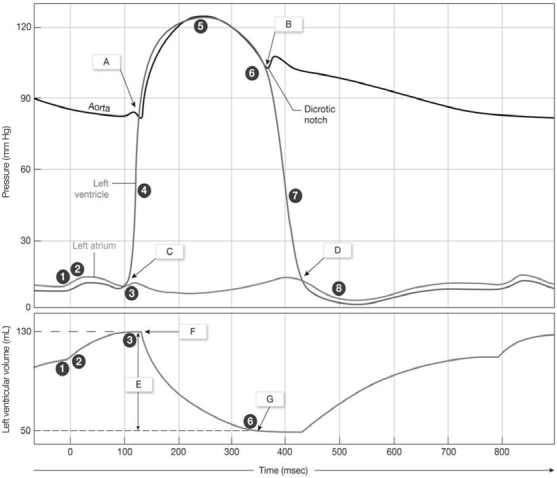 Use Figure 20-2 to answer the following questions:
-What occurs at the area labeled "C" on the graph?
Use Figure 20-2 to answer the following questions:
-What occurs at the area labeled "C" on the graph? (Multiple Choice)
4.8/5  (75)
(75) Which of the following describes what is directly measured by an ECG?
(Multiple Choice)
4.8/5 (76)
(76) An ECG is used to diagnose all of the following conditions except
(Multiple Choice)
4.9/5 (86)
(86) If the pacemaker cells in the SA node become more permeable to potassium ions, the
(Multiple Choice)
4.9/5 (81)
(81) Pacemaker cells isolated from the SA node generate action potentials at ________ beats per minute.
(Multiple Choice)
4.9/5 (82)
(82) The marginal branch and posterior interventricular branch are branches of the
(Multiple Choice)
4.9/5 (76)
(76) A tumor on the adrenal gland increasing catecholamine release will cause all of the following cardiovascular responses except
(Multiple Choice)
4.8/5 (75)
(75) Figure 20-2 Cardiac Cycle
Use Figure 20-2 to answer the following questions:
-What volume is labeled "E" on the graph?
Use Figure 20-2 to answer the following questions:
-What volume is labeled "E" on the graph? (Multiple Choice)
4.8/5 (71)
(71) Thick projections of muscle in the ventricles that anchor chordae tendineae are called
(Multiple Choice)
4.9/5 (77)
(77) Heart rate is controlled by neurons of the cardiovascular center located in the
(Multiple Choice)
4.8/5 (74)
(74) These structures keep the aortic valve cusps from sticking to the wall of the aorta.
(Multiple Choice)
4.9/5 (77)
(77) 
Filters
- Essay(0)
- Multiple Choice(0)
- Short Answer(0)
- True False(0)
- Matching(0)