



 Chat with AI
Exam 16: Fiscal Policy

Exam 1: Economics: Foundations and Models146 Questions
Exam 2: Trade-Offs, comparative Advantage, and the Market System153 Questions
Exam 3: Where Prices Come From: the Interaction of Demand and Supply147 Questions
Exam 4: Economic Efficiency, government Price Setting, and Taxes138 Questions
Exam 5: The Economics of Health Care115 Questions
Exam 6: Firms, the Stock Market, and Corporate Governance141 Questions
Exam 7: Comparative Advantage and the Gains From International Trade123 Questions
Exam 8: Gdp: Measuring Total Production and Income134 Questions
Exam 9: Unemployment and Inflation148 Questions
Exam 10: Economic Growth, the Financial System, and Business Cycles130 Questions
Exam 11: Long-Run Economic Growth: Sources and Policies141 Questions
Exam 12: Aggregate Expenditure and Output in the Short Run154 Questions
Exam 13: Aggregate Demand and Aggregate Supply Analysis145 Questions
Exam 14: Money, banks, and the Federal Reserve System146 Questions
Exam 15: Monetary Policy137 Questions
Exam 16: Fiscal Policy157 Questions
Exam 17: Inflation, unemployment, and Federal Reserve Policy130 Questions
Exam 18: Macroeconomics in an Open Economy142 Questions
Exam 19: The International Financial System132 Questions
Select questions type


Illustrate and explain the effects of tax reduction and simplification using the dynamic aggregate demand and supply model.To simplify the analysis,assume that aggregate demand is not affected by the tax cut.
(Essay)
4.9/5  (88)
(88) If we include consideration of potential effects of a proposed tax reduction and simplification on the labor supply,we would expect crowding out of investment and net exports brought about by the tax cut to be
(Multiple Choice)
4.9/5 (92)
(92) Table 27-3
 -Refer to Table 27-3.Consider the hypothetical information in the table above for potential real GDP,real GDP and the price level in 2013 and in 2014 if the Congress and the president do not use fiscal policy.If the Congress and the president use fiscal policy successfully to keep real GDP at its potential level in 2014,which of the following will be higher than if the Congress and the president had taken no action?
 (Multiple Choice)
4.7/5 (73)
(73) A government tax rebate of $1,000 would ________ your disposable income by ________.
(Multiple Choice)
4.8/5 (91)
(91) Describe the differences (in sign and relative magnitude)between the government purchases multiplier and the tax multiplier.
(Essay)
4.7/5 (70)
(70) The multiplier effect is the series of ________ increases in ________ expenditures that result from an initial increase in ________ expenditures.
(Multiple Choice)
5.0/5 (72)
(72) When President Obama took office in January 2009,he pledged to pursue an expansionary fiscal policy to try to pull the economy out of the recession.The next month,Congress passed the American Recovery and Reinvestment Act of 2009,a $787 billion package of ________ that was the largest fiscal policy action in U.S.history.
(Multiple Choice)
4.8/5 (83)
(83) The government budget for the country of Economia is in surplus in 2011,and in deficit in the following year,2012. We can conclude the
(Multiple Choice)
4.8/5 (63)
(63) Figure 27-8
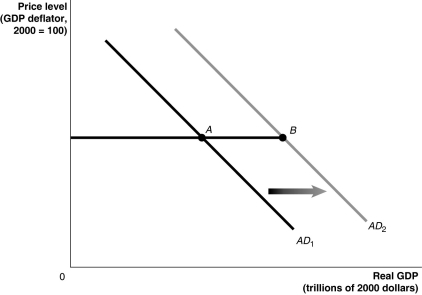 -Refer to Figure 27-8.If government purchases increase by $100 billion and lead to an ultimate increase in aggregate demand as shown in the graph below,the difference in real GDP between point A and point B will be
 (Multiple Choice)
4.8/5 (91)
(91) Figure 27-3
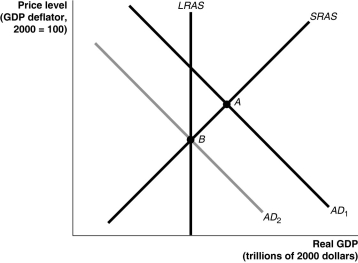 -Refer to Figure 27-3.In the graph above,suppose the economy is initially at point A.The movement of the economy to point B as shown in the graph illustrates the effect of which of the following policy actions by the Congress and the president?
 (Multiple Choice)
4.9/5 (84)
(84) Consider the following statement,"The Federal Reserve fights recessions by increasing the money supply so people will have more money to spend." What is wrong with the statement and how can it be corrected?
(Essay)
4.9/5 (67)
(67) The double taxation problem occurs because households pay taxes on dividends and capital gains from stock and they pay taxes on income.
(True/False)
4.9/5 (68)
(68) The federal government debt as a percentage of GDP did not rise
(Multiple Choice)
4.8/5 (86)
(86) To complement actions by the Fed to reduce inflation,Congress and the President can cut spending and/or raise taxes.
(True/False)
4.9/5 (79)
(79) Which of the following is an appropriate discretionary fiscal policy if equilibrium real GDP falls below potential real GDP?
(Multiple Choice)
4.7/5 (82)
(82) An increase in government spending lowers interest rates and increases the rate of investment in new capital.
(True/False)
4.8/5 (81)
(81) The level of crowding out associated with a tax cut will be larger if the tax change has a supply-side effect than it will be if it only has a demand-side effect.
(True/False)
4.8/5 (85)
(85) The federal government debt ________ when the federal government runs a deficit and ________ when the federal government runs a surplus.
(Multiple Choice)
4.8/5 (85)
(85) 
Filters
- Essay(0)
- Multiple Choice(0)
- Short Answer(0)
- True False(0)
- Matching(0)