



 Chat with AI
Exam 4: Economic Efficiency, government Price Setting, and Taxes

Exam 1: Economics: Foundations and Models146 Questions
Exam 2: Trade-Offs, comparative Advantage, and the Market System153 Questions
Exam 3: Where Prices Come From: the Interaction of Demand and Supply147 Questions
Exam 4: Economic Efficiency, government Price Setting, and Taxes138 Questions
Exam 5: The Economics of Health Care115 Questions
Exam 6: Firms, the Stock Market, and Corporate Governance141 Questions
Exam 7: Comparative Advantage and the Gains From International Trade123 Questions
Exam 8: Gdp: Measuring Total Production and Income134 Questions
Exam 9: Unemployment and Inflation148 Questions
Exam 10: Economic Growth, the Financial System, and Business Cycles130 Questions
Exam 11: Long-Run Economic Growth: Sources and Policies141 Questions
Exam 12: Aggregate Expenditure and Output in the Short Run154 Questions
Exam 13: Aggregate Demand and Aggregate Supply Analysis145 Questions
Exam 14: Money, banks, and the Federal Reserve System146 Questions
Exam 15: Monetary Policy137 Questions
Exam 16: Fiscal Policy157 Questions
Exam 17: Inflation, unemployment, and Federal Reserve Policy130 Questions
Exam 18: Macroeconomics in an Open Economy142 Questions
Exam 19: The International Financial System132 Questions
Select questions type


The area above the market supply curve and below the market price is equal to the
(Multiple Choice)
4.8/5  (74)
(74) Table 4-3
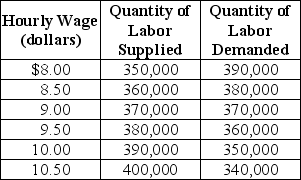 Table 4-3 shows the demand and supply schedules for the low-skilled labor market in the city of Westover.
-Refer to Table 4-3.If a minimum wage of $9.50 an hour is mandated,what is the quantity of labor demanded?
Table 4-3 shows the demand and supply schedules for the low-skilled labor market in the city of Westover.
-Refer to Table 4-3.If a minimum wage of $9.50 an hour is mandated,what is the quantity of labor demanded? (Multiple Choice)
4.8/5 (73)
(73) Figure 4-1
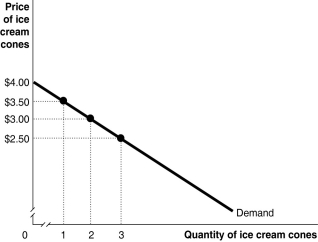 Figure 4-1 shows Kendra's demand for ice-cream cones curve.
-The difference between the lowest price a firm would have been willing to accept and the price it actually receives from the sale of a product is called
Figure 4-1 shows Kendra's demand for ice-cream cones curve.
-The difference between the lowest price a firm would have been willing to accept and the price it actually receives from the sale of a product is called (Multiple Choice)
4.8/5 (79)
(79) The maximum price that a buyer is willing to pay for a good measures his
(Multiple Choice)
4.9/5 (84)
(84) When ________ in a market,the total net benefit to society is maximized.
(Multiple Choice)
4.9/5 (85)
(85) The willingness of consumers to buy a product at different prices is shown on a
(Multiple Choice)
5.0/5 (72)
(72) The sum of consumer surplus and producer surplus is equal to
(Multiple Choice)
4.8/5 (64)
(64) FICA is a payroll tax imposed on employers and workers that is used to fund Social Security and Medicare. Which of the following statements regarding the tax is true?
(Multiple Choice)
4.9/5 (90)
(90) A tax is imposed on employers and workers that are used to fund Social Security and Medicare. This tax is sometimes referred to as
(Multiple Choice)
4.8/5 (74)
(74) Figure 4-4
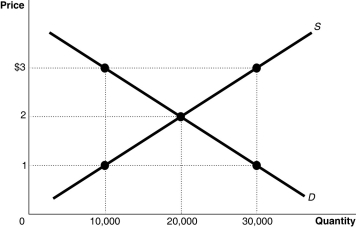 -Refer to Figure 4-4. The figure above represents the market for iced tea. Assume that this is a competitive market. Which of the following is true?
 (Multiple Choice)
4.9/5 (89)
(89) The additional benefit to a consumer from consuming one more unit of a good or service
(Multiple Choice)
5.0/5 (87)
(87) Increases in the minimum wage are intended to raise the incomes of low-income workers.Many economists favor a different policy to achieve this goal,a policy that avoids the deadweight losses that result from the minimum wage. What is this policy?
(Multiple Choice)
4.7/5 (89)
(89) The additional cost to a firm of producing one more unit of a good or service is the
(Multiple Choice)
4.8/5 (80)
(80) Figure 4-4
-Refer to Figure 4-4. The figure above represents the market for iced tea. Assume that this is a competitive market. If the price of iced tea is $3,what changes in the market would result in an economically efficient output?
-Refer to Figure 4-4. The figure above represents the market for iced tea. Assume that this is a competitive market. If the price of iced tea is $3,what changes in the market would result in an economically efficient output? (Multiple Choice)
4.9/5 (85)
(85) Table 4-5
 -Refer to Table 4-5. The equations above describe the demand and supply for Aunt Maud's Premium Hand Lotion. The equilibrium price and quantity for Aunt Maud's lotion are $20 and 30 thousand units. What is the value of producer surplus?
 (Multiple Choice)
4.8/5 (69)
(69) Is there a difference between the "true burden" of a tax and who is legally required to pay a tax? Briefly explain.
(Essay)
4.8/5 (91)
(91) Figure 4-7
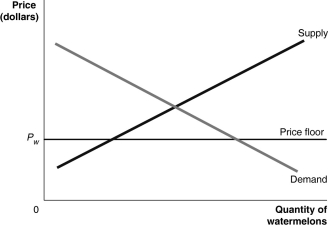 -Refer to Figure 4-7 which shows the market for watermelons. Suppose the government imposes a price floor of Pw. How will the price floor affect the quantity supplied,quantity demanded and quantity exchanged?
 (Essay)
4.8/5 (73)
(73) Figure 4-1
Figure 4-1 shows Kendra's demand for ice-cream cones curve.
-Refer to Figure 4-1. What is the total amount that Kendra is willing to pay for 3 ice cream cones?
Figure 4-1 shows Kendra's demand for ice-cream cones curve.
-Refer to Figure 4-1. What is the total amount that Kendra is willing to pay for 3 ice cream cones? (Multiple Choice)
4.8/5 (80)
(80) For most goods and services,the burden of a tax is on the sellers.
(True/False)
4.9/5 (68)
(68) The market price for coffee is $2.25 per cup.Austin is willing to pay $5.00 per cup,Colin is willing to pay $4.00 per cup,Lucy is willing to pay $3.00 per cup,and Ike is willing to pay $2.00 per cup.Construct a graph showing the consumer surplus for each cup of coffee purchased.How many cups of coffee will be purchased? What is the value of the consumer surplus each of the four consumers receives from their coffee purchases?
(Essay)
4.9/5 (79)
(79) 
Filters
- Essay(0)
- Multiple Choice(0)
- Short Answer(0)
- True False(0)
- Matching(0)