



 Chat with AI
Exam 2: Trade-Offs, comparative Advantage, and the Market System

Exam 1: Economics: Foundations and Models145 Questions
Exam 2: Trade-Offs, comparative Advantage, and the Market System152 Questions
Exam 3: Where Prices Come From: the Interaction of Demand and Supply149 Questions
Exam 4: Economic Efficiency,government Price Setting,and Taxes137 Questions
Exam 5: The Economics of Health Care117 Questions
Exam 6: Firms, the Stock Market, and Corporate Governance140 Questions
Exam 7: Comparative Advantage and the Gains From International Trade124 Questions
Exam 8: Gdp: Measuring Total Production and Income135 Questions
Exam 9: Unemployment and Inflation148 Questions
Exam 10: Economic Growth, the Financial System, and Business Cycles130 Questions
Exam 11: Long-Run Economic Growth: Sources and Policies134 Questions
Exam 12: Aggregate Expenditure and Output in the Short Run157 Questions
Exam 13: Aggregate Demand and Aggregate Supply Analysis145 Questions
Exam 14: Money,banks,and the Federal Reserve System144 Questions
Exam 15: Monetary Policy145 Questions
Exam 16: Fiscal Policy155 Questions
Exam 17: Inflation, unemployment, and Federal Reserve Policy135 Questions
Exam 18: Macroeconomics in an Open Economy145 Questions
Exam 19: The International Financial System139 Questions
Select questions type


Which of the following would shift a nation's production possibilities frontier outward?
(Multiple Choice)
4.8/5  (74)
(74) 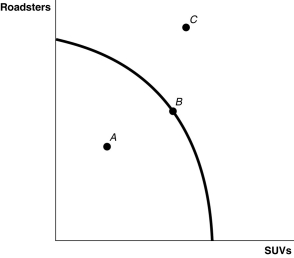 -Refer to Figure 2-1.Point A is
Figure 2-7
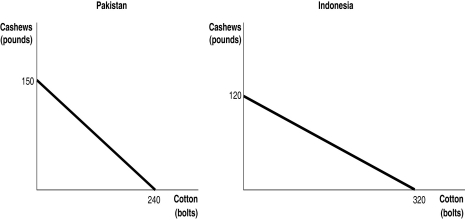 Figure 2-7 shows the production possibilities frontiers for Pakistan and Indonesia. Each country produces two goods, cotton and cashews.
-Refer to Figure 2-7.What is the opportunity cost of producing 1 pound of cashews in Pakistan?
Figure 2-7 shows the production possibilities frontiers for Pakistan and Indonesia. Each country produces two goods, cotton and cashews.
-Refer to Figure 2-7.What is the opportunity cost of producing 1 pound of cashews in Pakistan? (Multiple Choice)
4.8/5 (76)
(76) According to the production possibility model,if more resources are allocated to the production of physical and human capital,then which of the following is likely to happen?
(Multiple Choice)
4.9/5 (88)
(88) Consider a country that produces only two goods: kayaks and coconuts.Suppose it is possible for this country to increase its production of kayaks without producing fewer coconuts.In this case,its current output combination is efficient.
(True/False)
4.8/5 (84)
(84) Which of the following statements about an entrepreneur is false?
(Multiple Choice)
4.8/5 (79)
(79) "An Inquiry into the Nature and Causes of the Wealth of Nations" published in 1776 was written by
(Multiple Choice)
4.8/5 (70)
(70) Each person goes about her daily business seeking to maximize her own self interests.In doing so,she contributes to the welfare of society at large.This is the idea underlying Adam Smith's "invisible hand."
(True/False)
4.9/5 (79)
(79) Figure 2-4
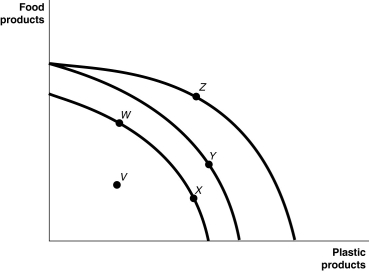 Figure 2-4 shows various points on three different production possibilities frontiers for a nation.
-Refer to Figure 2-4.Consider the following movements:
A.from point V to point W
B.from point W to point Y
C.from point Y to point Z
Which of the movements listed above represents economic growth?
Figure 2-4 shows various points on three different production possibilities frontiers for a nation.
-Refer to Figure 2-4.Consider the following movements:
A.from point V to point W
B.from point W to point Y
C.from point Y to point Z
Which of the movements listed above represents economic growth? (Multiple Choice)
4.8/5 (103)
(103) Suppose your expenses for this term are as follows: tuition: $12,000,room and board: $6,500,books and other educational supplies: $1,500.Further,during the term,you can only work part-time and earn $3,500 instead of your full-time salary of $14,000.What is the opportunity cost of going to college this term,assuming that your room and board expenses would be the same even if you did not go to college?
(Multiple Choice)
4.7/5 (75)
(75) An organization of producers that limits the amount of a good produced is known as a
(Multiple Choice)
4.9/5 (84)
(84) Crude oil is not an example of a factor of production,but when crude oil is processed into gasoline,it is a factor of production.
(True/False)
4.8/5 (84)
(84) Entrepreneurs bring together the factors of production to produce goods and services.
(True/False)
4.9/5 (83)
(83) The opportunity cost of taking a semester-long economics class is
(Multiple Choice)
4.7/5 (82)
(82) The natural resources used in production are made available in the
(Multiple Choice)
4.9/5 (70)
(70) 
Filters
- Essay(0)
- Multiple Choice(0)
- Short Answer(0)
- True False(0)
- Matching(0)