



 Chat with AI
Exam 16: Fiscal Policy

Exam 1: Economics: Foundations and Models145 Questions
Exam 2: Trade-Offs, comparative Advantage, and the Market System152 Questions
Exam 3: Where Prices Come From: the Interaction of Demand and Supply149 Questions
Exam 4: Economic Efficiency,government Price Setting,and Taxes137 Questions
Exam 5: The Economics of Health Care117 Questions
Exam 6: Firms, the Stock Market, and Corporate Governance140 Questions
Exam 7: Comparative Advantage and the Gains From International Trade124 Questions
Exam 8: Gdp: Measuring Total Production and Income135 Questions
Exam 9: Unemployment and Inflation148 Questions
Exam 10: Economic Growth, the Financial System, and Business Cycles130 Questions
Exam 11: Long-Run Economic Growth: Sources and Policies134 Questions
Exam 12: Aggregate Expenditure and Output in the Short Run157 Questions
Exam 13: Aggregate Demand and Aggregate Supply Analysis145 Questions
Exam 14: Money,banks,and the Federal Reserve System144 Questions
Exam 15: Monetary Policy145 Questions
Exam 16: Fiscal Policy155 Questions
Exam 17: Inflation, unemployment, and Federal Reserve Policy135 Questions
Exam 18: Macroeconomics in an Open Economy145 Questions
Exam 19: The International Financial System139 Questions
Select questions type


Calculate the value of the government purchases multiplier if the marginal propensity to consume equals 0.9,the tax rate equals 0.25,and the marginal propensity to import equals 0.15.
(Essay)
4.9/5  (83)
(83) Of the $825 billion American Recovery and Reinvestment Act stimulus package which was enacted in 2009,the largest spending increase occurred in which category?
(Multiple Choice)
4.9/5 (58)
(58) The tax multiplier equals the change in ________ divided by the change in ________.
(Multiple Choice)
4.7/5 (84)
(84) In preparing their estimates of the stimulus package's effect on GDP,Obama administration economists estimated a government purchases multiplier of 1.57.Economist Robert Barro argues that during wartime,the government purchases multiplier would be ________ the administration's estimate,and economists Lawrence Christiano,Martin Eichenbaum,and Sergio Rebelo argued that when short-term interest rates are near zero,the multiplier would be ________ the administration's estimate.
(Multiple Choice)
4.9/5 (73)
(73) The aggregate demand curve will shift to the left ________ the initial decrease in government purchases.
(Multiple Choice)
4.9/5 (78)
(78) Figure 27-3
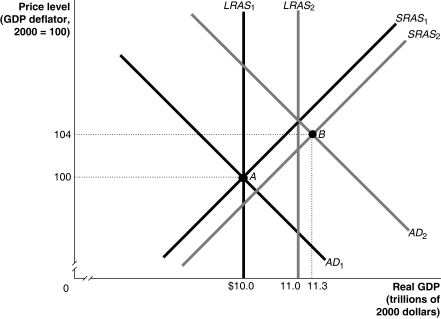 -Refer to Figure 27-3.In the dynamic model of AD-AS in the figure above,if the economy is at point A in year 1 and is expected to go to point B in year 2,Congress and the president would most likely pursue
 (Multiple Choice)
4.9/5 (75)
(75) Compare the effect on the price level and real GDP of a decrease in tax rates assuming a supply-side effect versus no supply-side effect.Compared to no supply-side effect,including a supply-side effect for the decrease in tax rates will cause the price level to increase ________ and real GDP to increase ________.
(Multiple Choice)
4.9/5 (84)
(84) Figure 27-2
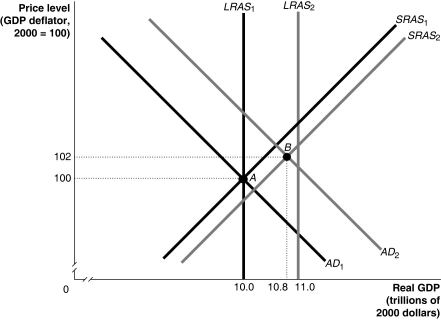 -Refer to Figure 27-2.In the dynamic model of AD-AS in the figure above,if the economy is at point A in year 1 and is expected to go to point B in year 2,Congress and the president would most likely pursue
 (Multiple Choice)
4.9/5 (80)
(80) Refer to Figure 27-1.Suppose the economy is in short-run equilibrium below potential GDP and no fiscal or monetary policy is pursued.Using the static AD-AS model in the figure above,this would be depicted as a movement from
(Multiple Choice)
4.9/5 (75)
(75) A recession tends to cause the federal budget deficit to ________ because tax revenues ________ and government spending on transfer payments ________.
(Multiple Choice)
4.9/5 (79)
(79) If real GDP is $300 billion below potential GDP and the tax multiplier equals -1.5,then how much would the government need to change taxes to bring the economy to equilibrium at potential?
(Essay)
5.0/5 (81)
(81) Suppose Congress increased spending by $100 billion and raised taxes by $100 billion to keep the budget balanced.What will happen to real equilibrium GDP?
(Multiple Choice)
4.8/5 (89)
(89) Refer to Figure 27-1.Suppose the economy is in short-run equilibrium above potential GDP and automatic stabilizers move the economy back to long-run equilibrium.Using the static AD-AS model in the figure above,this would be depicted as a movement from
(Multiple Choice)
4.8/5 (63)
(63) If the economy is falling below potential real GDP,which of the following would be an appropriate fiscal policy to bring the economy back to long-run aggregate supply? An increase in
(Multiple Choice)
4.9/5 (80)
(80) From an initial long-run equilibrium,if aggregate demand grows more slowly than long-run and short-run aggregate supply,then Congress and the president would most likely
(Multiple Choice)
4.8/5 (90)
(90) The aggregate demand curve will shift to the right ________ the initial decrease in taxes.
(Multiple Choice)
4.8/5 (91)
(91) Figure 27-1
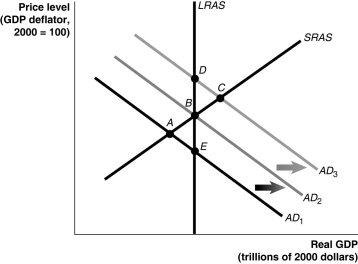 -Refer to Figure 27-1.An increase in taxes would be depicted as a movement from ________,using the static AD-AS model in the figure above.
 (Multiple Choice)
4.9/5 (81)
(81) 
Filters
- Essay(0)
- Multiple Choice(0)
- Short Answer(0)
- True False(0)
- Matching(0)