



 Chat with AI
Exam 15: Monetary Policy

Exam 1: Economics: Foundations and Models145 Questions
Exam 2: Trade-Offs, comparative Advantage, and the Market System152 Questions
Exam 3: Where Prices Come From: the Interaction of Demand and Supply149 Questions
Exam 4: Economic Efficiency,government Price Setting,and Taxes137 Questions
Exam 5: The Economics of Health Care117 Questions
Exam 6: Firms, the Stock Market, and Corporate Governance140 Questions
Exam 7: Comparative Advantage and the Gains From International Trade124 Questions
Exam 8: Gdp: Measuring Total Production and Income135 Questions
Exam 9: Unemployment and Inflation148 Questions
Exam 10: Economic Growth, the Financial System, and Business Cycles130 Questions
Exam 11: Long-Run Economic Growth: Sources and Policies134 Questions
Exam 12: Aggregate Expenditure and Output in the Short Run157 Questions
Exam 13: Aggregate Demand and Aggregate Supply Analysis145 Questions
Exam 14: Money,banks,and the Federal Reserve System144 Questions
Exam 15: Monetary Policy145 Questions
Exam 16: Fiscal Policy155 Questions
Exam 17: Inflation, unemployment, and Federal Reserve Policy135 Questions
Exam 18: Macroeconomics in an Open Economy145 Questions
Exam 19: The International Financial System139 Questions
Select questions type


When the Federal Reserve increases the money supply,at the previous equilibrium interest rate households and firms will now have
(Multiple Choice)
4.8/5  (68)
(68) Which of the following is true about the Federal Reserve and its ability to prevent recessions? The Federal Reserve
(Multiple Choice)
4.8/5 (69)
(69) Inflation rates during the years 1979-1981 were the highest the United States has ever experienced during peacetime.
(True/False)
5.0/5 (86)
(86) When housing prices fall,as they did beginning in 2006 following the housing market bubble,consumption spending on furniture,appliances,and home improvements ________ as many households found it ________ to borrow against the value of their homes.
(Multiple Choice)
4.8/5 (81)
(81) Mortgage lenders often resell mortgages in secondary markets.How might this make lenders act differently than if they intended to hold the mortgages themselves?
(Essay)
4.7/5 (92)
(92) Expansionary monetary policy refers to the ________ to increase real GDP.
(Multiple Choice)
4.8/5 (88)
(88) Most economists believe that the best monetary policy target is
(Multiple Choice)
4.9/5 (79)
(79) Figure 26-7
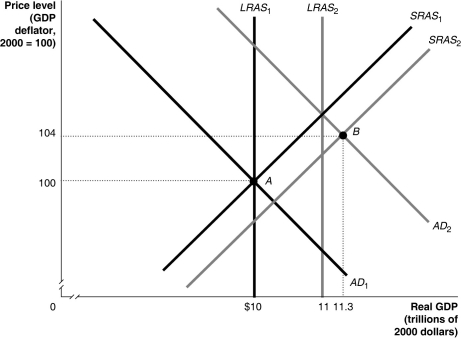 -Refer to Figure 26-7.In the dynamic AD-AS model,the economy is at point A in year 1 and is expected to go to point B in year 2,and the Federal Reserve pursues policy.This will result in
 (Multiple Choice)
4.7/5 (81)
(81) By the height of the housing bubble in 2005 and early 2006,lenders had greatly loosened the standards for obtaining a mortgage loan,with many mortgages being granted to ________ borrowers with flawed credit histories and ________ borrowers who did not document their incomes.
(Multiple Choice)
4.9/5 (86)
(86) When calculating GDP,the Bureau of Economic Analysis revises its quarterly data
(Multiple Choice)
5.0/5 (87)
(87) Firms that participate in regular open market transactions with the Federal Reserve are called
(Multiple Choice)
4.9/5 (69)
(69) Contractionary monetary policy to prevent real GDP from rising above potential real GDP would cause the inflation rate to be ________ and real GDP to be ________.
(Multiple Choice)
4.9/5 (68)
(68) In the Taylor rule,does the target for the federal funds rate respond differently for a recession caused by a decrease in aggregate demand and for a recession caused by a decrease in short-run aggregate supply? Explain whether there is or is not a difference in how the target for the federal funds rate changes.
(Essay)
4.9/5 (80)
(80) Table 26-2
 -Refer to Table 26-2.The hypothetical information in the table shows what the values for real GDP and the price level will be in 2011 if the Federal Reserve does not use monetary policy:
a.If the Fed wants to keep real GDP at its potential level in 2011,should it use an expansionary policy or a contractionary policy? Should the trading desk buy T-bills or sell them?
b.Suppose the Fed's policy is successful in keeping real GDP at its potential level in 2011.State whether each of the following will be higher or lower than if the Fed had taken no action:
(i) Real GDP
(ii) Full-employment real GDP
(iii) The inflation rate
(iv) The unemployment rate
c.Draw an aggregate demand and aggregate supply graph to illustrate your answer.Be sure that your graph contains LRAS curves for 2010 and 2011; SRAS curves 2010 and 2011; AD curve for 2010 and 2011,with and without monetary policy actions; and equilibrium real GDP and the price level in 2011 with and without policy.
-Refer to Table 26-2.The hypothetical information in the table shows what the values for real GDP and the price level will be in 2011 if the Federal Reserve does not use monetary policy:
a.If the Fed wants to keep real GDP at its potential level in 2011,should it use an expansionary policy or a contractionary policy? Should the trading desk buy T-bills or sell them?
b.Suppose the Fed's policy is successful in keeping real GDP at its potential level in 2011.State whether each of the following will be higher or lower than if the Fed had taken no action:
(i) Real GDP
(ii) Full-employment real GDP
(iii) The inflation rate
(iv) The unemployment rate
c.Draw an aggregate demand and aggregate supply graph to illustrate your answer.Be sure that your graph contains LRAS curves for 2010 and 2011; SRAS curves 2010 and 2011; AD curve for 2010 and 2011,with and without monetary policy actions; and equilibrium real GDP and the price level in 2011 with and without policy. (Essay)
4.8/5 (84)
(84) Monetarists think that the Fed should use ________ as a target when conducting monetary policy.
(Multiple Choice)
4.8/5 (79)
(79) A monetary policy target is a variable that the Fed can affect directly,which then affects one or more of the Fed's policy goals.
(True/False)
4.8/5 (83)
(83) Does the money demand curve have a positive slope or a negative slope? Why does it have this slope? Explain why an increase in the variable on the vertical axis of the money demand curve causes either an increase or a decrease in the variable on the horizontal axis of the money demand curve.
(Essay)
4.7/5 (78)
(78) Which of the following statements about inflation targeting is true?
(Multiple Choice)
4.9/5 (92)
(92) 
Filters
- Essay(0)
- Multiple Choice(0)
- Short Answer(0)
- True False(0)
- Matching(0)