



 Chat with AI
Exam 10: Economic Growth, the Financial System, and Business Cycles

Exam 1: Economics: Foundations and Models145 Questions
Exam 2: Trade-Offs, comparative Advantage, and the Market System152 Questions
Exam 3: Where Prices Come From: the Interaction of Demand and Supply149 Questions
Exam 4: Economic Efficiency,government Price Setting,and Taxes137 Questions
Exam 5: The Economics of Health Care117 Questions
Exam 6: Firms, the Stock Market, and Corporate Governance140 Questions
Exam 7: Comparative Advantage and the Gains From International Trade124 Questions
Exam 8: Gdp: Measuring Total Production and Income135 Questions
Exam 9: Unemployment and Inflation148 Questions
Exam 10: Economic Growth, the Financial System, and Business Cycles130 Questions
Exam 11: Long-Run Economic Growth: Sources and Policies134 Questions
Exam 12: Aggregate Expenditure and Output in the Short Run157 Questions
Exam 13: Aggregate Demand and Aggregate Supply Analysis145 Questions
Exam 14: Money,banks,and the Federal Reserve System144 Questions
Exam 15: Monetary Policy145 Questions
Exam 16: Fiscal Policy155 Questions
Exam 17: Inflation, unemployment, and Federal Reserve Policy135 Questions
Exam 18: Macroeconomics in an Open Economy145 Questions
Exam 19: The International Financial System139 Questions
Select questions type


In a closed economy,public saving is equal to which of the following? (Y = GDP,C = Consumption,G = Government purchases,T = Taxes,and TR = Transfers)
(Multiple Choice)
4.8/5  (93)
(93) Centrally-planned economies tend to grow more quickly than market economies.
(True/False)
4.8/5 (76)
(76) Explain and show graphically how an increase in household saving affects the equilibrium interest rate and the equilibrium quantity of loanable funds.
(Essay)
5.0/5 (67)
(67) How has economist Robert Fogel explained that economic growth is connected to life expectancy? Based on this connection,in what country would you expect to have a longer life expectancy,the United States or India? Explain.
(Essay)
4.7/5 (71)
(71) Growth in potential GDP in the United States is estimated to be about
(Multiple Choice)
4.8/5 (89)
(89) In a closed economy,private saving is equal to which of the following? (Y = GDP,C = Consumption,G = Government purchases,T = Taxes,and TR = Transfers)
(Multiple Choice)
4.8/5 (76)
(76) If labor productivity growth slows down in a country,this means that the growth rate in ________ has declined.
(Multiple Choice)
4.8/5 (78)
(78) SCENARIO21-1
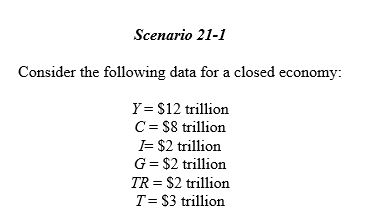 -Refer to Scenario 21-1.Based on the information above,what is the level of private saving in the economy?
 (Multiple Choice)
4.9/5 (89)
(89) Since 1950,expansions in the United States have become ________,while recessions have become ________.
(Multiple Choice)
5.0/5 (77)
(77) If the U.S.government decided to regulate the prices of airline tickets to keep them from falling when the economy is weak,there would tend to be a ________ of airline tickets in the market and this would likely ________ the profits of U.S.airlines.
(Multiple Choice)
4.7/5 (85)
(85) Which of the following will increase investment spending in the economy,holding everything else constant?
(Multiple Choice)
4.7/5 (78)
(78) What is investment in a closed economy if you have the following economic data?
Y = $10 trillion
C = $5 trillion
TR = $2 trillion
G = $2 trillion
(Multiple Choice)
4.7/5 (85)
(85) Financial securities that represent promises to repay a fixed amount of funds are known as
(Multiple Choice)
4.8/5 (87)
(87) 
Filters
- Essay(0)
- Multiple Choice(0)
- Short Answer(0)
- True False(0)
- Matching(0)