



 Chat with AI
Exam 11: Cash Flows and Other Topics in Capital Budgeting

Exam 1: An Introduction to the Foundations of Financial Management144 Questions
Exam 2: The Financial Markets and Interest Rates160 Questions
Exam 3: Understanding Financial Statements and Cash Flows127 Questions
Exam 4: Evaluating a Firms Financial Performance151 Questions
Exam 5: The Time Value of Money164 Questions
Exam 6: The Meaning and Measurement of Risk and Return151 Questions
Exam 7: The Valuation and Characteristics of Bonds151 Questions
Exam 8: The Valuation and Characteristics of Stock130 Questions
Exam 9: The Cost of Capital134 Questions
Exam 10: Capital-Budgeting Techniques and Practice158 Questions
Exam 11: Cash Flows and Other Topics in Capital Budgeting160 Questions
Exam 12: Determining the Financing Mix156 Questions
Exam 13: Dividend Policy and Internal Financing171 Questions
Exam 14: Short-Term Financial Planning144 Questions
Exam 15: Working-Capital Management168 Questions
Exam 16: International Business Finance114 Questions
Exam 17: Cash,receivables,and Inventory Management187 Questions
Select questions type


The initial outlay includes the cost of purchasing the asset and getting it operational,including the purchase price,shipping and installation,and any training costs for employees who will be operating the equipment,and any increases in working capital requirements.
(True/False)
4.9/5  (83)
(83) A project's standing alone risk allows for diversification within a sole firm.
(True/False)
4.8/5 (77)
(77) Which of the following should NOT be included as investment costs in evaluating a capital asset?
(Multiple Choice)
4.8/5 (65)
(65) Kelly Corporation is considering an investment proposal that requires an initial investment of $150,000 in equipment.Fully depreciated existing equipment may be disposed of for $40,000 pre-tax.The proposed project will have a five-year life,and is expected to produce additional revenue of $65,000 per year.Expenses other than depreciation will be $15,000 per year.The new equipment will be depreciated to zero over the five-year useful life,but it is expected to actually be sold for $20,000.Kelly has a 35% tax rate.
a.What is the net initial outlay for the proposed project?
b.What is the operating cash flow for years 1-4?
c.What is the total cash flow at the end of year five (operating cash flow for year 5 plus terminal cash flow)?
(Essay)
4.9/5 (82)
(82) Smith Manufacturing Inc.expects the following results in year one of a new project:
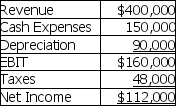 The annual change in operating cash flow is equal to
 (Multiple Choice)
4.9/5 (93)
(93) What is an incremental cash flow? What is a sunk cost? Why must you account for opportunity costs?
(Essay)
4.9/5 (70)
(70) Waterford Industries is considering the purchase of a new machine.It will replace an existing but obsolete machine that will be sold for $50,000.The existing machine is 8 years old,cost $200,000,had a 10-year useful life,and is being depreciated to zero using the straight-line method.Waterford's income tax rate is 35%.What is the after-tax salvage value of the old machine?
(Multiple Choice)
4.8/5 (73)
(73) Overhead costs are sometimes incremental cash flows and other times are considered sunk costs.
(True/False)
4.8/5 (80)
(80) AFB Corp.needs to replace an old lathe with a new,more efficient model.The old lathe was purchased for $50,000 nine years ago and has a current book value of $5,000.(The old machine is being depreciated on a straight-line basis over a ten-year useful life.)The new lathe costs $100,000.It will cost the company $10,000 to get the new lathe to the factory and get it installed.The old machine will be sold as scrap metal for $2,000.The new machine is also being depreciated on a straight-line basis over ten years.Sales are expected to increase by $8,000 per year while operating expenses are expected to decrease by $12,000 per year.AFB's marginal tax rate is 40%.Additional working capital of $3,000 is required to maintain the new machine and higher sales level.The new lathe is expected to be sold for $5,000 at the end of the project's ten-year life.What is the project's terminal cash flow?
(Multiple Choice)
4.9/5 (72)
(72) An opportunity cost is a relevant incremental cost for capital budgeting decisions.
(True/False)
4.8/5 (76)
(76) Which of the following should be excluded in an analysis of a new project's cash flows?
(Multiple Choice)
4.8/5 (90)
(90) In general,a project's cash flows will fall into one of three categories.What are these categories?
(Essay)
4.9/5 (76)
(76) P.D.Corporation is considering the purchase of a high-speed lathe that has an invoice price of $250,000.The cost to ship the lathe to P.D.'s factory is $10,000,and the existing facilities will require modifications that are expected to cost $20,000.The machine will be depreciated on a straight-line basis over its useful life of 10 years,assuming no salvage value.P.D.Corporation is planning on paying for the lathe using a line of credit at the bank that has an interest rate of 6 percent per year.The lathe is expected to increase production and sales.Sales are expected to increase by $100,000 per year.Inventory and accounts receivable balances are expected to increase by $10,000 and $20,000 respectively.Expenses to operate the lathe are $25,000 per year.P.D.'s marginal tax rate is 40%.
a.Calculate the initial outlay required to fund this project.
b.Calculate the incremental after-tax cash flow in year one of the project.
(Essay)
5.0/5 (83)
(83) Creighton Industries is considering the purchase of a new strapping machine,which will cost $150,000,plus an additional $10,500 to ship and install.The new machine will have a 5-year useful life and will be depreciated to zero using the straight-line method.The machine is expected to generate new sales of $45,000 per year and is expected to save $16,000 in labor and electrical expenses over the next 5-years.The machine is expected to have a salvage value of $20,000.Creighton's income tax rate is 35%.Creighton uses a 12.5% discount rate for capital budgeting purposes.What is the machine's NPV?
(Multiple Choice)
4.8/5 (81)
(81) Which of the following cash flows are NOT considered in the calculation of the initial outlay for a capital investment proposal?
(Multiple Choice)
4.9/5 (76)
(76) A six-year project for Little Egypt,Inc.results in additional accounts receivable of $150,000,additional inventory of $50,000,and additional accounts payable of $80,000 today.What is the change in the NPV of a project solely due to the additional net working capital (NWC)needs? Assume a 14% discount rate,and the recovery of net working capital at the end of the project.
(Multiple Choice)
4.8/5 (89)
(89) In general,a project's free cash flows will fall in one of the following three categories: initial outlay,differential cash flows over the project's life,and the terminal cash flow.
(True/False)
4.9/5 (83)
(83) Depreciation expense produces a cash inflow equal to the depreciation expense multiplied by the firm's marginal tax rate.
(True/False)
4.8/5 (90)
(90) 
Filters
- Essay(0)
- Multiple Choice(0)
- Short Answer(0)
- True False(0)
- Matching(0)