



 Chat with AI
Exam 10: Muscle Tissue

Exam 1: An Introduction to Anatomy and Physiology95 Questions
Exam 2: The Chemical Level of Organization183 Questions
Exam 3: The Cellular Level of Organization190 Questions
Exam 4: The Tissue Level of Organization139 Questions
Exam 5: The Integumentary System118 Questions
Exam 6: Bones and Bone Structure165 Questions
Exam 7: The Axial Skeleton146 Questions
Exam 8: The Appendicular Skeleton119 Questions
Exam 9: Joints134 Questions
Exam 10: Muscle Tissue137 Questions
Exam 11: The Muscular System152 Questions
Exam 12: Nervous Tissue158 Questions
Exam 13: The Spinal Cord, Spinal Nerves, and Spinal Reflexes115 Questions
Exam 14: The Brain and Cranial Nerves187 Questions
Exam 15: Sensory Pathways and the Somatic Nervous System125 Questions
Exam 16: The Autonomic Nervous System and Higher-Order Functions129 Questions
Exam 17: The Special Senses170 Questions
Exam 18: The Endocrine System188 Questions
Exam 19: Blood162 Questions
Exam 20: The Heart178 Questions
Exam 21: Blood Vessels and Circulation225 Questions
Exam 22: The Lymphatic System and Immunity167 Questions
Exam 23: The Respiratory System200 Questions
Exam 24: The Digestive System213 Questions
Exam 25: Metabolism, Nutrition, and Energetics140 Questions
Exam 26: The Urinary System137 Questions
Exam 27: Fluid, Electrolyte, and Acid-Base Balance66 Questions
Exam 28: The Reproductive System203 Questions
Exam 29: Development and Inheritance146 Questions
Select questions type


In-Text Figure Based Questions
-Which skeletal muscle fiber type-slow or fast-contains more mitochondria? (Figure 10-21)
(Multiple Choice)
4.8/5  (77)
(77) The region of the sarcomere containing the thick filaments is the
(Multiple Choice)
4.9/5 (70)
(70) The advantage of having many nuclei in a skeletal muscle fiber is the ability to
(Multiple Choice)
5.0/5 (83)
(83) Muscle tissue, one of the four basic tissue groups, consists chiefly of cells that are highly specializedfor
(Multiple Choice)
5.0/5 (81)
(81) Which of the following statements is/are false regarding human muscles?
(Multiple Choice)
4.9/5 (86)
(86) Which of the following is not an effect of aging on the muscular system?
(Multiple Choice)
4.8/5 (81)
(81) Figure 10-2 Muscle Contractions
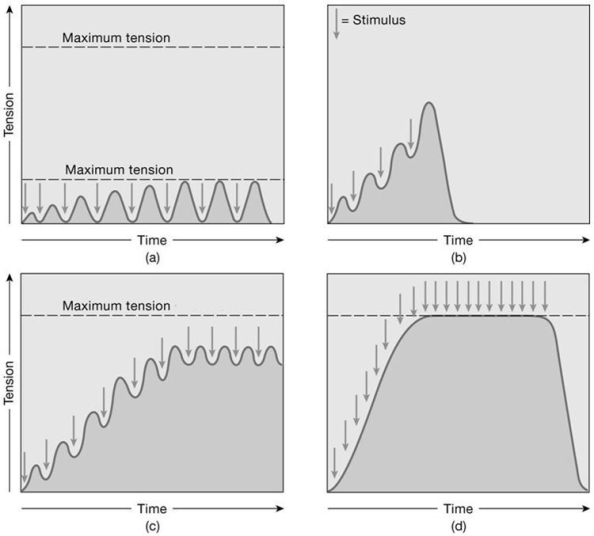 Use Figure 10-2 to answer the following questions:
-What is thought to happen in a muscle during the response shown in graph (a)?
Use Figure 10-2 to answer the following questions:
-What is thought to happen in a muscle during the response shown in graph (a)? (Multiple Choice)
4.9/5 (93)
(93) Skeletal muscle fibers are formed from embryonic cells called
(Multiple Choice)
5.0/5 (80)
(80) The skeletal muscle complex known as the triad consists of
(Multiple Choice)
4.9/5 (65)
(65) A single contraction-relaxation cycle in a muscle fiber produces a(n)
(Multiple Choice)
4.9/5 (74)
(74) How would an elevated level of thyroid hormone in the body affect skeletal muscles?
(Multiple Choice)
4.8/5 (63)
(63) A single motor neuron together with all the muscle fibers it innervates is called a(n)
(Multiple Choice)
4.8/5 (85)
(85) In response to action potentials arriving along the transverse tubules, the sarcoplasmic reticulum releases
(Multiple Choice)
4.8/5 (71)
(71) In which of the following would the motor units have the fewest muscle fibers?
(Multiple Choice)
4.8/5 (75)
(75) Large-diameter, densely packed myofibrils, large glycogen reserves, and few mitochondria are characteristics of
(Multiple Choice)
4.8/5 (76)
(76) Which of the following is true about the difference between cardiac muscle cells and skeletal muscle cells?
(Multiple Choice)
4.7/5 (86)
(86) 
Filters
- Essay(0)
- Multiple Choice(0)
- Short Answer(0)
- True False(0)
- Matching(0)