



 Chat with AI
Exam 26: Nursing Assessment: Respiratory System

Exam 1: Nursing Practice Today14 Questions
Exam 2: Health Disparities5 Questions
Exam 3: Culturally Competent Care12 Questions
Exam 4: Health History and Physical Examination15 Questions
Exam 5: Patient and Family Teaching17 Questions
Exam 6: Older Adults23 Questions
Exam 7: Community-Based Nursing and Home Care11 Questions
Exam 8: Complementary and Alternative Therapies15 Questions
Exam 9: Stress and Stress Management9 Questions
Exam 10: Pain21 Questions
Exam 11: End Of Life and Palliative Care14 Questions
Exam 12: Addictive Behaviors21 Questions
Exam 13: Inflammation and Wound Healing19 Questions
Exam 14: Genetics, Altered Immune Responses, and Transplantation29 Questions
Exam 15: Infection and Human Immunodeficiency Virus Infection22 Questions
Exam 16: Cancer35 Questions
Exam 17: Fluid, Electrolyte, and Acid-Base Imbalances31 Questions
Exam 18: Nursing Management: Preoperative Care20 Questions
Exam 19: Nursing Management: Intraoperative Care18 Questions
Exam 20: Nursing Management: Postoperative Care24 Questions
Exam 21: Nursing Assessment: Visual and Auditory Systems22 Questions
Exam 22: Nursing Management: Visual and Auditory Problems42 Questions
Exam 23: Nursing Assessment: Integumentary System13 Questions
Exam 24: Nursing Management: Integumentary Problems23 Questions
Exam 25: Nursing Management: Burns28 Questions
Exam 26: Nursing Assessment: Respiratory System24 Questions
Exam 27: Nursing Management: Upper Respiratory Problems25 Questions
Exam 28: Nursing Management: Lower Respiratory Problems47 Questions
Exam 29: Nursing Management: Obstructive Pulmonary Diseases41 Questions
Exam 30: Nursing Assessment: Hematologic System15 Questions
Exam 31: Nursing Management: Hematologic Problems39 Questions
Exam 32: Nursing Assessment: Cardiovascular System21 Questions
Exam 33: Nursing Management: Hypertension23 Questions
Exam 34: Nursing Management: Coronary Artery Disease and Acute Coronary Syndrome37 Questions
Exam 35: Nursing Management: Heart Failure23 Questions
Exam 36: Nursing Management: Dysrhythmias28 Questions
Exam 37: Nursing Management: Inflammatory and Structural Heart Disorders28 Questions
Exam 38: Nursing Management: Vascular Disorders31 Questions
Exam 39: Nursing Assessment: Gastrointestinal System17 Questions
Exam 40: Nursing Management: Nutritional Problems26 Questions
Exam 41: Nursing Management: Obesity18 Questions
Exam 42: Nursing Management: Upper Gastrointestinal Problems44 Questions
Exam 43: Nursing Management: Lower Gastrointestinal Problems46 Questions
Exam 44: Nursing Management: Liver, Pancreas, and Biliary Tract Problems41 Questions
Exam 45: Nursing Assessment: Urinary System21 Questions
Exam 46: Nursing Management: Renal and Urologic Problems38 Questions
Exam 47: Nursing Management: Acute Renal Failure and Chronic Kidney Disease36 Questions
Exam 48: Nursing Assessment: Endocrine System19 Questions
Exam 49: Nursing Management: Diabetes Mellitus38 Questions
Exam 50: Nursing Management: Endocrine Problems40 Questions
Exam 51: Nursing Assessment: Reproductive System19 Questions
Exam 52: Nursing Management: Breast Disorders24 Questions
Exam 53: Nursing Management: Sexually Transmitted Diseases16 Questions
Exam 54: Nursing Management: Female Reproductive Problems41 Questions
Exam 55: Nursing Management: Male Reproductive Problems27 Questions
Exam 56: Nursing Assessment: Nervous System21 Questions
Exam 57: Nursing Management: Acute Intracranial Problems35 Questions
Exam 58: Nursing Management: Stroke28 Questions
Exam 59: Nursing Management: Chronic Neurologic Problems33 Questions
Exam 60: Nursing Management: Alzheimers Disease and Dementia17 Questions
Exam 61: Nursing Management: Peripheral Nerve and Spinal Cord Problems29 Questions
Exam 62: Nursing Assessment: Musculoskeletal System13 Questions
Exam 63: Nursing Management: Musculoskeletal Trauma and Orthopedic Surgery39 Questions
Exam 64: Nursing Management: Musculoskeletal Problems19 Questions
Exam 65: Nursing Management: Arthritis and Connective Tissue Diseases42 Questions
Exam 66: Nursing Management: Critical Care38 Questions
Exam 67: Nursing Management: Shock, Systemic Inflammatory Response Syndrome, and Multiple Organ Dysfunction Syndrome27 Questions
Exam 68: Nursing Management: Respiratory Failure and Acute Respiratory Distress Syndrome24 Questions
Exam 69: Nursing Management: Emergency and Disaster Nursing25 Questions
Select questions type


A patient is admitted to the emergency department complaining of sudden onset shortness of breath and diagnosed with a possible pulmonary embolus. To confirm the diagnosis, the nurse will anticipate preparing the patient for a

Free
(Multiple Choice)
5.0/5  (84)
(84) Correct Answer: Verified
B
A patient with COPD has a "barrel chest." The nurse would expect the chest x-ray report to indicate that there is
Free
(Multiple Choice)
4.9/5 (72)
(72) Correct Answer:Verified
VerifiedA
While assessing the role-relationship health pattern in a patient with respiratory problems, the nurse should specifically ask about
Free
(Multiple Choice)
4.9/5 (95)
(95) Correct Answer:Verified
VerifiedD
The nurse is admitting a patient who has a diagnosis of an acute asthma attack. Which information obtained by the nurse indicates that the patient may need teaching regarding medication use?
(Multiple Choice)
5.0/5 (76)
(76) A patient is scheduled for a spiral CT scan to rule out a pulmonary embolus. Which information obtained by the nurse is most important to communicate to the health care provider before the examination?
(Multiple Choice)
5.0/5 (79)
(79) A patient with chronic hypoxemia (SaO2 levels of 89%-90%) caused by COPD has just been admitted with increasing shortness of breath. In planning for discharge, which of these actions by the nurse will be most effective in improving compliance with discharge teaching?
(Multiple Choice)
4.8/5 (86)
(86) When performing an assessment of the patient's respiratory system, the nurse uses the following illustrated technique to evaluate 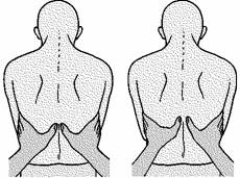
(Multiple Choice)
4.8/5 (81)
(81) On auscultation of a patient's lungs, the nurse hears short, high-pitched sounds just before the end of inspiration in the right and left lower lobes. The nurse records this finding as
(Multiple Choice)
4.9/5 (78)
(78) When auscultating a patient's chest while the patient takes a deep breath, the nurse hears loud, high-pitched, "blowing" sounds at both lung bases. The nurse will document these as
(Multiple Choice)
4.8/5 (83)
(83) An 80-year-old patient breathing room air has an ABG analysis. The nurse interprets which results as normal?
(Multiple Choice)
4.8/5 (83)
(83) A patient with a chronic cough with blood-tinged sputum undergoes a bronchoscopy. Following the bronchoscopy, the nurse should
(Multiple Choice)
4.9/5 (80)
(80) While caring for a patient with respiratory disease, the nurse observes that the patient's SpO2 drops from 94% to 85% when the patient ambulates in the hall. The nurse determines that
(Multiple Choice)
4.8/5 (89)
(89) When admitting a patient who has a pleural effusion, which technique will the nurse use to assess for tactile fremitus?
(Multiple Choice)
4.9/5 (81)
(81) A patient who has a 30-pack-year history of smoking asks the nurse, "How does smoking really harm my lungs?" The nurse's response will be based on the effect of smoking on
(Multiple Choice)
4.8/5 (77)
(77) In analyzing the results of a patient's blood gas analysis, the nurse will be most concerned about an
(Multiple Choice)
4.8/5 (85)
(85) When assessing the respiratory system of a 78-year-old patient, which of these data indicate that the nurse should take immediate action?
(Multiple Choice)
4.8/5 (70)
(70) The nurse is observing a student who is auscultating a patient's lungs. Which action by the student indicates that the nurse should intervene?
(Multiple Choice)
4.8/5 (75)
(75) The health care provider performs a thoracentesis on a patient with a right pleural effusion. In preparing the patient for the procedure, the nurse positions the patient
(Multiple Choice)
4.9/5 (76)
(76) A patient is admitted with a metabolic acidosis of unknown origin. Based on this diagnosis, the nurse would expect the patient to have
(Multiple Choice)
4.7/5 (79)
(79) A hypothermic patient is admitted to the emergency department, and pulse oximetry (SpO2) indicates that the O2 saturation is 95%. Which action should the nurse take next?
(Multiple Choice)
4.8/5 (72)
(72) 
Filters
- Essay(0)
- Multiple Choice(0)
- Short Answer(0)
- True False(0)
- Matching(0)