



 Chat with AI
Exam 10: Transaction and Translation Exposure

Exam 1: Current Multinational Challenges and the Global Economy33 Questions
Exam 2: Financial Goals and Corporate Governance54 Questions
Exam 3: The International Monetary System54 Questions
Exam 4: The Balance of Payments57 Questions
Exam 5: Current Multinational Financial Challenges: the Credit Crisis of 2007 - 200946 Questions
Exam 6: The Foreign Exchange Market57 Questions
Exam 7: International Parity Conditions56 Questions
Exam 8: Foreign Currency Derivatives and Swaps65 Questions
Exam 9: Foreign Exchange Rate Determination and Forecasting53 Questions
Exam 10: Transaction and Translation Exposure69 Questions
Exam 11: Operating Exposure54 Questions
Exam 12: The Global Cost and Availability of Capital57 Questions
Exam 13: Sourcing Equity and Debt Globally80 Questions
Exam 14: Multinational Tax Management57 Questions
Exam 15: Foreign Direct Investment and Political Risk55 Questions
Exam 16: Multinational Capital Budgeting and Cross-Border Acquisitions56 Questions
Exam 17: International Portfolio Theory and Diversification57 Questions
Exam 18: Working Capital Management63 Questions
Exam 19: International Trade Finance61 Questions
Select questions type


The current rate method is the most prevalent method today for the translation of financial statements.
(True/False)
4.8/5  (71)
(71) Use the information for the following problem(s).
Plains States Manufacturing has just signed a contract to sell agricultural equipment to Boschin, a German firm, for euro 1,250,000. The sale was made in June with payment due six months later in December. Because this is a sizable contract for the firm and because the contract is in euros rather than dollars, Plains States is considering several hedging alternatives to reduce the exchange rate risk arising from the sale. To help the firm make a hedging decision you have gathered the following information.
∙ The spot exchange rate is $1.40/euro
∙ The six month forward rate is $1.38/euro
∙ Plains States' cost of capital is 11%
∙ The Euro zone 6-month borrowing rate is 9% (or 4.5% for 6 months)
∙ The Euro zone 6-month lending rate is 7% (or 3.5% for 6 months)
∙ The U.S. 6-month borrowing rate is 8% (or 4% for 6 months)
∙ The U.S. 6-month lending rate is 6% (or 3% for 6 months)
∙ December put options for euro 625,000; strike price $1.42, premium price is 1.5%
∙ Plains States' forecast for 6-month spot rates is $1.43/euro
∙ The budget rate, or the lowest acceptable sales price for this project, is $1,075,000 or $1.35/euro
-Refer to Instruction 10.1.What is the cost of a put option hedge for Plains States' euro receivable contract? (Note: Calculate the cost in future value dollars and assume the firm's cost of capital as the appropriate interest rate for calculating future values.)
(Multiple Choice)
4.9/5 (83)
(83) ________ exposure is the potential for accounting-derived changes in owner's equity to occur because of the need to translate foreign currency financial statements into a single reporting currency.
(Multiple Choice)
4.8/5 (80)
(80) Losses from ________ exposure generally reduce taxable income in the year they are realized.________ exposure losses may reduce taxes over a series of years.
(Multiple Choice)
4.8/5 (76)
(76) ________ exposure measures the change in the present value of the firm resulting from unexpected changes in exchange rates.
(Multiple Choice)
4.8/5 (71)
(71) ________ exposure deals with cash flows that result from existing contractual obligations.
(Multiple Choice)
4.7/5 (85)
(85) Use the information for the following problem(s).
Plains States Manufacturing has just signed a contract to sell agricultural equipment to Boschin, a German firm, for euro 1,250,000. The sale was made in June with payment due six months later in December. Because this is a sizable contract for the firm and because the contract is in euros rather than dollars, Plains States is considering several hedging alternatives to reduce the exchange rate risk arising from the sale. To help the firm make a hedging decision you have gathered the following information.
∙ The spot exchange rate is $1.40/euro
∙ The six month forward rate is $1.38/euro
∙ Plains States' cost of capital is 11%
∙ The Euro zone 6-month borrowing rate is 9% (or 4.5% for 6 months)
∙ The Euro zone 6-month lending rate is 7% (or 3.5% for 6 months)
∙ The U.S. 6-month borrowing rate is 8% (or 4% for 6 months)
∙ The U.S. 6-month lending rate is 6% (or 3% for 6 months)
∙ December put options for euro 625,000; strike price $1.42, premium price is 1.5%
∙ Plains States' forecast for 6-month spot rates is $1.43/euro
∙ The budget rate, or the lowest acceptable sales price for this project, is $1,075,000 or $1.35/euro
-Refer to Instruction 10.1.Plains States would be ________ by an amount equal to ________ with a forward hedge than if they had not hedged and their predicted exchange rate for 6 months had been correct.
(Multiple Choice)
4.9/5 (75)
(75) ________ is a technique used by MNEs to deal with currency exposure.
(Multiple Choice)
4.9/5 (85)
(85) ________ gains and losses are "realized" whereas ________ gains and losses are only "paper."
(Multiple Choice)
4.9/5 (80)
(80) Using the table below,estimate the net exposure for Souris River Manufacturing of it's wholly-owned Canadian subsidiary. 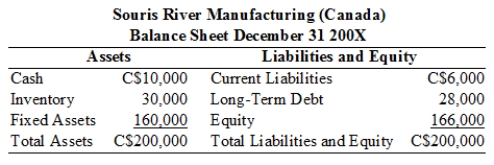
(Multiple Choice)
4.9/5 (83)
(83) A U.S.firm sells merchandise today to a British company for £100,000. The current exchange rate is $2.03/£ ,the account is payable in three months,and the firm chooses to avoid any hedging techniques designed to reduce or eliminate the risk of changes in the exchange rate.If the exchange rate changes to $2.01/£ the U.S.firm will realize a ________ of ________.
(Multiple Choice)
4.8/5 (91)
(91) The current rate method of foreign currency translation gains or losses resulting from remeasurement are carried directly to current consolidated income and thus introduces volatility to consolidated earnings.
(True/False)
4.8/5 (73)
(73) A balance sheet hedge is the main technique for managing ________.
(Multiple Choice)
4.7/5 (84)
(84) If the European subsidiary of a U.S.firm has net exposed assets of euro 500,000,and the euro drops in value from $1.40/euro to $1.30/euro the U.S.firm has a translation ________.
(Multiple Choice)
4.9/5 (74)
(74) If a European subsidiary of a U.S.firm has net exposed liabilities of euro 500,000,and the euro increases in value from $1.30/euro to $1.35/euro then the U.S.firm has a translation ________.
(Multiple Choice)
4.9/5 (83)
(83) The key arguments in opposition to currency hedging such as market efficiency,agency theory,and diversification do not have financial theory at their core.
(True/False)
4.8/5 (79)
(79) A foreign subsidiary's ________ currency is the currency used in the firm's day-to-day operations.
(Multiple Choice)
4.7/5 (81)
(81) Losses from ________ exposure generally reduce taxable income in the year they are realized.________ exposure losses are not cash losses and therefore,are not tax deductible.
(Multiple Choice)
4.8/5 (77)
(77) Use the information for the following problem(s).
Plains States Manufacturing has just signed a contract to sell agricultural equipment to Boschin, a German firm, for euro 1,250,000. The sale was made in June with payment due six months later in December. Because this is a sizable contract for the firm and because the contract is in euros rather than dollars, Plains States is considering several hedging alternatives to reduce the exchange rate risk arising from the sale. To help the firm make a hedging decision you have gathered the following information.
∙ The spot exchange rate is $1.40/euro
∙ The six month forward rate is $1.38/euro
∙ Plains States' cost of capital is 11%
∙ The Euro zone 6-month borrowing rate is 9% (or 4.5% for 6 months)
∙ The Euro zone 6-month lending rate is 7% (or 3.5% for 6 months)
∙ The U.S. 6-month borrowing rate is 8% (or 4% for 6 months)
∙ The U.S. 6-month lending rate is 6% (or 3% for 6 months)
∙ December put options for euro 625,000; strike price $1.42, premium price is 1.5%
∙ Plains States' forecast for 6-month spot rates is $1.43/euro
∙ The budget rate, or the lowest acceptable sales price for this project, is $1,075,000 or $1.35/euro
-Refer to Instruction 10.1.Plains States could hedge the Euro receivables in the money market.Using the information provided,how much would the money market hedge return in six months assuming Plains States reinvests the proceeds at the U.S.investment rate?
(Multiple Choice)
4.8/5 (75)
(75) Use the information for the following problem(s).
Plains States Manufacturing has just signed a contract to sell agricultural equipment to Boschin, a German firm, for euro 1,250,000. The sale was made in June with payment due six months later in December. Because this is a sizable contract for the firm and because the contract is in euros rather than dollars, Plains States is considering several hedging alternatives to reduce the exchange rate risk arising from the sale. To help the firm make a hedging decision you have gathered the following information.
∙ The spot exchange rate is $1.40/euro
∙ The six month forward rate is $1.38/euro
∙ Plains States' cost of capital is 11%
∙ The Euro zone 6-month borrowing rate is 9% (or 4.5% for 6 months)
∙ The Euro zone 6-month lending rate is 7% (or 3.5% for 6 months)
∙ The U.S. 6-month borrowing rate is 8% (or 4% for 6 months)
∙ The U.S. 6-month lending rate is 6% (or 3% for 6 months)
∙ December put options for euro 625,000; strike price $1.42, premium price is 1.5%
∙ Plains States' forecast for 6-month spot rates is $1.43/euro
∙ The budget rate, or the lowest acceptable sales price for this project, is $1,075,000 or $1.35/euro
-Refer to Instruction 10.1.Plains States chooses to hedge its transaction exposure in the forward market at the available forward rate.The payoff in 6 months will be ________.
(Multiple Choice)
4.9/5 (74)
(74) 
Filters
- Essay(0)
- Multiple Choice(0)
- Short Answer(0)
- True False(0)
- Matching(0)