



 Chat with AI
Exam 9: Monopoly

Exam 1: Introduction40 Questions
Exam 2: Supply and Demand131 Questions
Exam 3: Empirical Methods for Demand Analysis84 Questions
Exam 4: Consumer Choice67 Questions
Exam 5: Production128 Questions
Exam 6: Costs117 Questions
Exam 7: Firm Organization and Market Structure78 Questions
Exam 8: Competitive Firms and Markets97 Questions
Exam 9: Monopoly82 Questions
Exam 10: Pricing With Market Power138 Questions
Exam 11: Oligopoly and Monopolistic Competition84 Questions
Exam 12: Game Theory and Business Strategy90 Questions
Exam 13: Strategies Over Time67 Questions
Exam 14: Managerial Decision-Making Under Uncertainty116 Questions
Exam 15: Asymmetric Information112 Questions
Exam 16: Government and Business106 Questions
Exam 17: Global Business72 Questions
Select questions type


If the inverse demand curve a monopoly faces is p = 100 - 2Q, then profit maximization
(Multiple Choice)
4.8/5  (86)
(86) Since a monopoly can set any price it wants, it always makes a profit?
(True/False)
4.8/5 (75)
(75) 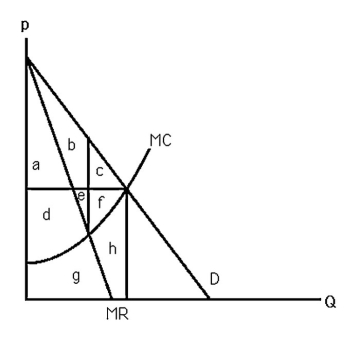 -The above figure shows the demand and marginal cost curves for a monopoly. Under monopoly, consumer surplus equals
 (Multiple Choice)
4.9/5 (66)
(66) Which of the following would force a monopoly to charge a lower price?
(Multiple Choice)
4.9/5 (71)
(71) Limited government licenses that create a monopoly do so because
(Multiple Choice)
4.7/5 (81)
(81) The less elastic is the demand for a firm's product, the greater is that firm's market power.
(True/False)
4.9/5 (70)
(70) If a firm uses introductory pricing, it is likely ________ short run profit and ________ long run profit.
(Multiple Choice)
4.9/5 (81)
(81) A monopoly that is maximizing profits never operates in the ________ portion of the demand curve.
(Multiple Choice)
4.7/5 (92)
(92)
-The above figure shows the demand and marginal cost curves for a monopoly. The deadweight loss of this monopoly equals
-The above figure shows the demand and marginal cost curves for a monopoly. The deadweight loss of this monopoly equals (Multiple Choice)
4.7/5 (79)
(79) Suppose a monopolist has TC = 100 + 10Q + 2Q2, and the demand curve it faces is p = 90 - 2Q. What will be the price, quantity, and profit for this firm?
(Essay)
4.8/5 (98)
(98) If a monopoly's demand curve shifts to the right, the monopoly
(Multiple Choice)
4.8/5 (88)
(88) In a recent court case, an expert witness defined a monopoly as a firm that can "raise price without reducing its total revenue." What does this imply about the elasticity of demand? Would this definition hold for a profit-maximizing monopoly? Explain.
(Essay)
4.8/5 (90)
(90)
-If the inverse demand curve a monopoly faces is p = 100 - 2Q, and MC is constant at 16, then the deadweight loss from monopoly equals
-If the inverse demand curve a monopoly faces is p = 100 - 2Q, and MC is constant at 16, then the deadweight loss from monopoly equals (Multiple Choice)
4.9/5 (85)
(85) If the demand for a firm's output is perfectly elastic, then the firm's Lerner Index equals
(Multiple Choice)
4.9/5 (75)
(75) 
Filters
- Essay(0)
- Multiple Choice(0)
- Short Answer(0)
- True False(0)
- Matching(0)