



 Chat with AI
Exam 12: Game Theory and Business Strategy

Exam 1: Introduction40 Questions
Exam 2: Supply and Demand131 Questions
Exam 3: Empirical Methods for Demand Analysis84 Questions
Exam 4: Consumer Choice67 Questions
Exam 5: Production128 Questions
Exam 6: Costs117 Questions
Exam 7: Firm Organization and Market Structure78 Questions
Exam 8: Competitive Firms and Markets97 Questions
Exam 9: Monopoly82 Questions
Exam 10: Pricing With Market Power138 Questions
Exam 11: Oligopoly and Monopolistic Competition84 Questions
Exam 12: Game Theory and Business Strategy90 Questions
Exam 13: Strategies Over Time67 Questions
Exam 14: Managerial Decision-Making Under Uncertainty116 Questions
Exam 15: Asymmetric Information112 Questions
Exam 16: Government and Business106 Questions
Exam 17: Global Business72 Questions
Select questions type


An auction in which the price announced by the auctioneer DESCENDS is called a(n)
(Multiple Choice)
4.8/5  (74)
(74) In the example of coordination problems between Google and Motorola Mobility, one method to solve the problems was
(Multiple Choice)
4.9/5 (88)
(88) Explain why it is unwise to bid more than your valuation of the good in a sealed bid second-price auction.
(Essay)
4.8/5 (89)
(89) In a two-player simultaneous game, if player A has a dominant strategy and player B does not, player B will
(Multiple Choice)
4.7/5 (76)
(76) If a firm does NOT know its rival's profit function, then we consider that information to be
(Multiple Choice)
4.8/5 (86)
(86) Which of the following statements is TRUE about a non-cooperative game?
(Multiple Choice)
4.8/5 (85)
(85) 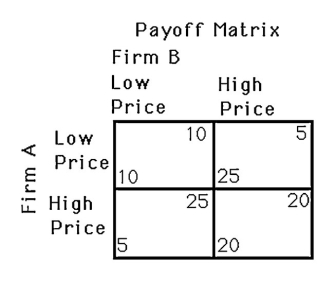 -The above figure shows a payoff matrix for two firms, A and B, that must choose between a high-price strategy and a low-price strategy. The Nash equilibrium in this game
 (Multiple Choice)
4.8/5 (68)
(68) 
Filters
- Essay(0)
- Multiple Choice(0)
- Short Answer(0)
- True False(0)
- Matching(0)