



 Chat with AI
Exam 10: Pricing With Market Power

Exam 1: Introduction40 Questions
Exam 2: Supply and Demand131 Questions
Exam 3: Empirical Methods for Demand Analysis84 Questions
Exam 4: Consumer Choice67 Questions
Exam 5: Production128 Questions
Exam 6: Costs117 Questions
Exam 7: Firm Organization and Market Structure78 Questions
Exam 8: Competitive Firms and Markets97 Questions
Exam 9: Monopoly82 Questions
Exam 10: Pricing With Market Power138 Questions
Exam 11: Oligopoly and Monopolistic Competition84 Questions
Exam 12: Game Theory and Business Strategy90 Questions
Exam 13: Strategies Over Time67 Questions
Exam 14: Managerial Decision-Making Under Uncertainty116 Questions
Exam 15: Asymmetric Information112 Questions
Exam 16: Government and Business106 Questions
Exam 17: Global Business72 Questions
Select questions type


If a monopoly charges higher prices to consumers who buy smaller quantities than to consumers who buy larger quantities, then
(Multiple Choice)
5.0/5  (76)
(76) What is one reason car dealerships might move away from perfect price discrimination to uniform pricing?
(Multiple Choice)
4.8/5 (82)
(82) Customers are usually more willing to pay more for the first unit of a good they purchase than for the second, third, or subsequent units. This implies that
(Multiple Choice)
4.9/5 (74)
(74) A specialized rice grower sells rice in two markets, the United States and Japan, and the marginal cost is the same in both markets. The price elasticity of demand in the United States is -2.0, and the price elasticity of demand in Japan is -1.5. If the grower practices group price discrimination, which country's consumers will pay a higher price and by how much?
(Essay)
4.7/5 (83)
(83) For a perfect-price-discriminating monopoly, the marginal revenue curve
(Multiple Choice)
4.7/5 (84)
(84) Suppose all individuals are identical, and their monthly demand for Internet access from a certain leading provider can be represented as p = 5 - (1/2)q where p is price in $ per hour and q is hours per month. The firm faces a constant marginal cost of $1. The profit maximizing two-part tariff results in the firm selling
(Multiple Choice)
4.9/5 (77)
(77) When firms price discriminate they turn ________ into ________.
(Multiple Choice)
4.9/5 (72)
(72) If a market is controlled by a perfect-price-discriminating monopoly, then
(Multiple Choice)
4.8/5 (90)
(90) At the current price of a good Al's consumer surplus equals 8 and Ben's consumer surplus equals 15. By using two-part pricing a monopolist could increase his profit by
(Multiple Choice)
4.8/5 (85)
(85) Suppose all individuals are identical, and their monthly demand for Internet access from a certain leading provider can be represented as p = 5 - (1/2)q where p is price in $ per hour and q is hours per month. The firm faces a constant marginal cost of $1. Potential consumer surplus equals
(Multiple Choice)
4.9/5 (96)
(96) If you purchase one pound of apples the price is $1.50 per pound. If you buy a five pound bag of apples, the cost is $5.00. This is most likely an example of
(Multiple Choice)
4.8/5 (75)
(75) Pizza joints often offer substantially lower prices for pizza picked up at the shop than for delivered pizzas even though they charge a delivery fee. This may be an attempt at
(Multiple Choice)
4.9/5 (82)
(82) 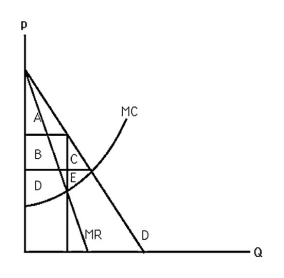 The above figure shows the market for a given product. Defining welfare as consumer surplus plus producer surplus, calculate the social welfare associated with perfect competition, single-price monopoly, and a perfect-price-discriminating monopoly. Which market structure(s)maximize social welfare?
 (Essay)
4.9/5 (87)
(87) 
Filters
- Essay(0)
- Multiple Choice(0)
- Short Answer(0)
- True False(0)
- Matching(0)