



 Chat with AI
Exam 17: Monopolistic Competition

Exam 1: Getting Started337 Questions
Exam 2: The Usand Global Economies201 Questions
Exam 3: The Economic Problem273 Questions
Exam 4: Demand and Supply322 Questions
Exam 5: Elasticities of Demand and Supply335 Questions
Exam 6: Efficiency and Fairness of Markets352 Questions
Exam 7: Government Actions in Markets239 Questions
Exam 8: Taxes267 Questions
Exam 9: Global Markets in Action276 Questions
Exam 10: Externalities300 Questions
Exam 11: Public Goods and Common Resources177 Questions
Exam 12: Markets With Private Information101 Questions
Exam 13: Consumer Choice and Demand287 Questions
Exam 14: Production and Cost266 Questions
Exam 15: Perfect Competition275 Questions
Exam 16: Monopoly377 Questions
Exam 17: Monopolistic Competition213 Questions
Exam 18: Oligopoly222 Questions
Exam 19: Markets for Factors of Production178 Questions
Exam 20: Economic Inequality155 Questions
Select questions type


In the long run, a firm in monopolistic competition ________ a markup of price over marginal cost and a firm in perfect competition ________ a markup of price over marginal cost.
(Multiple Choice)
4.9/5  (76)
(76) Why would a firm in a monopolistically competitive industry advertise?
(Essay)
4.9/5 (70)
(70) If you have found the percentage of the value of total revenue accounted for by the four largest firms in an industry, you have found the
(Multiple Choice)
4.8/5 (80)
(80)  -An industry has only four firms, who have market shares of 45 percent, 25 percent, 20 percent, and 10 percent.What is the Herfindahl-Hirschman Index?
 (Essay)
4.8/5 (90)
(90) In monopolistic competition, the presence of a large number of firms making a differentiated product means that
(Multiple Choice)
4.8/5 (84)
(84) The Herfindahl-Hirschman Index is used as a guideline to determine if a market is competitive or concentrated.Calculate the index value for each market described below.
a∙100 firms, each of which produces 1 per cent of market output
b∙50 firms, each of which produces 2 per cent of market output
c∙25 firms, each of which produces 4 per cent of market output
d∙20 firms, each of which produces 5 per cent of market output
e∙10 firms, each of which produces 10 per cent of market output
f∙5 firms, each of which produces 20 per cent of market output
g∙2 firms, each of which produces 50 per cent of market output
(Essay)
4.7/5 (79)
(79) If a firm in the long run produces less than its efficient scale, it
(Multiple Choice)
5.0/5 (81)
(81) It would be impossible for members of the fast-food industry to collude to fix prices because
(Multiple Choice)
5.0/5 (82)
(82) How would a merger between Coca-Cola and Pepsi Cola affect the four-firm concentration ratio for the soft drink market? How would it affect the Herfindahl-Hirschman Index for the soft drink market?
(Essay)
4.8/5 (80)
(80)  -Kevin owns a personal training gymnasium in Orlando.The above figure shows the demand and cost curves for his firm, which competes in a monopolistically competitive market.Kevin will train how many clients per day?
 (Multiple Choice)
4.7/5 (82)
(82) In the long run, a firm in monopolistic competition ________ excess capacity and a firm in perfect competition ________ excess capacity.
(Multiple Choice)
4.7/5 (83)
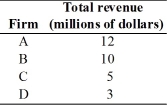
(83)
-An industry's total revenue is $100 million.The above table shows the total revenue of the four largest firms in an industry.
a∙Calculate this industry's four-firm concentration ratio.
b∙Is this industry competitive?
c∙What market type does it most likely represent?
-An industry's total revenue is $100 million.The above table shows the total revenue of the four largest firms in an industry.
a∙Calculate this industry's four-firm concentration ratio.
b∙Is this industry competitive?
c∙What market type does it most likely represent? (Essay)
4.7/5 (84)
(84) 
Filters
- Essay(0)
- Multiple Choice(0)
- Short Answer(0)
- True False(0)
- Matching(0)