



 Chat with AI
Exam 13: Consumer Choice and Demand

Exam 1: Getting Started337 Questions
Exam 2: The Usand Global Economies201 Questions
Exam 3: The Economic Problem273 Questions
Exam 4: Demand and Supply322 Questions
Exam 5: Elasticities of Demand and Supply335 Questions
Exam 6: Efficiency and Fairness of Markets352 Questions
Exam 7: Government Actions in Markets239 Questions
Exam 8: Taxes267 Questions
Exam 9: Global Markets in Action276 Questions
Exam 10: Externalities300 Questions
Exam 11: Public Goods and Common Resources177 Questions
Exam 12: Markets With Private Information101 Questions
Exam 13: Consumer Choice and Demand287 Questions
Exam 14: Production and Cost266 Questions
Exam 15: Perfect Competition275 Questions
Exam 16: Monopoly377 Questions
Exam 17: Monopolistic Competition213 Questions
Exam 18: Oligopoly222 Questions
Exam 19: Markets for Factors of Production178 Questions
Exam 20: Economic Inequality155 Questions
Select questions type


Moving along an indifference curve, if a consumer requires a large amount of the good measured along the y-axis to make up for one unit less of the good measured on the x-axis, then
(Multiple Choice)
5.0/5  (80)
(80) Total utility ________ as a person consumes more of one good and marginal utility ________.
(Multiple Choice)
4.8/5 (73)
(73) Mary likes to consume either pizza or spaghetti.She has $48 to spend on these meals.
a∙One week the price of pizza is $8 and the price of spaghetti is $6.Mary uses the indifference curve analysis she learned in microeconomics to decide how much of each type of meal to buy.She puts pizza on the vertical axis and spaghetti on the horizontal axis.What is the marginal rate of substitution at the combination of pizza and spaghetti that Mary chooses?
b∙The next week, the price of pizza is $6 and the price of spaghetti is $8 so Mary adjusts her consumption combination to maximize her total utility.What is her marginal rate of substitution now?
(Essay)
4.8/5 (76)
(76) In a budget line/indifference curve diagram, at the consumer's equilibrium at the best affordable point,
(Multiple Choice)
4.9/5 (80)
(80) Using Gabriel's budget line and his indifference curves between horseback riding lessons and baseball lessons, and then changing the prices of each activity holding his income constant, which of the following can be derived?
(Multiple Choice)
4.9/5 (90)
(90) Describe the consumer equilibrium in the indifference curve/budget line model.
(Essay)
4.8/5 (69)
(69) The benefit that John gets from eating an additional grape is called the ________ the grape.
(Multiple Choice)
4.9/5 (75)
(75) Sam's budget is $60.00.The combinations of gasoline and coffee along one of Sam's indifference curves are combinations
(Multiple Choice)
4.9/5 (93)
(93) Luke enjoys eating tuna sashimi and drinking Pepsi.His consumer equilibrium occurs where his budget line
(Multiple Choice)
4.9/5 (76)
(76) If the total utility of 2 bags of chips is 25, the total utility of 3 bags is 33, and the total utility of 4 bags is 40 units, then the marginal utility of the 3rd and 4th bags are
(Multiple Choice)
4.9/5 (83)
(83) What is the difference between a budget line and an indifference curve?
(Multiple Choice)
4.8/5 (98)
(98) 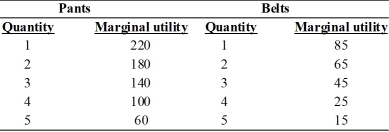 -Tris is shopping for pants and belts.He has a budget of $100.The price of a pair of pants is $20 and the price of a belt is $5.His marginal utility schedules are above.What combination of pants and belts does Tris buy? Explain your answer.
 (Essay)
4.8/5 (77)
(77)  -Which of the above figures reflects an increase in the consumer's budget?
 (Multiple Choice)
4.9/5 (78)
(78) If Tommy is consuming a combination of goods and services on his budget line, has he allocated his entire budget?
(Essay)
4.9/5 (71)
(71) Sarah earns $500 per week selling baskets made out of tree vines.With this money she buys sushi and rose bushes.Each piece of sushi costs $1 and each rose bush costs $10.If Sarah spends $170 per week on sushi, the maximum quantity of rose bushes can she buy each week is ________ bushes.
(Multiple Choice)
4.9/5 (74)
(74) 
Filters
- Essay(0)
- Multiple Choice(0)
- Short Answer(0)
- True False(0)
- Matching(0)