



 Chat with AI
Exam 9: Global Markets in Action

Exam 1: Getting Started337 Questions
Exam 2: The Usand Global Economies201 Questions
Exam 3: The Economic Problem273 Questions
Exam 4: Demand and Supply322 Questions
Exam 5: Elasticities of Demand and Supply335 Questions
Exam 6: Efficiency and Fairness of Markets352 Questions
Exam 7: Government Actions in Markets239 Questions
Exam 8: Taxes267 Questions
Exam 9: Global Markets in Action276 Questions
Exam 10: Externalities300 Questions
Exam 11: Public Goods and Common Resources177 Questions
Exam 12: Markets With Private Information101 Questions
Exam 13: Consumer Choice and Demand287 Questions
Exam 14: Production and Cost266 Questions
Exam 15: Perfect Competition275 Questions
Exam 16: Monopoly377 Questions
Exam 17: Monopolistic Competition213 Questions
Exam 18: Oligopoly222 Questions
Exam 19: Markets for Factors of Production178 Questions
Exam 20: Economic Inequality155 Questions
Select questions type


When protection is encouraged to protect a growing domestic industry; which of the following is being used?
(Multiple Choice)
4.9/5  (88)
(88) 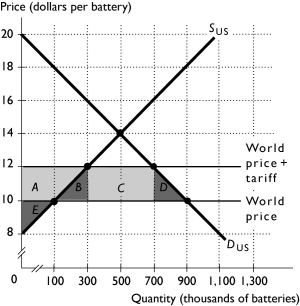 -The above figure shows the U.S.market for replacement cell phone batteries.With free trade, U.S.production is equal to ________ batteries per year.When a $2 tariff is in place, U.S.production is equal to ________ batteries per year.
 (Multiple Choice)
4.9/5 (83)
(83) Economics demonstrates that opening up unrestricted free international trade is beneficial to all nations.However, are there any losers from such a policy change?
(Essay)
4.8/5 (77)
(77) How does a tariff affect the consumer surplus and the producer surplus from the imported good? Is the overall economy helped or harmed by tariffs? Briefly explain your answers.
(Essay)
4.8/5 (79)
(79) Suppose the United States subsidizes domestic chicken production and then sells surpluses on the world market at a price below the cost of production.In foreign countries, the argument that would made to restrict chicken trade with the United States would be the
(Multiple Choice)
4.7/5 (84)
(84) Who gains from imports? How do they gain? Who loses? How do they lose? Does the overall economy gain or lose from imports?
(Essay)
4.7/5 (73)
(73)
-The above figure shows the U.S.market for replacement cell phone batteries.When there is no international trade, the equilibrium price is ________ per battery and when there is international trade the equilibrium price is ________ per battery.
-The above figure shows the U.S.market for replacement cell phone batteries.When there is no international trade, the equilibrium price is ________ per battery and when there is international trade the equilibrium price is ________ per battery. (Multiple Choice)
4.9/5 (67)
(67) When politicians debated the North American Free Trade Agreement (NAFTA), some told stories of U.S.workers whose jobs would be moved to Mexico.Which of the following arguments in favor of protection was being used?
(Multiple Choice)
4.8/5 (79)
(79) Relative to free trade, domestic producers of a good are _______ off with a tariff because of the ________ .
(Multiple Choice)
4.9/5 (86)
(86) If Country A opens up their corn market to trade with the rest of the world and the global price of corn is lower than the equilibrium price of corn in Country A, then Country A will ________ corn, which will ________ consumer surplus, ________ producer surplus, and ________ total surplus.
(Multiple Choice)
4.9/5 (72)
(72) 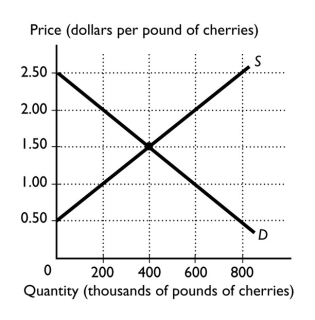 -The figure above shows the U.S.demand and U.S.supply curves for cherries.In the absence of international trade, how many pounds of cherries would U.S.farmers produce?
 (Multiple Choice)
4.8/5 (73)
(73) 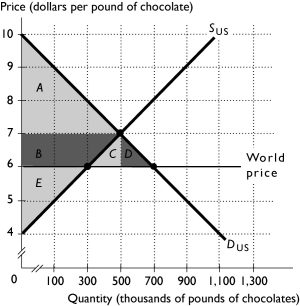 -The above figure shows the U.S.market for chocolate.With international trade, the gain in total surplus is equal to
 (Multiple Choice)
4.9/5 (68)
(68) 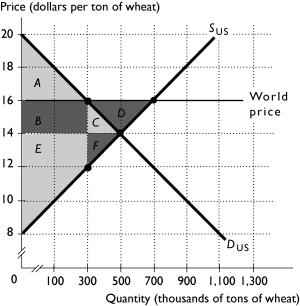 -The above figure shows the U.S.market for wheat.When there is no international trade, consumer surplus is equal to ________.
 (Multiple Choice)
4.8/5 (86)
(86) Why are the losers from free international trade not fully compensated for their losses?
(Multiple Choice)
4.7/5 (75)
(75)
-The above figure shows the U.S.market for replacement cell phone batteries.With free trade, the United States imports ________ batteries and once the tariff illustrated in the figure is imposed, the United States imports ________ batteries.
-The above figure shows the U.S.market for replacement cell phone batteries.With free trade, the United States imports ________ batteries and once the tariff illustrated in the figure is imposed, the United States imports ________ batteries. (Multiple Choice)
4.8/5 (80)
(80) Airlines in other countries buy airplanes from Boeing because
(Multiple Choice)
4.8/5 (78)
(78)  The figure above shows the U.S. market for airplanes, where SUS is the domestic supply curve and DUS is the domestic demand curve. The United States trades freely with the rest of the world. The world price of an airplane is $150 million.
-In the figure above, U.S.consumers buy ________ airplanes per year at ________ million per airplane.
The figure above shows the U.S. market for airplanes, where SUS is the domestic supply curve and DUS is the domestic demand curve. The United States trades freely with the rest of the world. The world price of an airplane is $150 million.
-In the figure above, U.S.consumers buy ________ airplanes per year at ________ million per airplane. (Multiple Choice)
4.7/5 (83)
(83)  -The above figure shows the U.S.market for 1 carat diamonds.With free trade, U.S.production of diamonds is equal to ________ diamonds.When the quota illustrated in the figure is in place, U.S.production is equal to ________ diamonds.
 (Multiple Choice)
4.7/5 (89)
(89) If the United States exports planes to Brazil and imports ethanol from Brazil, the price received by U.S.producers of planes ________ and the price received by Brazilian producers of ethanol ________.
(Multiple Choice)
4.9/5 (69)
(69) 
Filters
- Essay(0)
- Multiple Choice(0)
- Short Answer(0)
- True False(0)
- Matching(0)