



 Chat with AI
Exam 6: Efficiency and Fairness of Markets

Exam 1: Getting Started337 Questions
Exam 2: The Usand Global Economies201 Questions
Exam 3: The Economic Problem273 Questions
Exam 4: Demand and Supply322 Questions
Exam 5: Elasticities of Demand and Supply335 Questions
Exam 6: Efficiency and Fairness of Markets352 Questions
Exam 7: Government Actions in Markets239 Questions
Exam 8: Taxes267 Questions
Exam 9: Global Markets in Action276 Questions
Exam 10: Externalities300 Questions
Exam 11: Public Goods and Common Resources177 Questions
Exam 12: Markets With Private Information101 Questions
Exam 13: Consumer Choice and Demand287 Questions
Exam 14: Production and Cost266 Questions
Exam 15: Perfect Competition275 Questions
Exam 16: Monopoly377 Questions
Exam 17: Monopolistic Competition213 Questions
Exam 18: Oligopoly222 Questions
Exam 19: Markets for Factors of Production178 Questions
Exam 20: Economic Inequality155 Questions
Select questions type


Which of the following is part of the cost of income transfers?
(Multiple Choice)
4.9/5  (78)
(78)  -In the figure above, when the market is in equilibrium, marginal benefit ________ marginal cost, so the quantity of pizza produced is ________.
 (Multiple Choice)
4.8/5 (88)
(88) Jenn is willing to pay $75 for a purse and the purse's price is $60.What is Jenn's consumer surplus on this purse?
(Essay)
4.7/5 (74)
(74) Auditors working for a large accounting firm are often away from the office.When they are in the office, they are allowed to use any desk that is available.Which method is used to allocate desks?
(Multiple Choice)
4.7/5 (65)
(65) The chair of the Department of Economics at Colorado State University decided that office space is for tenured faculty and that graduate students are required to share cubicles.What method is used to allocate office space?
(Multiple Choice)
4.8/5 (86)
(86)  -The figure above shows the market for brooms.If 800 brooms are produced,
 (Multiple Choice)
4.7/5 (83)
(83) When society produces the combination of goods and services on the PPF that it values the most highly, society has
(Multiple Choice)
4.9/5 (63)
(63) 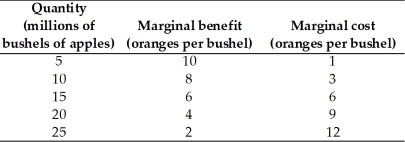 -Using the values for the marginal benefit and the marginal cost of a bushel of apples given in the table above, what is the allocatively efficient quantity of apples? Suppose 10 million bushels of apples are produced.Should the quantity be increased or decreased? What if 20 million bushels are produced; should the quantity be increased or decreased?
 (Essay)
4.9/5 (75)
(75) When a product benefits people other than the buyer of the product, the product is said to have
(Multiple Choice)
4.8/5 (73)
(73) 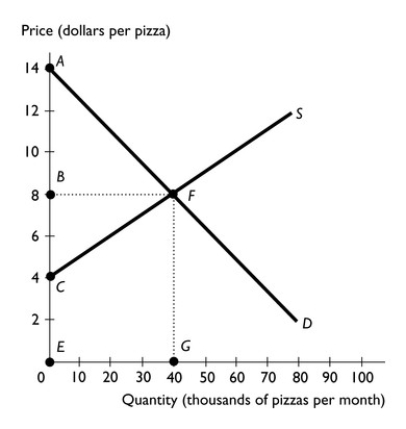 -The figure above shows the supply and demand curves for pizza.If the market is at its competitive equilibrium, what area in the graph above represents:
a∙consumer surplus?
b∙producer surplus?
-The figure above shows the supply and demand curves for pizza.If the market is at its competitive equilibrium, what area in the graph above represents:
a∙consumer surplus?
b∙producer surplus? (Short Answer)
4.9/5 (81)
(81) When less than the efficient amount of a good is produced, how does the marginal benefit of the last unit produced compare to its marginal cost?
(Essay)
4.9/5 (73)
(73) What are some of the potential obstacles that can lead to market failure by preventing a market from reaching the efficient outcome? Briefly define each obstacle.
(Essay)
4.8/5 (68)
(68) Which of the following government policies ensures market efficiency?
(Multiple Choice)
4.8/5 (85)
(85) Which of the following is true? When there are no externalities, public goods, common resources, taxes or subsidies, then
I∙allocative efficiency occurs when marginal benefit exceeds marginal cost by as much as possible.
Ii∙an a competitive equilibrium, resource allocation is efficient.
Iii∙fair rules require income transfers from the rich to the poor.
(Multiple Choice)
4.8/5 (90)
(90) 
Filters
- Essay(0)
- Multiple Choice(0)
- Short Answer(0)
- True False(0)
- Matching(0)